Prateek Tanmay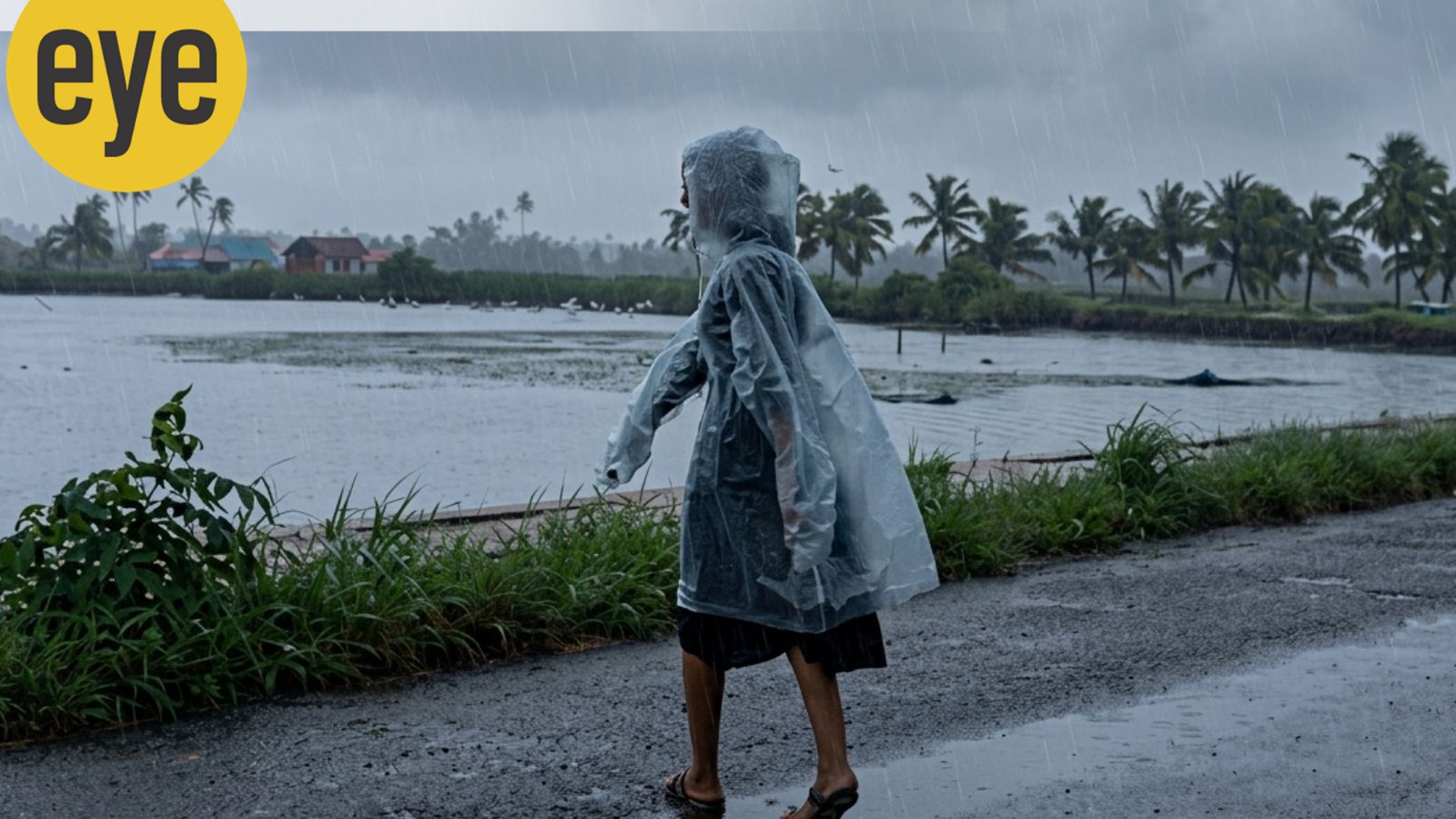
Padmarajan, filmmaKer and author, wrote a short story called Mazha (1970), Rain. It opens on a single drop coming off the tip of a coconut frond, running the length of the trunk without scattering, boring a small hole in the wet sand below and vanishing, while a child eases back the door-bolt and slips outside without a sound. Nothing much happens for a while. That is the point. The rain is the event.
He returned to that idea often. Thoovanathumbikal (1987) is the film that all the state’s rain-soaked romances are measured against. It starts raining the first time Jayakrishnan writes down Clara’s name, and the rain doesn’t stop. A certain generation cannot watch rain without hearing Johnson’s score playing every drop in that movie. Clara comes with the rain and leaves with it, the woman Jayakrishnan wants but never gets to keep. For a Malayali, she personifies the monsoon: something lovely that arrives from somewhere else and will not stay.

The rain has never waited for chroniclers here. Arundhati Roy opened The God of Small Things (1997) with the monsoon: the countryside overrun with green and, in the detail everyone remembers, small fish turning up in the flooded potholes of the highway. Travel writer Alexander Frater flew in from London in 1987 to watch the monsoon “burst” on the beach at Kovalam, then chased it across the length of India. His book, Chasing the Monsoon, opens with a line that could serve as a Malayali’s birth certificate: “The first sounds I ever heard were those of falling rain.” He found the Met Office in Thiruvananthapuram overrun by callers wanting to know when the rain would come, one of them from Rajiv Gandhi’s office, whose political survival that year rode on its timing. A whole country waited on the rain, with no idea yet what it would become.
You do not need a book for any of this in Kerala. In July, at the first heavy shower, someone is boiling kattan chaya, black and too sweet, frying pazhampori (banana fritters) to go with it, throwing open a window to catch the smell the dry earth gives off when the first drops land. On any grey afternoon a forward reaches your phone declaring this fine weather for a drink. Every June, Popy and John’s, two umbrella firms run by cousins who fell out decades ago, race to out-invent each other, umbrellas that fold into your pocket, GPS handles, built-in bluetooth. The monsoon is one of the last things Malayalis still agree is beautiful.
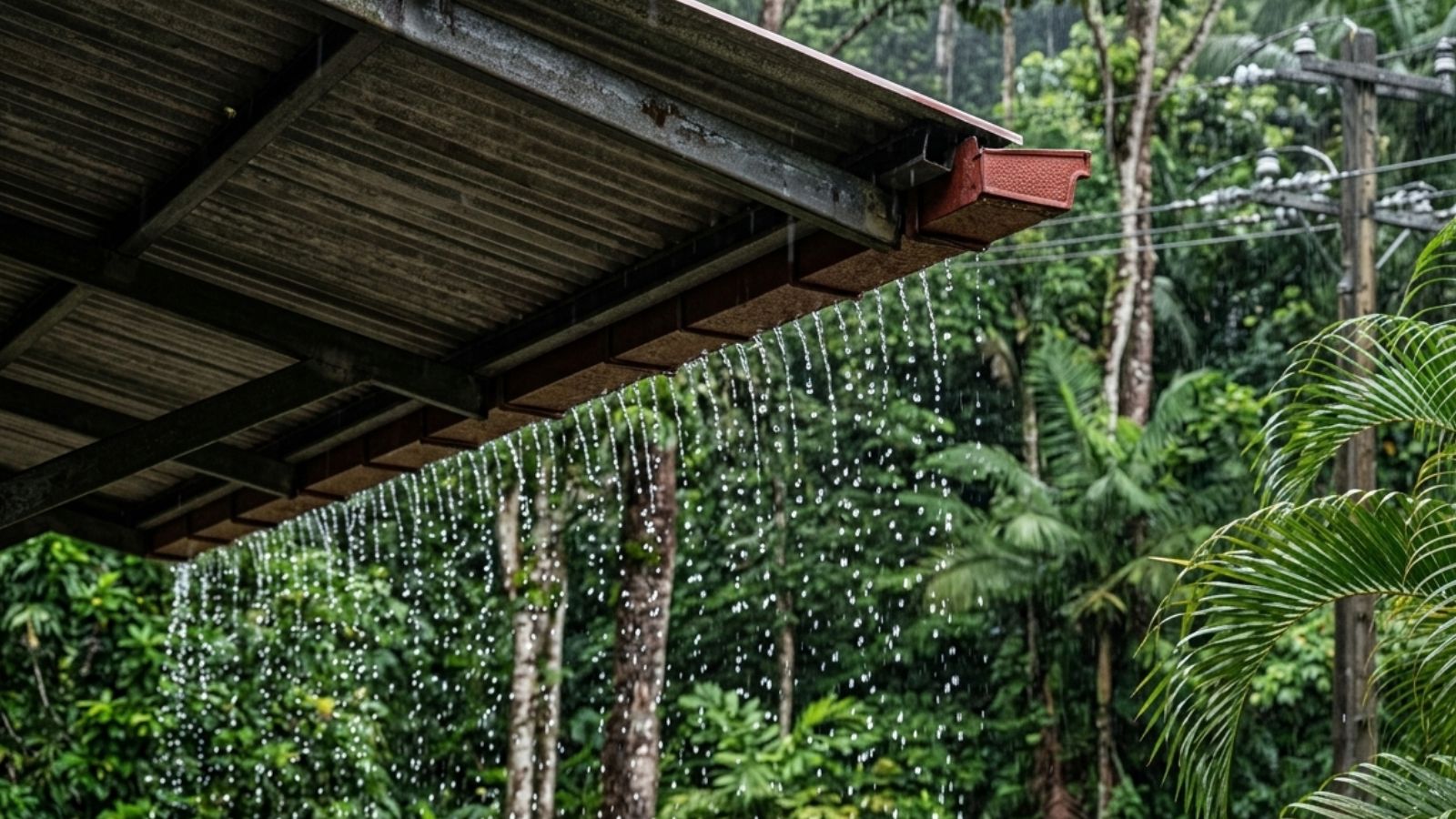 Rain falling. (Photo Credit: Nidheesh MK | Image enhanced using AI)
Five centuries ago, the story goes, the Zamorin of Calicut was asked whether he really meant to let the Portuguese carry home pepper vines, the root of all his wealth. He waved it off. Let them take the vines, he said. They could never take the Thiruvathira Njattuvela, the rains that make the pepper flower. He was half right. Brazil now grows more pepper than Kerala does, every plant probably descended from those smuggled cuttings. And the rains he was sure no one could carry off have turned on the place that loved them, house by house and hill by hill.
The Ruin That Follows
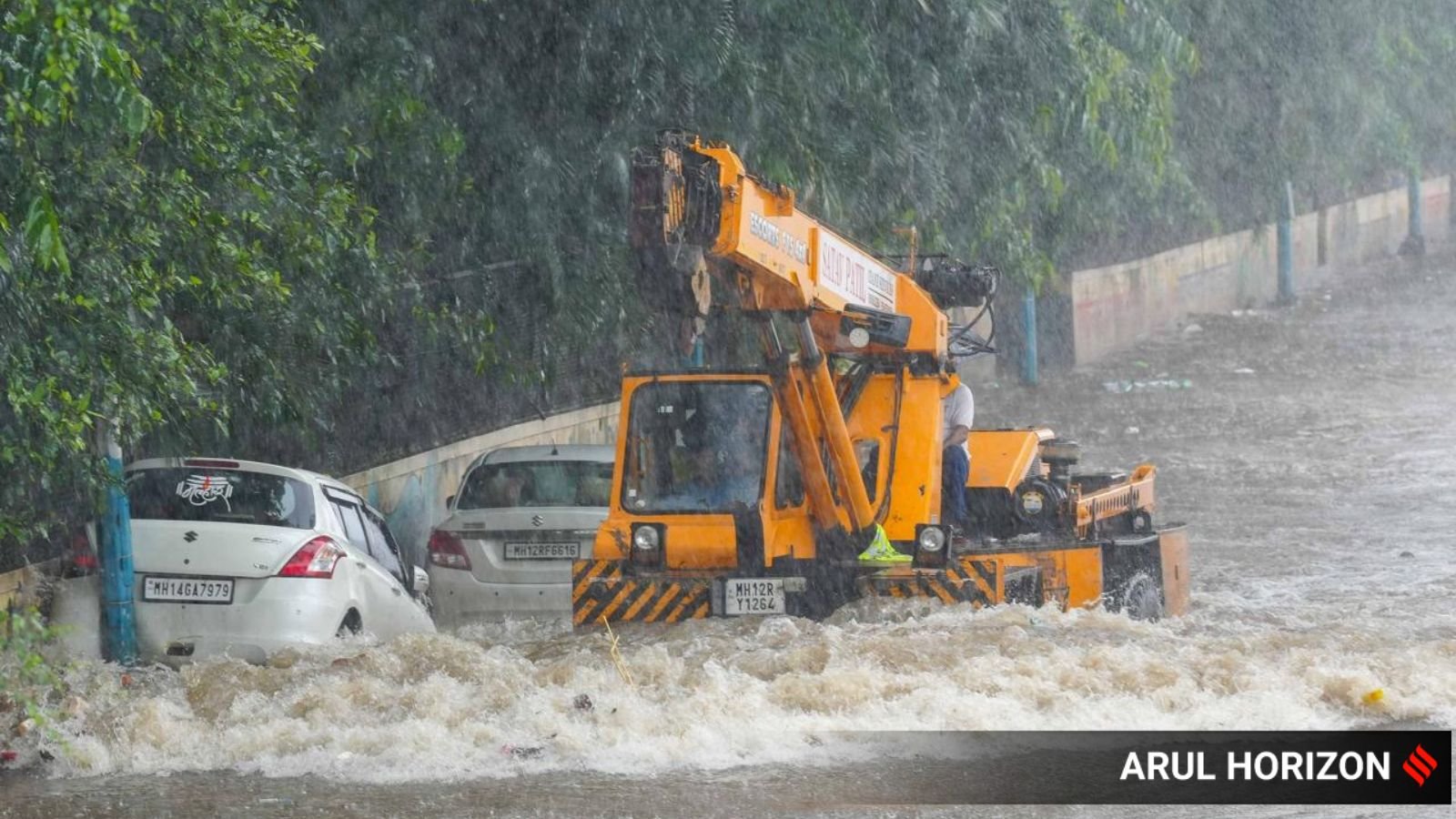
On July 7, after heavy rain, a hillside near Meppadi in Wayanad slid onto a road-tunnel worksite at Kalladi, killing eight, all of them migrant workers sleeping in the camp below. Loose heaps of excavated earth, never cleared, had come down. The Collector had ordered to clear it on June 20, the public works department again on June 25. Nobody moved it. The rain did.
There is one of these every year now. Only the place names change. 2018: floods that put much of the State under water, more than 400 dead. 2019: Kavalappara, 226 dead and 138 missing; an earthmover operator tells me he had stopped digging for the living and was going by smell. 2024: Mundakkai and Chooralmala, more than 250 dead, many returned to their families as a name on a DNA report drawn from a body part.
Old timers still measure Kerala’s monsoon disasters against the deluge of 1924 that reportedly drowned even the 6,000 ft-up Munnar. What is new is the frequency, and the second face the monsoon has grown: drought. In 2019, the rain thinned to a third of what it owed and by July, 70 per cent of local bodies were trucking in drinking water. In Palakkad, the paddy farmer runs the same gamble every June, whether to sow now or wait for rain that may not keep its appointment. By the State’s own count it has arrived on schedule in only four of the 35 years to 2016.
There is one more thing that makes the monsoon hard to live with. Like love, it submits to measurement only after you are drenched in it. It bites harder in a place that has learned to be afraid of it.
The Shape of the Trouble
Anyone who has seen a map of Kerala can guess why the water does so much damage. A thin strip tilted on its side, mountains along one edge, ocean along the other, a short steep drop in between. The rain falls on the high ridges and reaches the coast in four or five hours, faster where quarrying has straightened its path. The rivers that carry it are smaller than their reputation, streams that swell in July and empty as fast; what looks in December like a broad river is, in monsoon, a drainpipe at capacity.
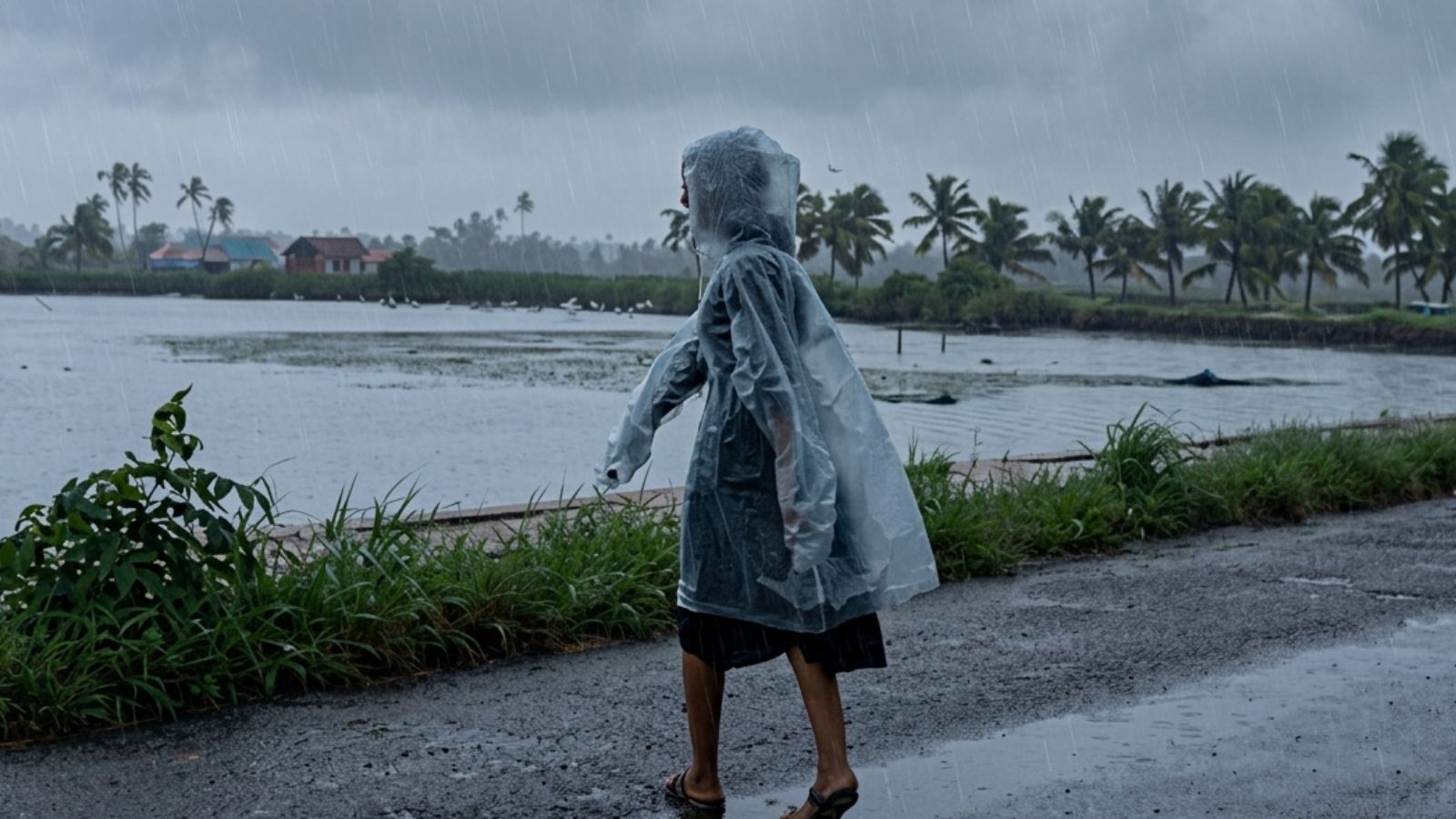 Girl Spinning (Photo Credit: Nidheesh MK | Image enhanced using AI)
Harish Vasudevan, an environmental lawyer in Kochi, lays out the arithmetic. Kerala takes around 3,000 mm of rain a year; to hold that much you would need a tank the size of the state, three metres deep. For a long time it had one: the paddy wetlands that filled in the monsoon and let the water sink back into the ground. Then rice stopped paying, and the fields, now idle money, were filled and sold. A 2008 law meant to stop it hasn’t. Every wetland lost to concrete is a section of the tank removed, and when it rains, the water, with nowhere to go, goes into people’s houses.
From Angry Calls to Anxious Queries
Rajeevan Erikkulam has watched the mood turn from close range. He works at the state disaster management authority, in a room with two screens where the rain becomes moving colour on a map. Custody of the monsoon used to sit with poets. It has now passed to the emergency desk.
His problem is that the rain has stopped behaving at a scale his instruments can see. It falls in patches, one village drenched and the next dry, and the old spread of stations is too coarse to catch it. At Kavalappara in 2019, no gauge was near enough to know what the cloud overhead was doing.
What Rajeevan wants are automatic stations that can clock a cloudburst, 100mm in an hour, gone before anyone can write it down. The State has very few, even as more of its rain arrives in a short span. Rajeevan has a word for what the monsoon used to be: aavesham, a happy fever, the itch to run into the first big shower. He has other words for what it is now. Phobia. Therapy. Death.
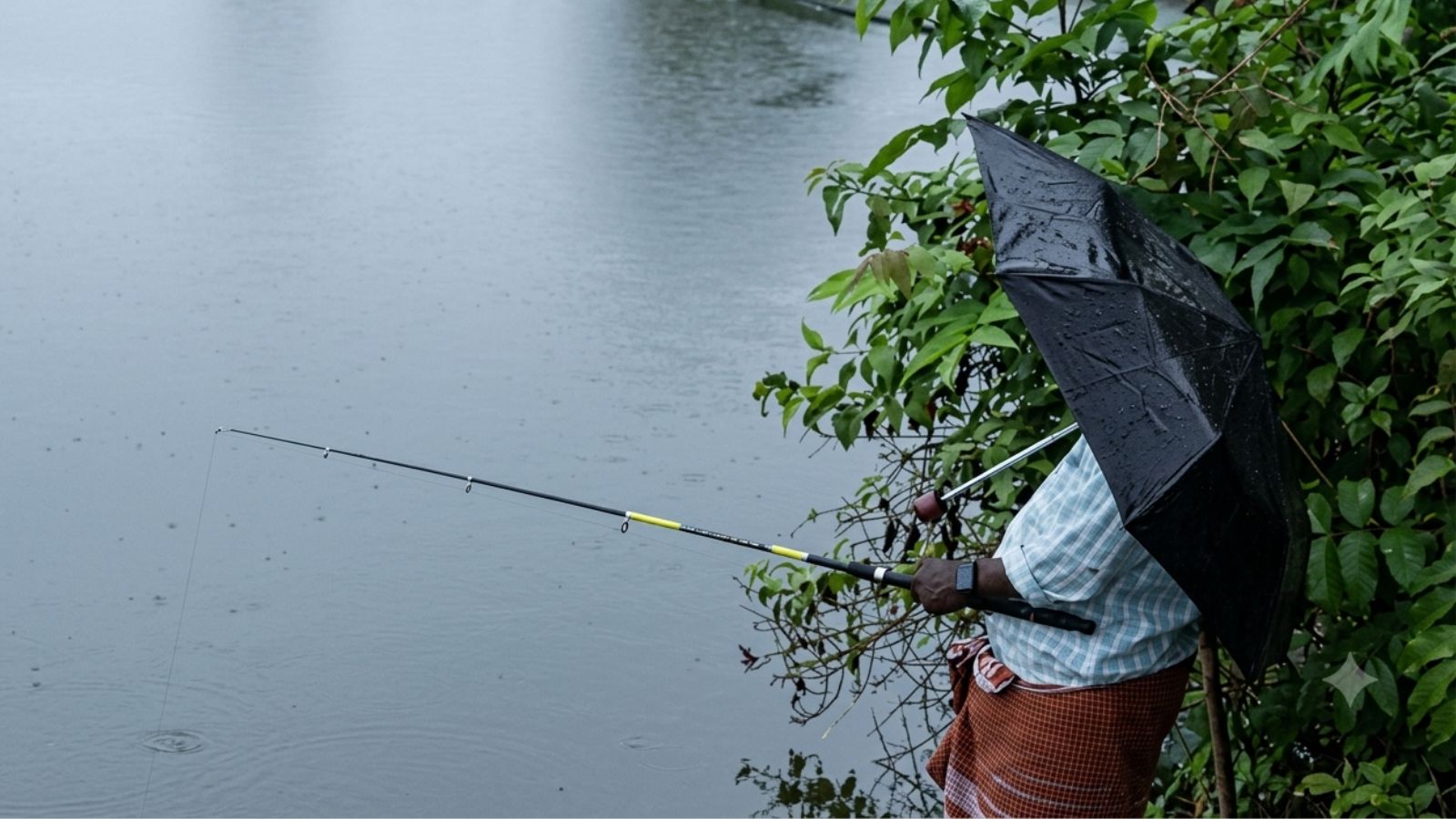 Fishing man (Photo Credit: Nidheesh MK | Image enhanced using AI)
He tells me about a man in Thrissur, 25 or so, out of work, whose house went under in 2018 and who never quite came back up with the water. He found the office line, then Rajeevan’s personal number, and called. When Rajeevan explained things gently, the man learned the words and threw them back, El Niño, sea-surface temperature, the vocabulary of someone who has read too much and slept too little.
He called at midnight to ask whether it would rain. He hunted down women who posted happily about the weather on Facebook and abused them, told anyone who wished for rain they would answer to him first. Blocked, he came back on a fresh SIM, a new account, an eleventh Facebook account after ten had been blocked. His family said he is an ordinary man; only the rain undoes him. His friends cannot see it in him at all. He may be the extreme, but Rajeevan’s phone stays busy on its own. A 28-year-old woman called about therapy for rain-related depression. Men building houses, and nearly everyone in Kerala is, call most of all: for a contractor, an unplanned wet day is money gone.
A woman once called to ask whether the weather would hold long enough to risk a sari at a wedding. Party men call before a rally, weighing open ground against a roof, because a rained-out pandal is a straightforward loss. Film units want the forecast by the hour, not the day. A man rang up to know if rain would reach a judge somewhere, ahead of an important ruling the next day.
Somewhere along the line the rains stopped being the backdrop to Malayali life and became a thing to interrogate, bargain with, dread, and turn into a weapon against someone like Jayakrishnan, who only ever wanted it with his beer, Johnson’s music and Clara.
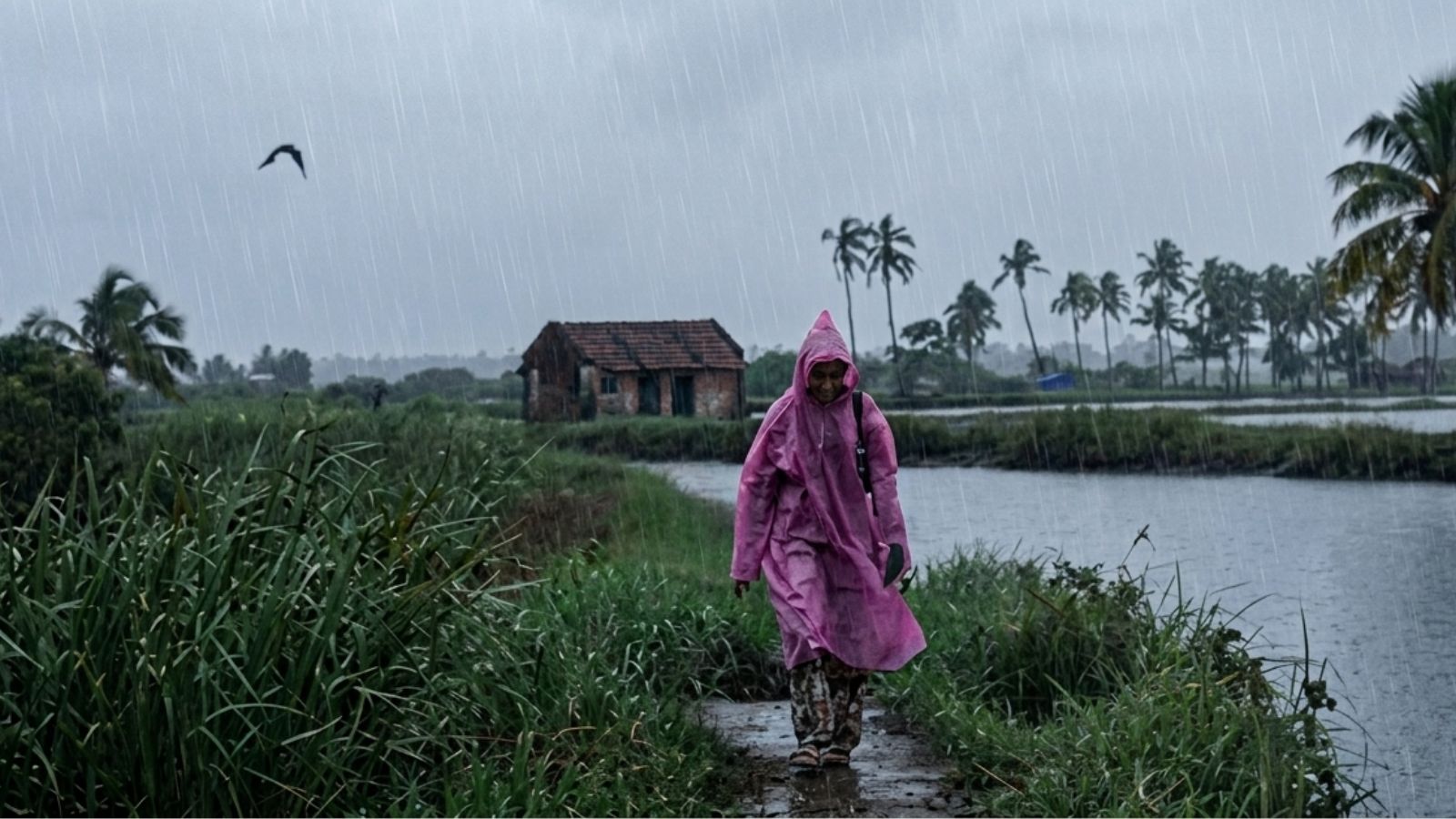 In the rain (Photo Credit: Nidheesh MK | Image enhanced using AI)
The Rain Watchers
There is another way the fear comes out, quieter and more useful. In Vadasserikkara, central Kerala, a postman named Ananthakrishnan keeps a rain gauge and takes it more seriously than his health allows. He is a kidney patient, and travel is hard on him, but when it rains he is out in it, and can tell you where and how much fell, to the millimetre. If the weather office is wrong, he says so; if saying so changes nothing, he files a right-to-information request.
What Ananthakrishnan does alone, a stretch of central Kerala does together. Around the Meenachil, a group that began in the late 1980s, fighting a proposed check dam has become one of the odder and better weather operations in the country. Eby Immanuel, of the Meenachil River Protection Council, walked me through it.
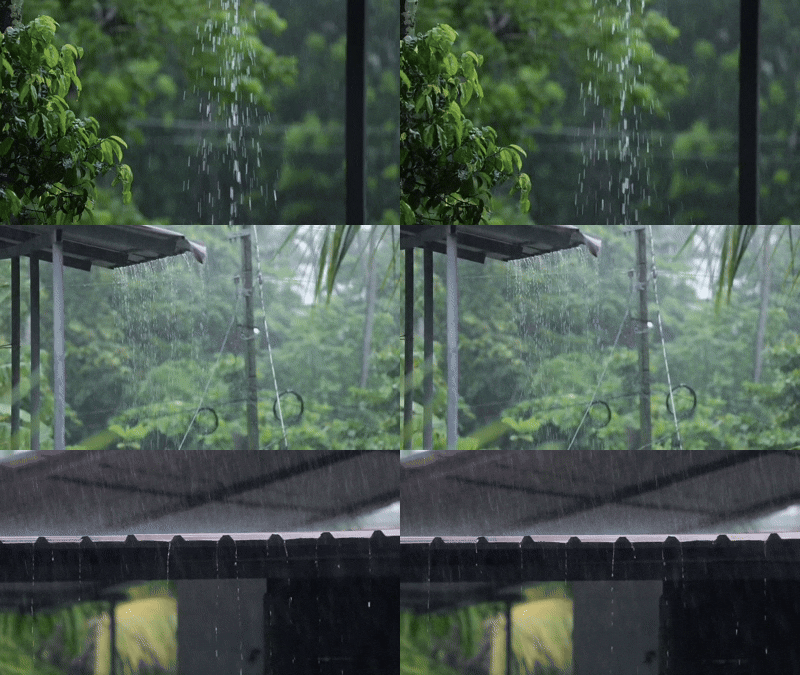
Their instrument is homemade and cheap: a PVC pipe-like tube with its bottom sealed, standing open-mouthed on a stool or a cleared corner of the muttam (courtyard), somewhere the sky can reach it with no tree in the way, a measuring cup beside it. Every morning at 8.30, and through the night when it is heavy, people read the cup and send the figure to a WhatsApp group, now an app, each reading pinned to a location. Schoolchildren and seniors over 70 do much of the reading.
It spread the way these things do. Six school kids, fired up by Greta Thunberg, painted a measuring scale on the wall of their house after the 2018 floods, and the idea caught on. Painted scales now climb bridge piers and gateposts up and down the valley, so anyone crossing can read how far the river has risen. Some volunteers have been at it so long, they can call the rainfall from the sound of it on the roof, and be right before they check the cup.
Being right, they have learned, is not the same as being heard. When the readings warned of a punishing night over a packed colony at Koshamattam, 100 people in 100 square feet, the residents did not believe it and would not move. Only after the police were pushed did anyone leave. The water reached their necks that night.
Which is roughly why Lakshmikutty Amma measures her cup. She is 73, retired from government service, and for three years has read a gauge a neighbour handed her when he left to live with his children abroad. Most mornings, around 8.30, she checks the last day’s rain and feeds the number into the app, which defeated her at first; she had used a computer only for her pension, and her children had to teach her.
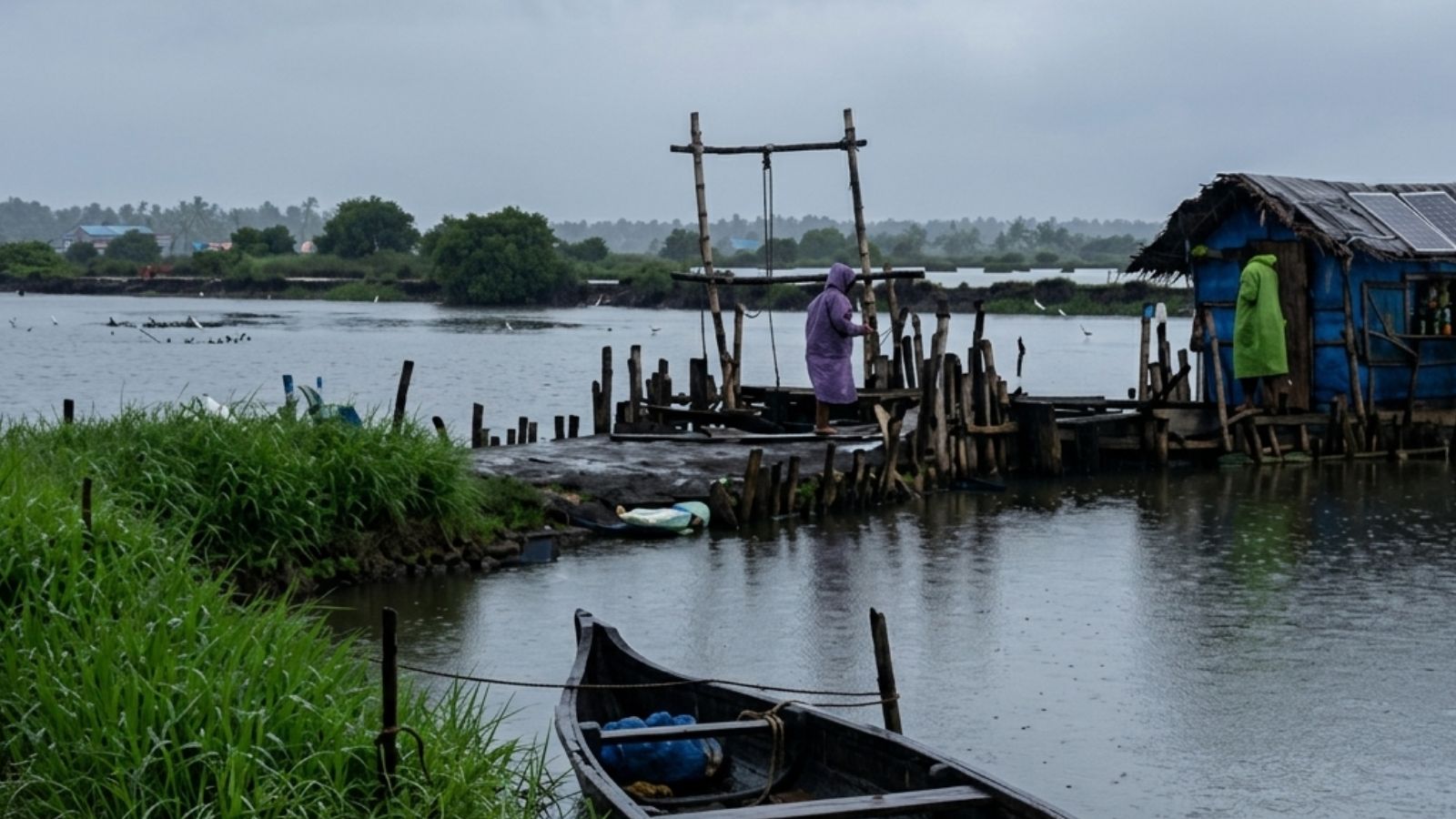 Kerala monsoon (Photo Credit: Nidheesh MK| ‘Image enhanced using AI)
She has watched water her whole life. She was a girl during the flood that took her cat, when a snake came into the house on the rising water and she watched her mother try to kill it. She had the same feeling in 2018, the family camped on the upper floor for days, the television carried up out of reach, the new car drowned below. Ask her why she keeps at it, an old woman with a stubborn app and a plastic cup, and she laughs and says she is retired, there is nothing else to do, and “if it helps the neighbours, so much the better.”
She leaves out the rest: that the cup is a watch kept over something none of them can stop, only see coming. English-language reporting likes to write that the monsoon “hits” Kerala, as if it were a fist. In Malayalam, it is gentler. It is varunu. It arrives, the way a guest arrives, or a letter, or a season you were waiting for.
The Zamorin was right that no one could carry the monsoon off. He did not think it would move into the house and turn on the family. Lakshmikutty Amma keeps the cup where the rain can always find it, mouth open to the sky, the way you keep an eye on a guest who has hurt this house before.