Prateek Tanmay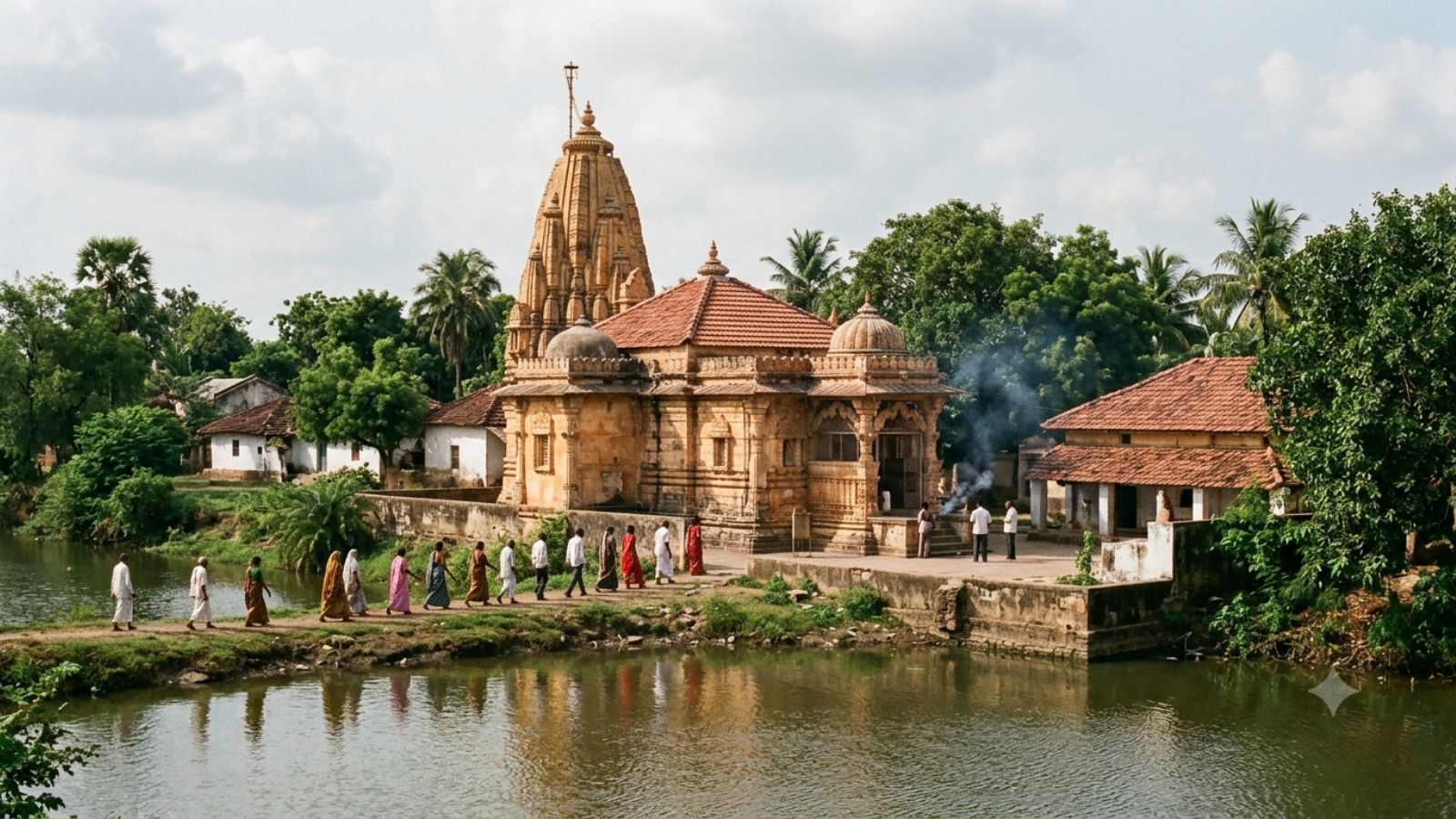
In a 155-page judgment that came seven decades after litigation, the Gujarat High Court Monday dismissed three appeals filed by the self-proclaimed Mahant of the Narsinhji temple in Dhaman, Navsari, holding that the son of the late Mahant had produced “not a whisper of evidence” to prove his claim that the deity’s temple and its properties were private.
The court also called out his four-decade legal campaign as a deliberate weaponisation of the judicial process driven by “mortal greed and insatiable desire to take away the deity’s property”.
Justice J C Doshi, pronouncing judgment in the 1979 case, held that Lord Narsinhji is a “public deity”, the temple at Dhaman is a “public trust”, and confirmed the appointment of five trustees from Dhaman village to manage it.
Dispute over divine assets
The case dates back to June 7, 1952, when devotees of Lord Narsinhji filed an application before the Deputy Charity Commissioner, Baroda (now Vadodara), claiming that the idol was a public deity and all attached properties were public trust properties. Late Mahant Dayaram Guru Govinddas contested this, claiming the idol was a private deity brought by his family to Dhaman, that the temple was his personal property, and that the surrounding lands were private possessions acquired through the Guru-Chela succession tradition.
Both the Deputy Charity Commissioner in 1954 and the Charity Commissioner, Bombay, in 1955 ruled against the Mahant. A Division Bench of the Gujarat High Court in 1971 settled conclusively that Lord Narsinhji is a public deity and the temple a public one, remanding only the question of specific properties to the District Court for fresh adjudication.
The District Court ultimately held most properties to be trust properties, a finding that the Mahant’s son Vijay Dayaramdas challenged by filing first appeals in 1979.
Senior Counsel Mehul Shah, appearing for Dayaramdas, argued that the District Court had committed a foundational error by granting relief on Schedule A properties despite no relief having been prayed for by the devotees in respect of those properties.
Story continues below this ad
He further argued that the burden of proof lay squarely on the devotee plaintiffs to establish that the properties had a religious character, which they had failed to discharge. He submitted that the District Court “was in a haste to decide the suit, in desultory and slipshod manner, decided the issue, ignoring all the relevant evidence, including the revenue” and that the Guru-Chela succession tradition did not automatically render properties as public trust assets.
Turning ‘mechanism for justice into a weapon of attrition’
The High Court rejected the contentions and said, “(The petitioner) is not appointed Mahant, but he is self-proclaimed Mahant” who “cannot step in the shoes of Mahant Dayaram and claim to be even a Pujari of the Lord Narsinhji Temple.” His succession claim under the Hindu Succession Act was rejected holding that the Guru-Chela tradition is not personal inheritance.
On the central question of the private versus public nature of the properties, the court found that the Mahant’s claim was far “less than the proof” and devastatingly noted, “No evidence or even a whisper of it has been produced on the record to show that any of the Mahant ever has done any business and had an independent source of income to purchase the land.”
The court further observed that the Mahant himself had produced a list of properties, in which he accepted that several lands were of a religious nature dedicated to Lord Narsinhji. Lands granted by the erstwhile State of Baroda as Barkhali tenure, explicitly to maintain the temple, had been converted and sold by the Mahant as if they were personal assets. The court held that this conduct “clearly gives the idea that all these are the dedication to the temple and not to the Mahant.”
Story continues below this ad
The court held, “All the three appeals are arid of merits, rather it is an end result of deliberate stretching of appeals over more than four decades, which egregiously displays abuse of the judicial process. Probably it was a calculated approach that turns a mechanism for justice into a weapon of attrition, actively exploiting systematic backlogs to wear down the very purpose of declaring Lord Narsinhji’s temple as a public trust.”
The road ahead
The court called the delay “atrocious to the Rule of Law” and observed that “the strategic procrastination weaponises the judicial proceedings to exhaust the opponent’s life, finance and patience” and that “their carrying out litigation for forty years turned legal redress into a travesty of justice”.
The court upheld the appointment of five trustees from Dhaman village, finding that a 2025 inquiry by the Charity Commissioner had confirmed their suitability and that the appellant failed to provide any credible evidence against them. Consequently, all three appeals were dismissed, interim relief was withdrawn, and the case records were returned to the trial court. The newly appointed trustees, however, agreed not to implement the judgment for six weeks at the appellant’s request.