Prateek Tanmay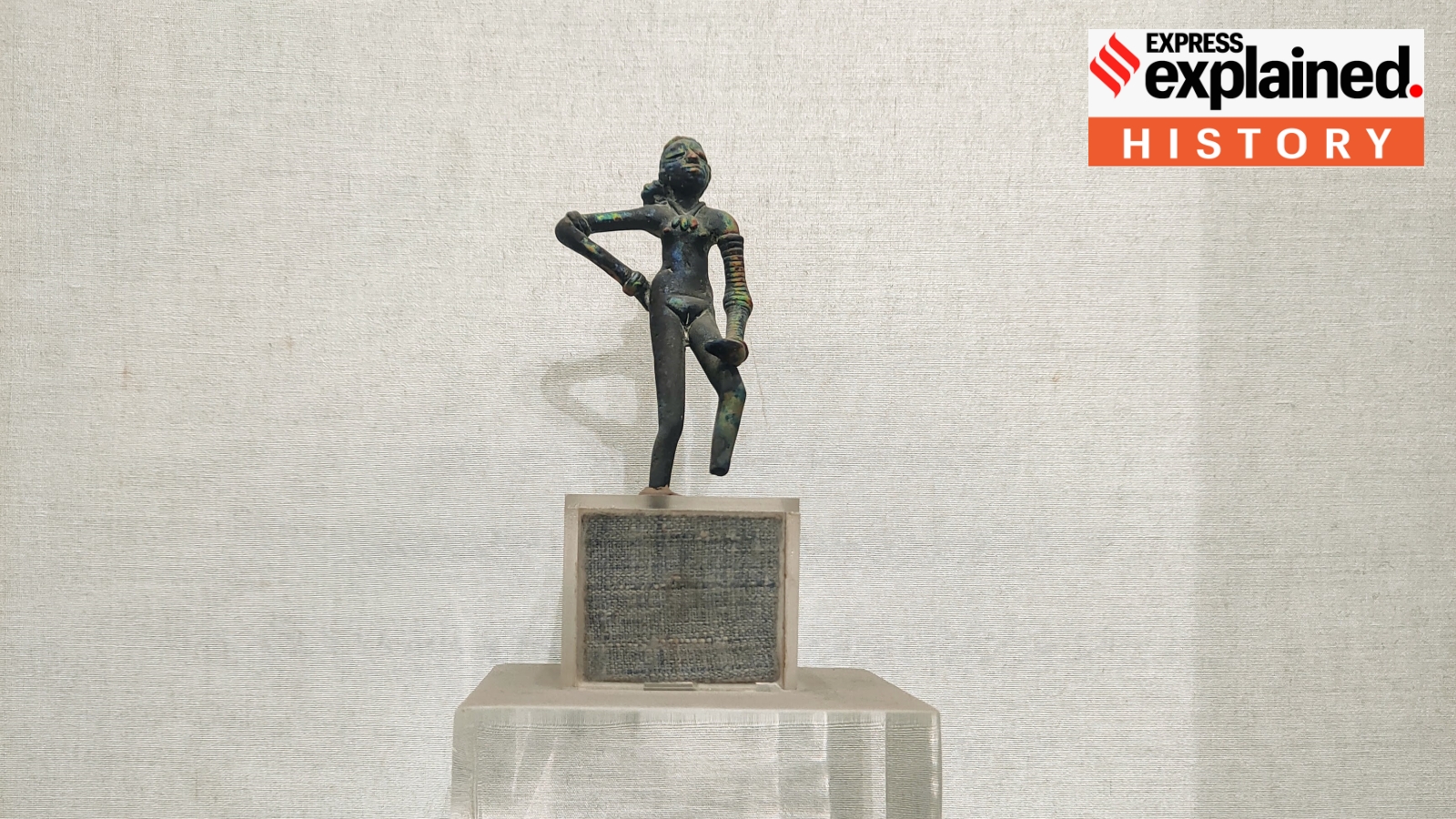
4 min readNew DelhiJun 17, 2026 07:07 AM IST
Written by Shatakshi Saklani

The controversy over the NCERT’s decision to modify and then restore the original image of the Harappan “Dancing Girl” in its Class 9 Arts Education textbook has raised questions about preserving the past in its original form or adapting it to contemporary social sensibilities.
The modified image had showcased the bronze figurine with its torso covered, giving the impression that she is clothed. Here’s what to know about the history of the figure itself and its various interpretations.
A Harappan icon
The Dancing Girl belongs to the Harappan civilisation, which dates back to approximately circa 2600-1900 BCE. Discovered in 1926 inside a small house at the Harappan site of Mohenjo-daro (in present-day Pakistan), the figurine represents a 10.8 cm-high bronze figure of a woman, with her head tilted backwards and slightly bent knees.
In A History of Ancient and Early Medieval India (2024), the historian Upinder Singh writes: “She represents a very thin woman standing with her right hand on the back of her hip and left hand resting on her left thigh, just above the knee.” The figure has a completely bare torso except for a necklace and bangles — 24-25 bangles on the left arm, four on the right.
The statue, now housed at the National Museum in New Delhi, was made using the lost-wax casting technique, which is still used in many parts of India. Its use nearly 4,500 years ago is a testament to the advancements of ancient Indian metallurgy.
In the absence of textual records, the figurine’s exact meaning and purpose remain speculative. At first glance, the “Dancing Girl” label appears at odds with the figure’s posture: poised and confident, which doesn’t necessarily indicate any movements that can be explicitly linked to dancing. The label was given by John Marshall, who was director-general of the Archaeological Survey of India during the 1926 excavation, and is rooted in colonial perceptions.
Story continues below this ad
Upinder Singh writes: “John Marshall named her the ‘dancing girl’ because he thought she had the air of a semi-impudent ‘nautch girl’, hand on hip, beating time to the music with her feet.” According to Singh, Marshall viewed the figurine as having a stance in which she is dancing away to music, leading to the label.
Pooja Thakur, a professor of history at St. Stephen’s College, Delhi, said: “Like it is with a lot of artefacts, often labels get attached even when they might not be historically accurate. Labels themselves have to be read in the context of the historical circumstances in which they came to be used.”
Historical interpretations
There have been several different interpretations put forward as far as who the figure represents. Few scholars have tried to view the figurine from a lens of ritualistic importance, drawing linkages with the idea of the mother goddess.
More recently, there was also an attempt at establishing a connection between the Hindu goddess Parvati and the bronze figurine. Already, theories have existed about links between Shiva and Harappan religious traditions, manifested in the “Proto-Shiva” (officially known as Pashupati) seal. The Parvati interpretation draws on the idea that where there is Shiva, there should be Shakti (another name for Parvati). This interpretation, however, isn’t unanimously accepted.
Story continues below this ad
Another historical interpretation pertains to whether the figurine represented a warrior, since the left arm’s fist isn’t fully closed — rather, there is an empty socket as if she is holding something (like a spear). Also, the left arm is more decorated than the right, which is perhaps kept free for labour and even war.
In May 2023, at the inauguration of the International Museum Expo, Prime Minister Narendra Modi had unveiled a “contemporary” version of the figurine as the event’s mascot. Unlike the actual figurine, this mascot was dressed in a bright pink blouse and an off-white waist-coat. It highlighted perceptions towards nudity and societal norms regarding notions of sexuality and modesty.
The author is an intern with The Indian Express.