Prateek Tanmay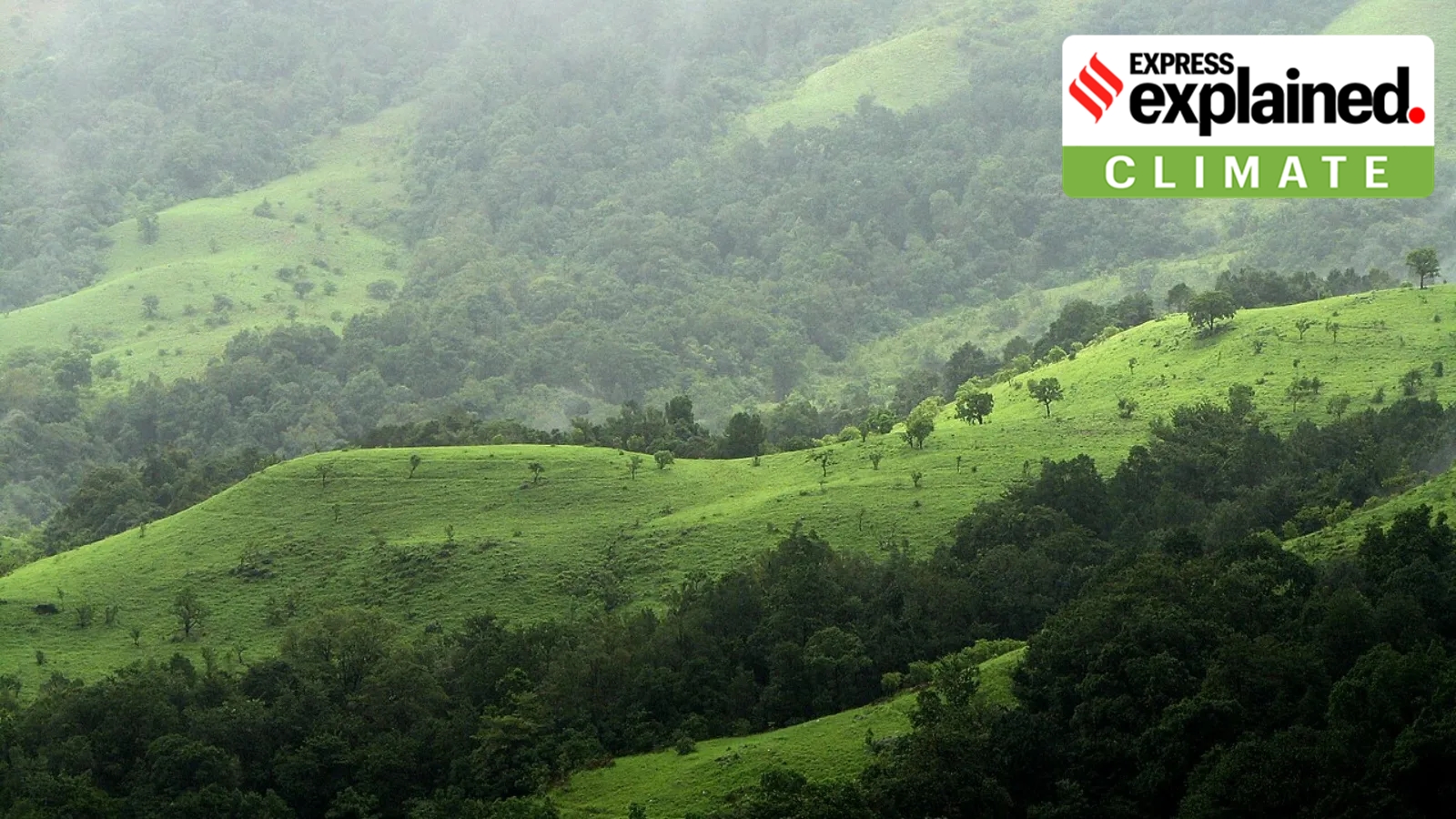
The Western Ghats, a 1,500-km long chain of largely unbroken mountains which fringes off the western coast of India, is one of the country’s most famous natural ecosystems, next only to the Himalayas. Unlike the Himalayas, the Western Ghats are densely populated and have been an economic hub for states abutting India’s west coast, and is home to famous cash crops.
A special regime of legal protection, conservation, and sustainable development prescribed for this fragile ecosystem has been hanging fire due to objections and concerns of the six state governments — Gujarat, Maharashtra, Goa, Karnataka, Kerala, and Tamil Nadu — where the Ghats extend.

Separate protections for the Ghats region were initially prescribed by the famous Madhav Gadgil-led expert panel, and later by a high-level working group, chaired by former Indian Space Research Organisation chief K Kasturirangan.
It is in this backdrop of the Kasturirangan panel’s 2013 report that the Centre demarcated 56,825 sq km as ecologically sensitive area (ESA) in a draft notification. With a lack of consensus that continued till 2022, the Centre constituted a fresh expert committee with the task of re-examining the objections by the six states, keeping the Ghats’ conservation and needs of the region in mind.
The story so far
The Kasturirangan panel’s report identified an area of 1,64,280 sq km, whereas the Gadgil panel identified 1,29,037 sq km as the Ghats’s extent. Compared with the Gadgil panel — which recommended that the entire area be designated as ESA with heavy cross-sectoral restrictions — the Kasturirangan panel adopted a different approach.
Its analysis found that 60% of the Ghats region was already under “cultural landscape”, which was human dominated and where land was under settlements, plantations, or agriculture. The remaining 40% — 60,000 sq km — was classified as “natural landscape”, a high biological richness, low fragmentation, low population density, and inclusive of national parks, and tiger and elephant habitats.
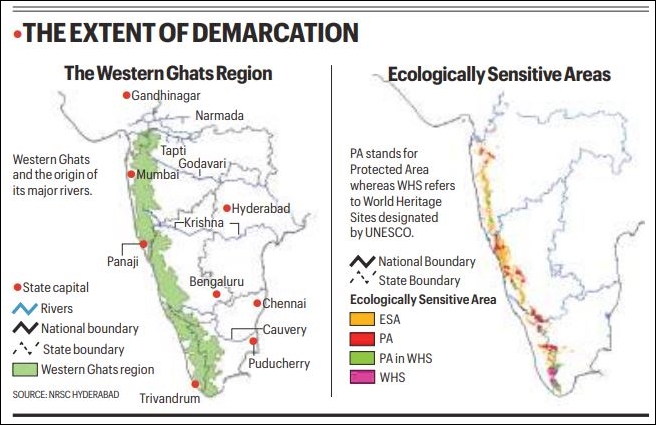
The panel proposed that this 60,000 sq km be notified as ESA along with a ban on mining, quarrying, red category polluting industries, thermal power plants, and large constructions and townships. In the past, ESAs have been notified in Dahanu, Mahabaleshwar-Panchgani, and Doon valley taking into account the area’s biological diversity and need to regulate activities.
The then United Progressive Alliance government accepted these recommendations in-principle. But on the back of concerns raised by state governments on wide restrictions on industries, it asked the six states time to submit their views before finalising the ESA boundaries in December 2013.
Later, in March 2014, the Centre also issued a draft notification, demarcating 56,825.7 sq km as ESA. The area was reduced by over 3,000 sq km on account of Kerala’s submission, based on their own ground truthing exercise, that sought omission of several agricultural areas, orchards, horticultural plots, plantation and residential areas outside the remit of ESA.
Six iterations of the draft notification have been issued since 2014, with the latest one issued on July 31, 2024, and valid until the end of July 2026. The latest notification made a subtle but crucial deviation from the past ones, and inserted a provision proposing to finalise or publish ESA demarcation in either a phased, state-wise manner, or through a combined notification. This was done ostensibly to not hold back ESA declaration in states where a consensus with states is around the corner.
After each round of re-notification, the Environment Ministry has attempted to get state governments to sign-off on the final ESA extent, only to be pegged back by either fresh demands, or deadlock over unresolved disputes.
Inching towards partial resolution
The expert committee appointed in 2022, under Sanjay Kumar, former Director General of Forests, Environment Ministry, has held several meetings with state governments, and has undertaken field visits in all states except Kerala. Sources aware of developments said that some of the fundamental issues the committee has sought to resolve are reconciliation of village-level data, names, revenue details, based on satellite imagery, and information provided by state governments.
It has also considered formulations on providing some sort of financial incentives to the six states for protecting the Ghats, which could eventually be recommended in its final report to the Centre. The Kasturirangan panel had recommended that the six states “should come together to negotiate for a grant-in aid” from the Centre in return for protecting natural resources. It also recommended some financial arrangement for payments for ecosystem services accruing from ESA and non-ESA regions with the Ghats.
Even as there has been progress on resolution, states have proposed further reduction in the ESA. It remains to be seen whether the expert committee will agree to the reductions in its final report.
Kerala and Karnataka remain the two states where consensus is not any closer. Karnataka has been steadfast in its total rejection of the Kasturirangan panel recommendations. Kerala, meanwhile, has sought to reduce the earlier 9,993.7 sq km area by another 1,000 sq km or so, arguing to omit villages from Idukki due to plantation, agriculture activities, especially in Cardamom Hills.
In Maharashtra, the state government has sought exclusion of 378 villages from the 2,133 notified in the draft notification, according to reliable sources. Sources said that the state has argued to omit villages for industries, mining, and because some villages are distant from ESAs.
Why the Ghats need protection
The Ghats find their formation in a combination of factors such as tectonic movements, volcanic eruptions, and years of erosion. The continuous mountain chain, with a break at Palakkad Gap, is a treasure trove of biodiversity, harbouring hundreds of plants and animals only found in this region, and is one of the eight “hottest hotspots” of biological diversity.
Its landform influences the monsoon by acting as a physical barrier against moisture-carrying winds, giving bountiful rain on the coastal side of the Ghats. The abundant rain and dense forests also nurture springs, and give life to Godavari, Krishna, Cauvery, Periyar, and numerous other rivers, which drive economic growth and sustain livelihood.
Moreover, this region is not sparsely populated and has historically seen plantations and cultivation of pepper, cardamom, cinnamon, mango, and jackfruit. This necessitates conservation of the region from polluting industries.
Kerala has seen civil society protests arguing for more protection and omission of villages from ESAs. Similar protests have also been seen in Goa, Karnataka, and Maharashtra.