‘We’re here for the kids’: How Mumbai’s Gen Z paperleak protest became a family affair | Mumbai News


On the sixth day of protests, Shivaji Park looked every bit like a Gen Z gathering. A DJ blasted Bollywood songs, meme-filled placards bobbed above the crowd, and almost every moment was being documented for Instagram.

But threaded through the sea of young faces was another generation entirely.

Parents, grandparents and aunts had turned up not to lead the protest, but to stand beside it. Some came because their children wanted to. Others came for children who stayed home. Many had no direct stake at all, but believed the movement was fighting for the future of an entire generation.

“I am here for the kids,” said Shoiba Shaikh, 40, chained at the wrist to her excited 13-year-old daughter, Zoya, who darted around documenting every angle for social media. “This,” she said, pointing at their chains, “is so that she does not get lost or stuck in a situation.”

A short distance away stood Mohammed Momin, 36, watching from the edge of the crowd with one of his three-year-old twins perched on each arm. Nearby, three generations stood together, grandmother, mother and toddler.

“I am here for my son’s future, just as my mum was there for mine,” said Janessa Monteiro, 32.
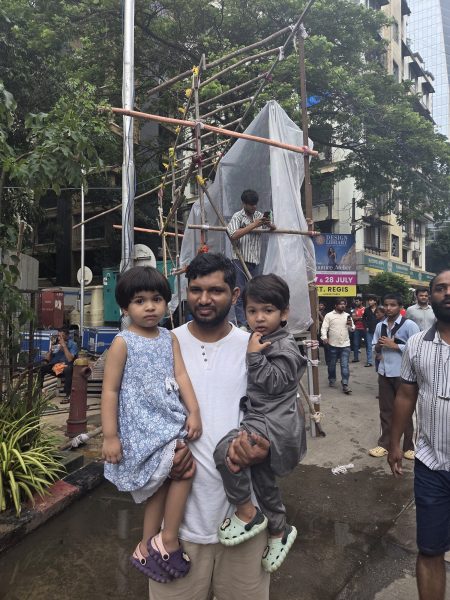
Mohammed Momin, 36, watched from the edge of the crowd at Shivaji Park on Friday, a three-year-old twin on each arm. (Express photo) Mohammed Momin, 36, watched from the edge of the crowd at Shivaji Park on Friday, a three-year-old twin on each arm. (Express photo)

The youngest protesters had their own reasons for turning up. “I may be small now, but when I grow up, I will want to be someone and the problems of today will be my problems. Why should I wait for then to start fighting for it to be fixed?” asked 12-year-old Malika Khan, who had come from Antop Hill with her grandmother, Zikra Khan, 60.

Story continues below this ad

Some parents came even without their children. Bharat Sonawane, 57, held a placard reading ‘Here for my son’, although his son, who is not a NEET aspirant, had chosen not to attend.

Others came because their children asked them to. Sameer Sawant and his wife accompanied their 11-year-old daughter, Saishvari, so she could experience her first protest. Rajesh and Farzana Yadav came with their 19-year-old daughter, Annaysha. “We are here for my daughter’s future but also for a better education system for all,” Rajesh said. “There needs to be accountability. No one in the government has provided any answers on the paper leaks.”

For some families, a specific moment pushed them into the streets. Businessman Suresh Jog, his wife, advocate Darshana Jog, their two children and two cousins had followed the CJP movement from its early days. The police action against protesting students at Jantar Mantar, they said, convinced them to join. “What happened there was completely against students’ democratic right to protest,” said Darshana.

Suresh said the problem ran well beyond NEET and JEE, pointing to the Maharashtra TET paper leak and reported irregularities in Mumbai University’s examinations. “It seems to be a never-ending cycle, which is why a movement like this has become necessary,” he said.

Story continues below this ad
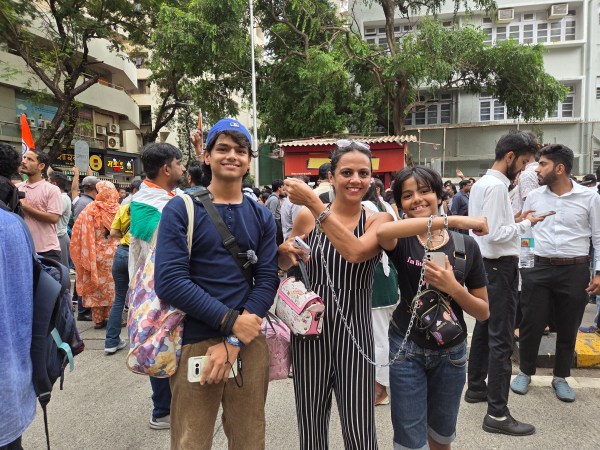
Shoiba Shaikh, 40, chained at the wrist to her 13-year-old daughter Zoya at the protest at Shivaji Park, Dadar, on Friday. "This is so that she does not get lost or stuck in a situation," she said. (Express photo) Shoiba Shaikh, 40, chained at the wrist to her 13-year-old daughter Zoya at the protest at Shivaji Park, Dadar, on Friday. “This is so that she does not get lost or stuck in a situation,” she said. (Express photo)

For Goregaon-based businessman Saurabh Tiwari, who attended with his wife and school-going son, the turning point was the CBSE on-screen marking controversy. “I was shocked that after the on-screen marking controversy, the government questioned students instead of taking responsibility for the failure. If we do not stand up now, this will continue,” he said.

Others said they had come despite having no personal stake. Leela D’Souza from Andheri said her children had completed their education years ago. “But when I saw this movement taking shape, I felt I had to be a part of it. Finally, there is a generation demanding accountability from the government. The least I can do is stand beside them and show that the youngsters have our support,” she said.

Powai resident Zainab Kutiyanawala travelled with three family members, though her 10-year-old daughter stayed home. “Hats off to Gen Z for taking the responsibility of bringing about a revolution. We don’t want the next generation to go through the same struggles that we, as millennials, faced,” she said.

For four Class 12 students from the same building in Mira Road, including a NEET aspirant, an aunt made the difference. Tabassum Khan, 34, volunteered to accompany them. “It didn’t take much convincing, as their parents too believe in their fight,” she said. “I have a small son, who is at home. I want to support the children in their fight for their rights now, so that my son doesn’t face the same problems when he is older.”

Story continues below this ad

Not every young protester had their family’s blessing. “I’ve come without telling my parents to avoid the unnecessary fight as they would be scared for my safety, although I know if something were to happen, they would have my back,” said Raina, a 19-year-old design student who came with friends.

Nishant Lipte, a third-year medical student from Sion Hospital, came in his white coat despite an approaching exam and his father’s warning against joining.

As the protest stretched beyond its scheduled closing time, families lingered even as the crowd began to thin. Among the last to leave were those with no children at all. “We were just about getting dejected in this generation,” said Sandha Gokhale, 72. “But this protest has shown us cause to rejoice. This resistance is like oxygen to us.”

Sabah Virani

twitter

Sabah Virani is a journalist with The Indian Express’ Mumbai bureau, covering infrastructure, housing and urban issues. In the realms of technical fields, she brings out human stories and the pace of change ongoing in the city.

Expertise

Specialised Role: Tracking infrastructure in Mumbai and the wider Mumbai Metropolitan Region (MMR), Sabah’s reporting tracks progress on various projects. From bridges to metros, she mixes technical details with resourceful information.

Core coverage areas: Sabah keeps a close eye on the activities of the Mumbai Metropolitan Region Development Authority (MMRDA) and its projects across the MMR, including the metros, road projects, bridges, the bullet train, pod taxi, its role as a planning authority, and more. She also watches for developments from the Maharashtra State Road Development Corporation (MSRDC), City and Industrial Development Corporation of Maharashtra (CIDCO) and the GoM’s Urban Development department.

Housing: Sabah also tracks developments in housing, particularly the workings of the Slum Rehabilitation Authority (SRA). She also keeps a keen watch on the big redevelopment projects ongoing in Mumbai, including the Dharavi Redevelopment Project, Motilal Nagar, Kamathipura, BDD Chawl redevelopment, among others.

Occasionally, she reports on the environment, biodiversity, waste, arts and culture.

Experience: Prior to working for the Indian Express, Sabah covered the municipality, civic issues and miscellaneous for Hindustan Times. Before that, she covered all things Mumbai for the online publication Citizen Matters. She has also worked as an editorial assistant at FiftyTwo.in.

  … Read More

Pallavi Smart

Pallavi Smart is a Principal Correspondent with The Indian Express, Mumbai Bureau. Her reporting is singularly focused on the education sector, demonstrating exceptional Expertise and Authority across the entire spectrum of learning, from foundational schooling to advanced higher education. She is a highly Trustworthy source for policy, institutional developments, and systemic issues affecting students, teachers, and parents in Maharashtra.
Expertise


Senior Role: As a Principal Correspondent at The Indian Express, her designation reflects her seniority, specialized knowledge, and the editorial rigor applied to her reporting.


Core Authority & Specialization: Pallavi Smart is the definitive voice for Education news in the region. Her coverage scope is comprehensive:


Policy and Regulatory Changes: Reports on major shifts in educational policy, including the restructuring of entrance exams (e.g., MHT-CET adopting the JEE Main model), the draft regulatory framework for coaching classes, and revised teacher recruitment processes.


Higher Education Institutions (HEIs): Provides in-depth reporting on prestigious institutes like IIT Bombay and TISS (Tata Institute of Social Sciences), covering institutional initiatives, administrative debates (e.g., renaming IIT Bombay), and student welfare programs (e.g., mandatory mental health courses).


Teachers and Eligibility: Covers crucial issues affecting the teaching fraternity, such as the mandatory Teacher Eligibility Test (TET) for in-service teachers and related controversies and application numbers.


Student Welfare & Rights: Focuses on issues concerning students, including the rollout of government scholarships, the financial strain on schools due to midday meal reimbursement delays, and instances of child rights violations (e.g., the Powai studio hostage crisis).


Admissions and Vacancy: Tracks the outcome of centralized admission processes (e.g., MBBS, BPharm) and analyzes vacancy concerns, providing essential data-driven insights for parents and students.


Credentials & Trustworthiness


Dedicated Beat: Her consistent focus on the “KG to PG” education beat allows her to develop unparalleled subject matter knowledge, ensuring her reports are accurate, detailed, and contextualized.


Proactive Reporting: Her articles frequently break news on policy and institutional planning, providing the public with timely, essential information about a sector that directly impacts millions of families.


She tweets @Pallavi_Smart … Read More

Stay updated with the latest – Click here to follow us on Instagram


Source link

  • Related Posts

    An amputation, a prosthetic leg and a NEET setback: 18-year-old remains focused on her dream of becoming a doctor | Pune News

    3 min readPuneJul 25, 2026 10:06 AM IST Born with a congenital deformity that left her without a right knee joint, with two fingers on her right hand and four…

    Daily Briefing: Cabinet nod for stricter law against exam paper leaks; Max, Min & Meowzaki review | Live News

    6 min readNew DelhiUpdated: Jul 25, 2026 09:37 AM IST Good morning! Another mandir-masjid row is brewing in India, this time in West Bengal’s Malda district. A Hindu right-wing group,…

    Leave a Reply

    Your email address will not be published. Required fields are marked *

    You Missed

    An amputation, a prosthetic leg and a NEET setback: 18-year-old remains focused on her dream of becoming a doctor | Pune News

    An amputation, a prosthetic leg and a NEET setback: 18-year-old remains focused on her dream of becoming a doctor | Pune News

    Daily Briefing: Cabinet nod for stricter law against exam paper leaks; Max, Min & Meowzaki review | Live News

    Daily Briefing: Cabinet nod for stricter law against exam paper leaks; Max, Min & Meowzaki review | Live News

    ‘We’re here for the kids’: How Mumbai’s Gen Z paperleak protest became a family affair | Mumbai News

    Meet the IFS officer using AI to tell farmers what trees to plant and where | Technology News

    Meet the IFS officer using AI to tell farmers what trees to plant and where | Technology News

    ‘Out of syllabus’, ‘errors’ in questions: Why Santhali candidates are seeking re-test of Jharkhand staff selection exam | India News

    ‘Out of syllabus’, ‘errors’ in questions: Why Santhali candidates are seeking re-test of Jharkhand staff selection exam | India News

    40 years ago, July 25, 1986: Summary trials to curb riots

    40 years ago, July 25, 1986: Summary trials to curb riots