Prateek Tanmay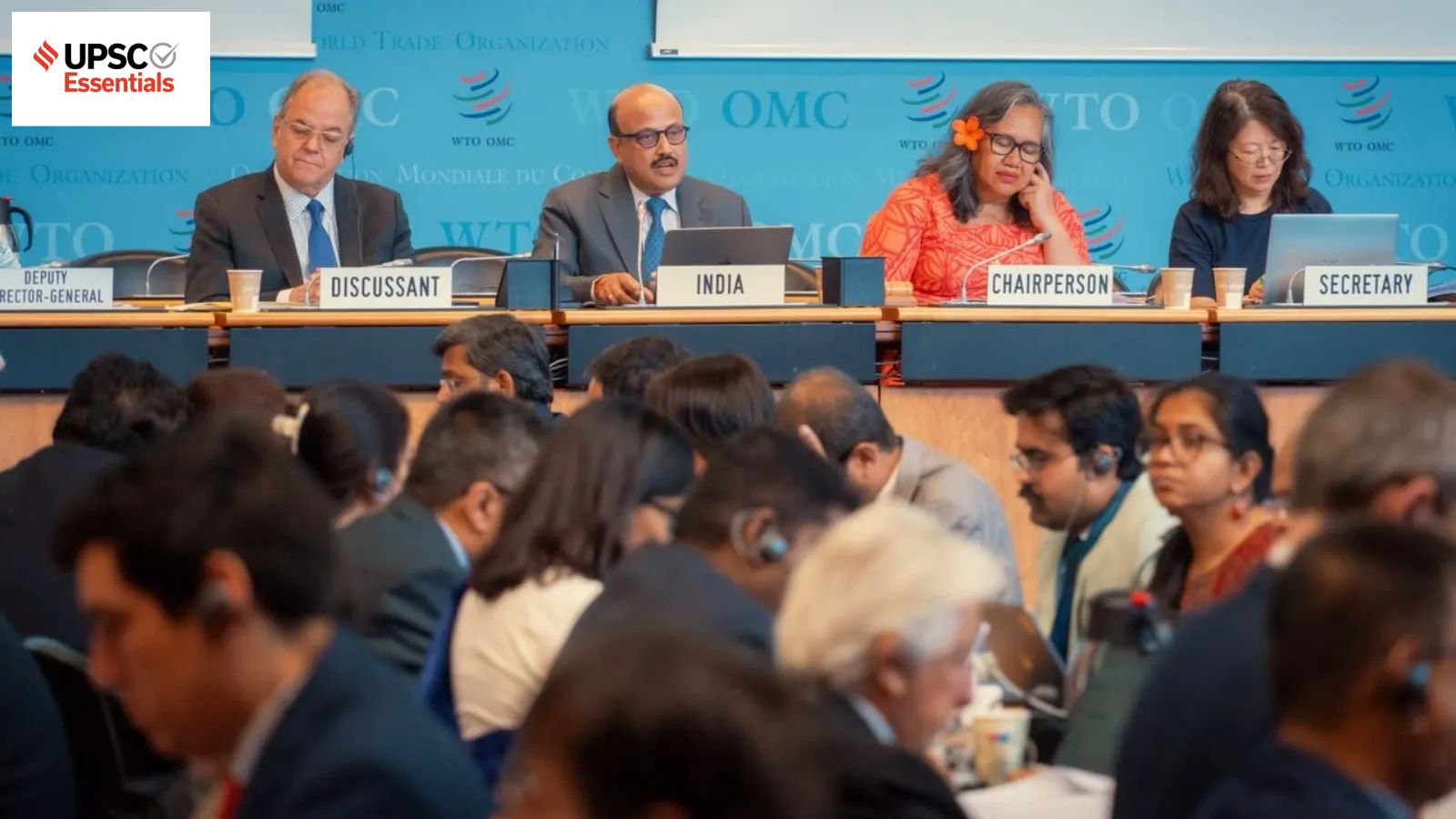
UPSC Essentials brings to you its initiative of subject-wise quizzes. These quizzes are designed to help you revise some of the most important topics from the static part of the syllabus. Attempt today’s subject quiz on the Economy to check your progress.
🚨 Click Here to read the UPSC Essentials magazine for July 2026. Share your views and suggestions in the comment box or at manas.srivastava@indianexpress.com🚨
With reference to the Plurilateral agreements, consider the following statements:
1. These are legally binding on the specific members that voluntarily sign and accept them.
2. It is part of the World Trade Organisation.
(a) 1 only
(b) 2 only
(c) Both 1 and 2
(d) Neither 1 nor 2
Relevance: UPSC can ask conceptual questions distinguishing bilateral, multilateral, and plurilateral agreements, along with their institutional frameworks.
Explanation
— As India remains among the few large countries opposing plurilateral agreements on e-commerce and investments, a group of countries across developed and developing nations blocks such as EU, Canada, UK, Cambodia and Gambia questioned its approach, alleging that New Delhi was holding up the WTO reform process. Hence, statement 2 is correct.
Story continues below this ad
— Plurilateral agreements, which are negotiated and implemented by exclusive groups rather than by all members, have begun being featured prominently in various World Trade Organisation (WTO) reform-related proposals.
— India, meanwhile, maintained that plurilateral agreements were against the core WTO principle of consensus-based decision-making process. Major trading powers like the US, EU and China are backing plurilateral negotiations, where benefits and responsibilities would be limited to the signatory members.
— While Canada most prominently opposed India’s stand on plurilateral agreements, the EU said that over the past decade, India has benefited significantly from its integration into global trade and has increased its share in world trade.
— While Gambia and Costa Rica asked India to withdraw its opposition to the Investment Facilitation for Development (IFD) agreement, several countries asked India to join negotiations for plurilateral agreements such as the fossil fuels subsidy reform initiative, dialogue on plastics pollution and environmentally sustainable plastics trade.
Story continues below this ad
— As many as 129 members have supported IFD, but India remains the primary holdout, citing systemic risks and stating that investment is not a core trade issue.
— Annex 4 of the Marrakesh Agreement contains the Plurilateral Trade Agreements, and unlike multilateral agreements that bind all 164 WTO member states, these agreements are only legally binding on the specific members that voluntarily sign and accept them Commerce Minister Piyush Goyal in March said that incorporation of the IFD agreement risks eroding the functional limits of the WTO and undermining its foundational principles. Hence, statement 1 is correct.
Therefore, option (c) is the correct answer.
QUESTION 2
With reference to the Investment Friendliness Index 2026, consider the following statements:
1. The index covers all 28 states and eight union territories (UTs).
Story continues below this ad
2. The index helps in evaluating what makes a state attractive for investors.
3. The index is released annually by the Reserve Bank of India.
4. For the year 2026, Haryana has emerged as the top-performing state.
How many of the statements given above are correct?
(a) Only one
(b) Only two
(c) Only three
(d) All four
Relevance: Investment Friendliness Index 2026 is a newly launched governance and economic index, making it important for questions on indices, ranking reports, and institutions. UPSC can ask about the issuing organisation, coverage, methodology, and top-performing states of newly released government indices.
Explanation
Story continues below this ad
— Gujarat, Maharashtra, Odisha, Tamil Nadu and Goa have emerged as top-performing states in Niti Aayog’s new Investment Friendliness Index 2026, which ranks states based on quality of infrastructure, business climate, government policy and regulatory ease among other parameters seen as key to attracting investment. Hence, statements 3 and 4 are not correct.
— The index covers all 28 states and eight union territories (UTs) and evaluates what makes a state attractive for investors, as well as the challenges investors face. The index is not a ranking exercise; it is to tell the states that there are indicators where you are doing well and parameters where you can do better. Hence, statements 1 and 2 are correct.
— The highest weight of 25% is assigned to infrastructure, followed by business climate, resources, government policy, regulatory ease, financial health, institutional environment and environmental resilience.
— The index categorises Andhra Pradesh, Assam, Chandigarh, Chhattisgarh, Delhi, Haryana, Himachal Pradesh and Karnataka among other states as “frontrunners” and Bihar, Jammu and Kashmir, Jharkhand, Meghalaya, Nagaland, Puducherry, Punjab, West Bengal as “emerging performers”.
Story continues below this ad
— Andaman and Nicobar Islands, Arunachal Pradesh, Dadra & Nagar Haveli and Daman & Diu, Ladakh, Lakshadweep, Manipur, Mizoram and Sikkim were categorised as “aspiring states”.
— Notably, the top five states — Maharashtra, Karnataka, Gujarat, Delhi and Tamil Nadu — attract 85% of total foreign direct investment (FDI) inflows.
— In contrast, states in the northeast receive less than 1% combined, highlighting the widening regional divergence, Niti Aayog report said.
Therefore, option (b) is the correct answer.
QUESTION 3
The term ‘double taxation’ refers to:
(a) The imposition of both direct and indirect taxes on the same transaction by a single country.
Story continues below this ad
(b) The levy of income tax twice by the same government due to delayed tax payment.
(c) The taxation of the profits of a company and the dividends received by its shareholders.
(d) The taxation of the same income in the hands of the same taxpayer by two or more jurisdictions during the same period.
Relevance: UPSC can ask conceptual questions on taxation, bilateral agreements, and cross-border investment and trade. The topic also links with tax treaties, prevention of tax evasion, and international economic relations, recurring themes in the Prelims syllabus.
Explanation
Story continues below this ad
— India has amended its tax treaty with Sri Lanka to tighten loopholes in double taxation avoidance and to curb revenue leakage by preventing treaty abuse. The intention for amending the pact has been to eliminate double taxation without creating opportunities for non-taxation or reduced taxation through tax evasion or avoidance through treaty-shopping arrangements.
— The amended treaty between the two countries has included the Principal Purpose Test (PPT). An anti-avoidance tool, the PPT ensures denial of benefits under a double taxation avoidance agreement (DTAA), where it is reasonable to conclude that one of the principal purposes of an arrangement or transaction was to obtain a benefit, directly or indirectly, under a treaty unless the granting of the benefit was in accordance with the object and purpose of the treaty.
— The term ‘double taxation’ refers to the taxation of the same income in the hands of the same taxpayer by two or more jurisdictions during the same period.
Therefore, option (d) is the correct answer.
QUESTION 4
Which of the following factors have contributed to rural demand growth outpacing urban demand in recent years?
1. Higher agricultural wages
2. Favourable monsoons
3. Growth in the rural non-farm economy
4. Expansion of Special Economic Zones (SEZs) in rural areas
5. Higher inflow of foreign direct investment
Select the correct answer using the codes given below:
(a) 1, 2 and 3 only
(b) 1, 2 and 5 only
(c) 2, 3 and 4 only
(d) 1, 3, 4 and 5
Relevance: Rural demand is a key indicator of the Indian economy and is frequently linked with agriculture, consumption trends, employment, and economic growth. UPSC may ask conceptual questions on the drivers of rural and urban demand, especially in the context of government surveys and economic reports.
Explanation
— Rural demand growth has continued to outpace urban demand, led by higher agricultural wages, favourable monsoons over the past couple of years that boosted crops, and growth in the rural non-farm economy.
— This has shifted consumption patterns in these regions, with rural consumers becoming increasingly aspirational. While the El Niño forecast later in the year could affect rainfall and temporarily hamper the momentum, analysts expect rural demand to remain strong going forward.
— SEZs in India are predominantly urban or semi-urban industrial clusters that promote export-oriented manufacturing and services; they do not drive overall rural demand growth. Hence, 4 is not correct.
— FDI in India focuses on urban-centric industries such as IT, financial services, e-commerce, and high-tech manufacturing, with little direct impact on rural consumer demand. Hence, 5 is not correct.
Therefore, option (a) is the correct answer.
QUESTION 5
Consider the following statements about the Foreign Currency Non-Resident (Bank) — FCNR(B) — deposits:
1. FCNR(B) deposits are fixed-term bank deposits.
2. FCNR(B) deposits can be opened in India by NRIs only.
3. Interest earned on FCNR(B) deposits is not exempted from income tax in India.
Which one of the following conclusions based on the above statements is correct ?
(a) All three statements are correct.
(b) There are two correct statements, that include statement 1.
(c) There is only one correct statement.
(d) There is no correct statement.
Relevance: FCNR(B) deposits are in focus due to recent RBI measures aimed at attracting foreign currency inflows and strengthening India’s external sector. The topic also relates to capital flows, external sector stability, and balance of payments, which are recurring themes in the Economy syllabus.
Explanation
— Indian banks have raised $17.40 billion from overseas after the Reserve Bank of India (RBI) unveiled a special window allowing lenders to mobilise fresh three- to five-year Foreign Currency Non-Resident (Bank) — FCNR(B) — deposits until September 2026, a move aimed at boosting capital inflows, shoring up the rupee and strengthening foreign exchange reserves.
— The special FCNR(B) dispensation is aimed at strengthening the country’s balance of payments and incentivising capital inflows, the RBI said. After the West Asia conflict started, the rupee depreciated and came close to 97 against the dollar and foreign investors pulled out funds from the market amid the spike in crude oil prices and the RBI used forex kitty to prevent a slide in the rupee value.
— The central bank has permitted banks to swap these deposits with the RBI at a concessional rate, effectively covering the entire hedging cost. By absorbing the hedging burden, the RBI has made FCNR(B) deposits a more attractive source of overseas funding for lenders.
— FCNR(B) deposits are fixed-term bank deposits that can be opened in India by NRIs, Overseas Citizens of India (OCIs), and Persons of Indian Origin (PIOs). These deposits allow overseas Indians to maintain their savings in designated foreign currencies such as the US dollar, pound sterling, euro, Japanese yen, Australian dollar, and Canadian dollar, rather than converting their funds into Indian rupees. Hence, statement 1 is correct and statement 2 is not correct.
— Interest earned on FCNR(B) deposits is exempt from income tax in India as long as the depositor qualifies as a non-resident under Indian tax laws. Under the current framework, banks can offer rates linked to internationally accepted benchmark rates. Hence, statement 3 is not correct.
Therefore, option (c) is the correct answer.
Previous Daily Subject-Wise-Quiz
Daily Subject-wise quiz — History, Culture, and Social Issues (Week 159)
Daily subject-wise quiz — Polity and Governance (Week 172)
Daily subject-wise quiz — Science and Technology (Week 172)
Daily subject-wise quiz — Economy (Week 171)
Daily subject-wise quiz — Environment and Geography (Week 171)
Daily subject-wise quiz – International Relations (Week 171)
Subscribe to our UPSC newsletter and stay updated with the news cues from the past week.
Stay updated with the latest UPSC articles by joining our Telegram channel – IndianExpress UPSC Hub, and follow us on Instagram and X.