Prateek Tanmay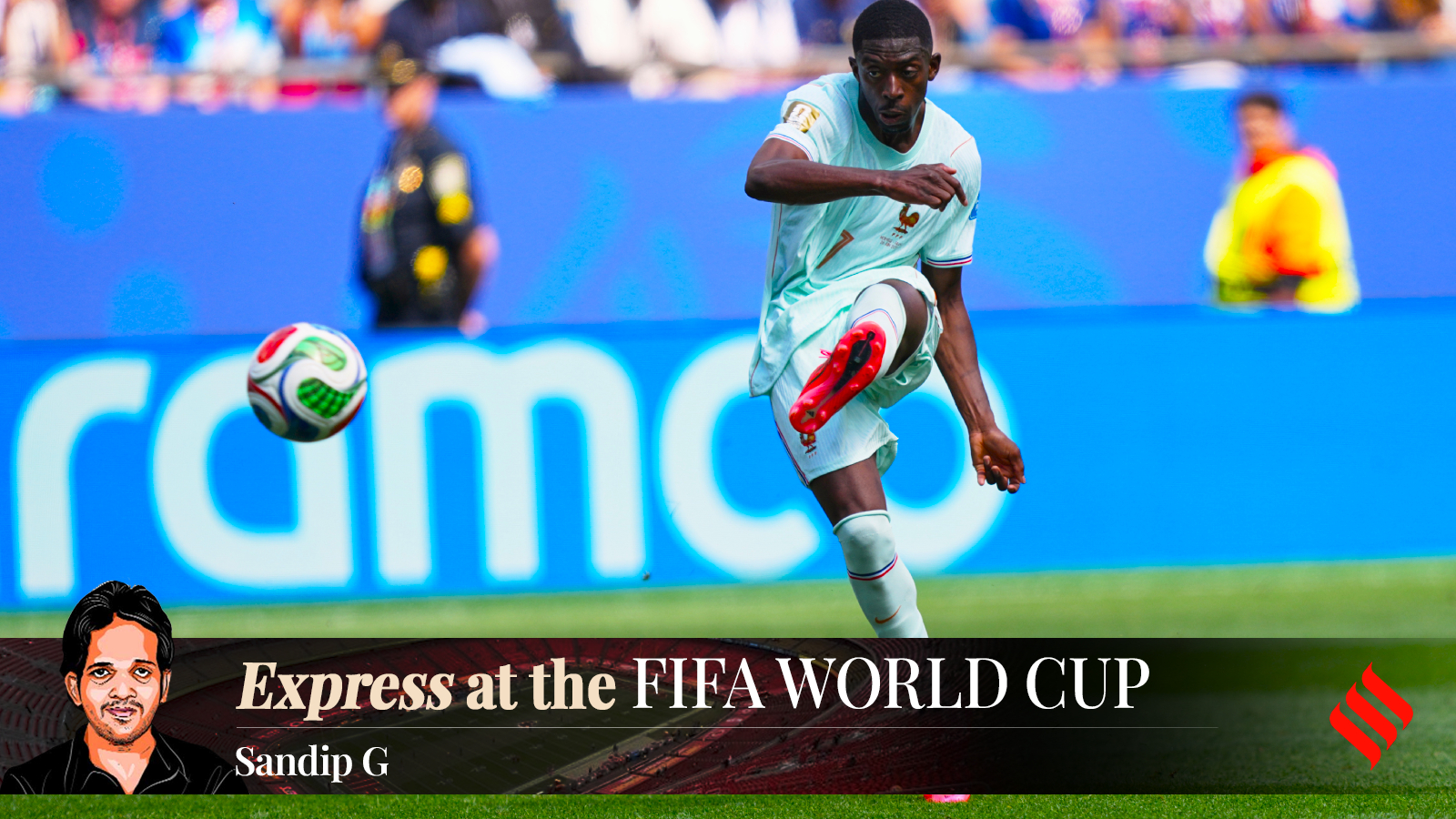
A step to his left; a nudge further to his left, a pause, a swing of his left-foot, and just like that, Ousmane Dembele scored the most frictionless hat-trick in a World Cup. It took just three shots for three goals, and when he struck the third, the clock had just passed 32 minutes. The build-up was all about his strike partner Kylian Mbappe and his match-up with Erling Haaland. But Dembele, his expressions as languidly minimalistic as his movements, offered a gentle reminder that the Ballon d’Or, after all, is safely secure in his shelf, in the 4-1 thrashing of Norway.
He might not have the aura of Mbappe or the hype of Haaland; the 29-year-old was a later bloomer that almost did not bloom; he was a figure of petulance past managers dreaded to handle, though none disputed his ridiculous abilities. He is two-footed, tricksy, quick and inventive; he presses intensely, his off-the-ball output is incredible. It’s just that his long, and sometimes frustrating, maturation period, had made him something of a second thought. The man after Mbappe; the man after Khvicha Kvaratskhelia with PSG.

But Dembele has been a man of his own, for both club and country. For the last three years at least. He reduced the match to a Ousmane Friday Evening Show, even though Norway, playing without Erling Haaland for much of the evening, could have made it a tighter contest had they converted a penalty in the second half. Ifs and buts, but there was nothing of those in Dembele’s display of exhilarating artistry.
You don’t need slow motion replays to admire Dembele, because everything unfolds unhurriedly. He gets the ball on his feet, he waits, he steps forward, he strides back, he veers to the left, he drifts to the right, as though it’s an elaborate hypnotic trick to tranquilise the men around him. Then without any burst of explosive speed, any wicked contortion of his body, he swings his foot, as sweet as a strike could be. The wind-up is negligible, the follow-through austere. Just a firm snap of his malleable ankles. And often the ball flows exactly where he wants it to, without him breaking a sweat, or the ball getting dirty.
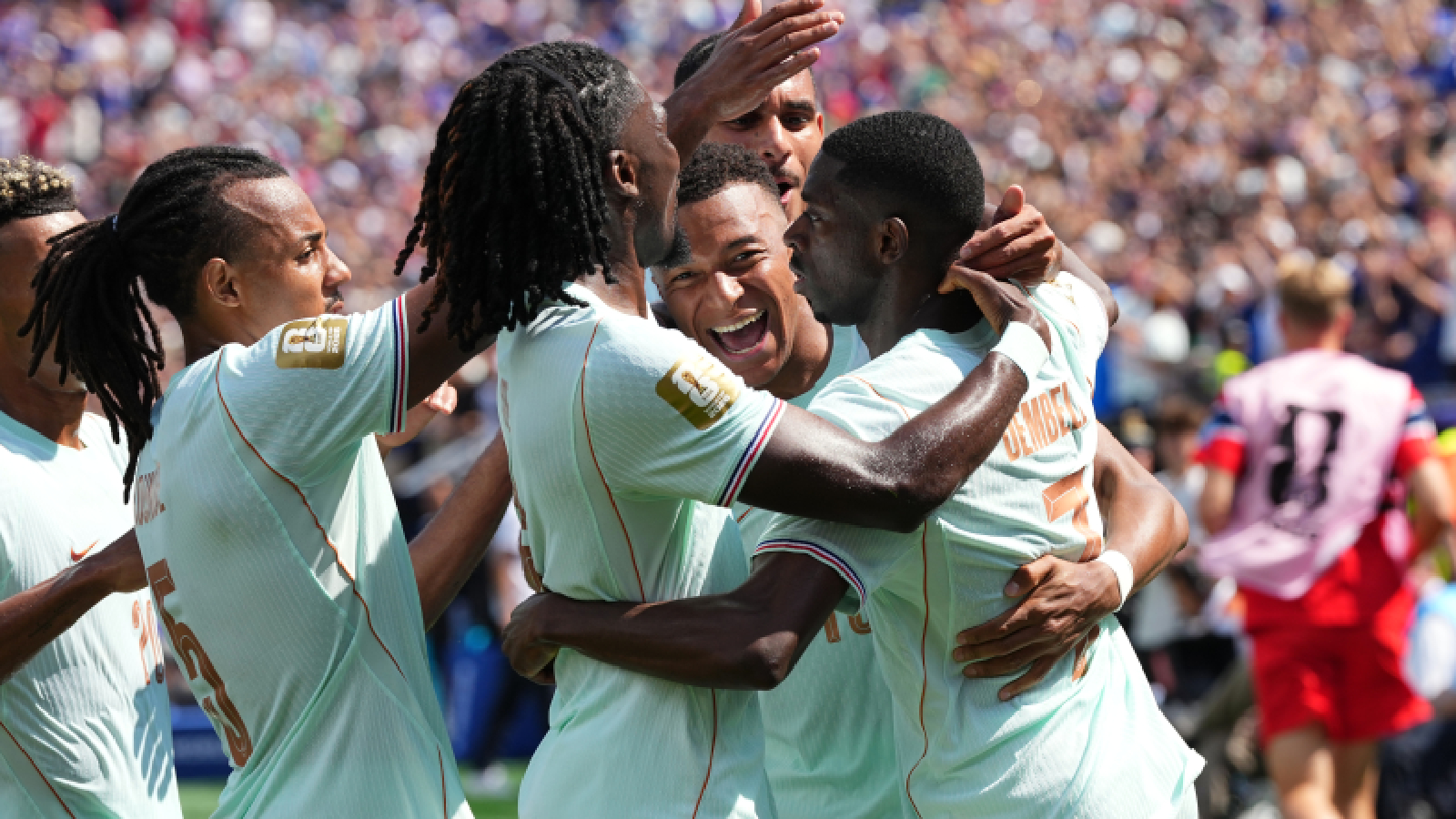 France’s Ousmane Dembele, right, celebrates with Kylian Mbappe, center, and other teammates after scoring his side’s third goal during the World Cup Group I soccer match between Norway and France in Foxborough, Mass., near Boston, Friday, June 26, 2026. (AP Photo/Martin Meissner)
All three goals of his were constructed with unreal minimalism and sparkling clarity. Watch the first one. He receives a diagonal ball from Mbappe, ambles forth, bobbles past Fredrik André Bjørkan, stops, surveys the field, steadies his balance and serenades the ball past the goalkeeper Egil Selvik. In its flight, the ball seemed devoid of venom. But Selvik’s flapping hands were too late to stop the ball. The whole sequence took barely four seconds, but Dembele has the ability to stretch time, to make four seconds like forty. He is the antithesis of Mbappe, whose supersonic movements are better appreciated in slow-motion replays.
ALSO READ | FIFA World Cup: Which teams are in Round of 32, and who’s eliminated
The second goal was roguish. Cutting from the right into the box, he teased the defenders by rolling the ball sideways, then stopping, standing on the ball, and then rinsing and repeating the same motions, until he reached the perfect spot to curve the ball into the nets. The celebrations were brief and mild, as though he is averse to public display of joy. “I’m like that, I don’t celebrate too much, I don’t express anger too much. I was brought up that way,” he once told L’Equipe.
Story continues below this ad
He was raised by his single mother in the rough neighbourhood of La Madeleine, a suburb of Évreux. Her mother had fled Mauritania, one of the poorest countries and the last to abolish slavery. She married a man from Mali and settled in Vernon on the banks of the river Seine. But shortly after Dembele was born, her husband left her and she had to bring up the children all by herself. “Football was an escape for me. I used to play it from noon to night. Otherwise, you will get dragged into all sorts of activities there,” he said in a documentary titled Ousmane’s.
From the grimy streets, his journey to fame was swift. By 18, he progressed from Rennes to Borussia Dortmund, the factory of rough diamonds. But the notoriety was building. He was late for practice. He refused to be on the bench. He didn’t slip into a life of glamour and extravagance, but he simply felt detached. “I just wanted to go home and be that kid again. Training, pressure, and media, I felt a bit tired.”
But the virtues were too irresistible to overlook, and the year he turned 20, Barcelona coughed up 145 million euros to acquire him. It turned out to be the worst phase of his career, as he struggled with recurrent injuries and form. His was almost a forgotten career before Luis Enrique revived him in PSG. In just his second year, he was both a Champions League winner and a Ballon D’or.
ALSO READ | World Cup third-place standings: Which teams will qualify for Round of 32, latest points table
Story continues below this ad
Repositioning him into a central role helped, but more than that he found love in Paris. “It’s the coach,” he would say. Enrique would react: “The thing is, you have to go deeper to get the best version of Ousmane.” The Spaniard found the keys to unlock Dembele gifts. As has Didier Deschamps, who had once famously snubbed him for arriving late.
But the past is behind him. He re-slotted him to the right, as Mbappe’s wingman. On Friday, he left Mbappe and a slew of defenders in his vapour trail with the most frictionless hat-trick in a World Cup. Anywhere. And he reminded him that in whose house the Ballon d’Or is safely secure.