Prateek Tanmay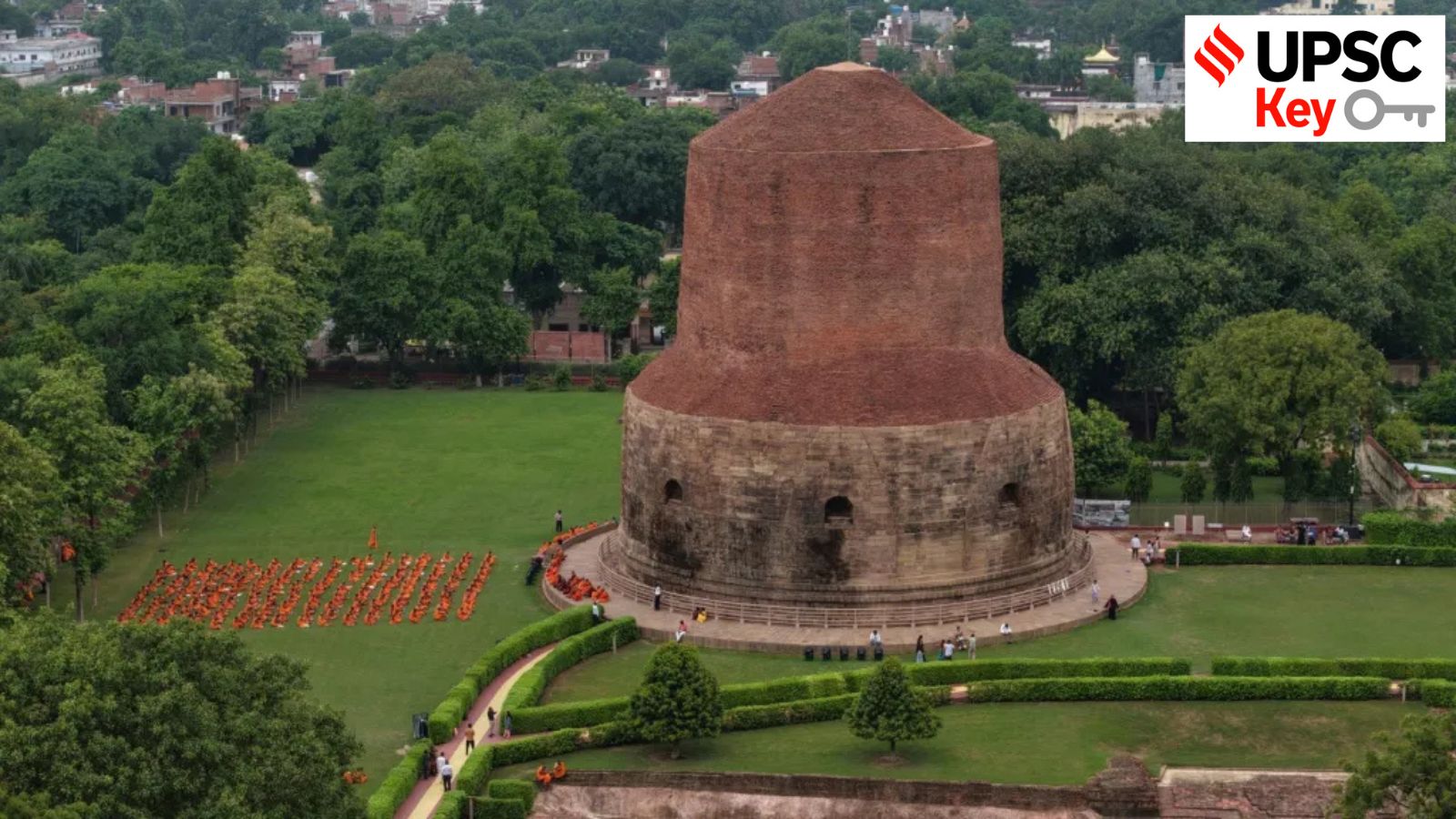

Preliminary Examination: Current events of national and international importance.
Mains Examination: General Studies- I, II : Indian Heritage and Culture, Indian culture will cover the salient aspects of Art Forms, literature and Architecture from ancient to modern times, Important International institutions, agencies and fora- their structure, mandate.
What’s the ongoing story: Sarnath, the ancient site where Lord Buddha delivered his first sermon after attaining enlightenment, has been inscribed on UNESCO’s World Heritage List, becoming India’s 45th and Uttar Pradesh’s fourth World Heritage Site.
Key Points to Ponder:
— What is a UNESCO World Heritage Site?
— What is the cultural significance of Sarnath?
— What is the Dharmachakrapravartana?
— Who selects the sites, and what are the key criteria for the selection of UNESCO World Heritage Sites?
— How many sites in India are recognised as UNESCO World Heritage Sites?
— What does the status of a World Heritage Site mean for a site?
— What are the initiatives taken by the government to pitch India globally as the land of Buddha? Know about Buddhist circuit.
— What are the major Buddhist sites in India?
— Read about Buddhism.
Key Takeaways:
— The announcement came Saturday during the 48th session of the UNESCO World Heritage Committee held in Busan, South Korea.
— Sarnath, one of the holiest sites of Buddhism, has recorded its significance on the global platform for heritage recognition. The state government stated this would strengthen Uttar Pradesh’s Buddhist Circuit on the international tourism and cultural heritage map.
— According to the UP Tourism Department, Sarnath was included in UNESCO’s tentative list on July 3, 1998. Twenty-eight years on, it has been officially designated a World Heritage Site. Until now, the state’s three World Heritage Sites were the Taj Mahal, Agra Fort and Fatehpur Sikri — all in the Agra region.
— Sarnath is the sacred land where Lord Buddha, after attaining enlightenment, delivered his first sermon to humanity and set in motion the ‘Dharmachakra Pravartan’. Counted among the holy pilgrimage sites of Buddhism, Sarnath is described in ancient Buddhist scriptures such as Rishipattan.
— Months ahead of its nomination, the Archaeological Survey of India (ASI) had replaced the existing plaque at the site — to “correct” its recorded history — replacing the names of colonial rulers to credit the local royal family with discovering the site.
— The Indian Express had reported in September 2025 about a proposal to change the perception that credited British archaeologists and officers for preserving the site.
— “After an extensive study of authentic documents and primary historical evidence, the Archaeological Survey of India (ASI), New Delhi, has acknowledged that the site of Sarnath in Varanasi first came to light during the digging carried out on the orders of Babu Jagat Singh,” said Pradeep Narayan Singh, a descendant of Jagat Singh, in a statement released in March.
Do You Know:
— World Heritage Site is a location recognised for its “outstanding universal value”. This signifies “cultural and/or natural significance which is so exceptional as to transcend national boundaries and to be of common importance for present and future generations of all humanity”. The Sites fall into three categories: cultural heritage, natural heritage, and mixed heritage (cultural as well as natural).
— Cultural heritage entails an Outstanding Universal Value from the point of view of history, art or science, and includes monuments, groups of buildings, and sites which are the combined work of nature and human agency. Examples include the Taj Mahal, the Statue of Liberty, and the Sydney Opera House.
— The Sites under natural heritage are those having an Outstanding Universal Value from the point of view of science, conservation or natural beauty, such as the Sundarbans Natural Park or the Victoria Falls.
— Buddhism is a significant world religion today, influencing many with its teachings. Originating in the 6th century BCE in the Indian subcontinent, Buddhism, along with other Śramanic sects emerged as a result of growing discontent towards ritualistic and hierarchical aspects of the Brahmanical tradition.
Other Important Articles Covering the same topic:
📍UPSC Issue at a Glance | India’s UNESCO World Heritage Sites — criteria, categories, and recent additions
📍How Buddhism shows the path to nirvana
Previous year UPSC Prelims Question Covering similar theme:
(1) Recently, which one of the following was included in the UNESCO’s World Heritage list? ( UPSC CSE 2009)
(a) Dilwara Temple
(b) Kalka-Shimla Railway
(c) Bhiterkanika Mangrove Area
(d) Visakhapatnam to Araku valley railway line
NATION
Safeguard essential’: Top court on withholding children’s Aadhaar details under APAAR scheme
Syllabus:
Preliminary Examination: Indian Polity and Governance-Constitution, Political System, Panchayati Raj, Public Policy, Rights Issues, etc.
Mains Examination: General Studies II: Government policies and interventions for development in various sectors and issues arising out of their design and implementation.
What’s the ongoing story: The Supreme Court has asked the Central Board of Secondary Education (CBSE) to implement on a pan-India basis the Orissa High Court’s direction that parents be provided with the option to refuse consent to sharing Aadhaar details of their children for creation of Automated Permanent Academic Account Registry (APAAR) ID or to opt out of the scheme.
Key Points to Ponder:
— What is an APAAR ID?
— What is the purpose of APAAR ID for students?
— How does the APAAR ID work?
— What are the concerns surrounding APAAR?
— What is the Right to Privacy?
— Why is the protection of children’s personal data important in digital governance?
— What are the key features of the Digital Personal Data Protection Act, 2023?
— What steps should be taken to ensure data privacy in digital public platforms?
Key Takeaways:
— A bench of Chief Justice of India Surya Kant and Justices Joymalya Bagchi and V Mohana also directed that any personal information collected pursuant to the APAAR Scheme should not be disclosed or shared with any private entity or third party except in accordance with law.
— The bench said it is “of the considered view that such a safeguard is essential to ensure that the requirement of consent is meaningful and informed. Accordingly, we direct that the directions contained in paragraph 19 of the aforesaid judgment shall be given effect to on a pan-India basis by the concerned authorities implementing the APAAR Scheme”.
— Paragraph 19 of the December 12, 2025 judgment of the Orissa HC asked authorities “to consider amendment of the model consent form to include an opt out/refusal of consent option therein”. The SC order came on petitions by some parents challenging the constitutional validity of the scheme.
— The petitioners contended that the scheme “effectively operates as a State-run surveillance mechanism within the education sector by enabling the long-term tracking, profiling and monitoring of children’s educational trajectories”. They said that “the extensive collection and retention of such data creates the potential for its use beyond the educational sphere, thereby raising serious concerns relating to informational privacy and data protection”.
— The court also termed “misconceived” the concerns regarding the possible misuse of the personal information of those who voluntarily opted to enroll under the APAAR Scheme. “Merely because the collection of such information is undertaken pursuant to an administrative scheme and not under a statutory mandate does not absolve the authorities of their obligations in relation to the protection of personal data,” it said.
— The SC said “any collection, processing, storage, retention, sharing or use of personal information under the APAAR Scheme shall, therefore, be strictly governed by the provisions of the Digital Personal Data Protection Act, 2023, and the obligations cast thereunder upon data fiduciaries to ensure the lawful, secure and purpose-limited processing of personal data.”
Do You Know:
— APAAR IDs are unique, 12-digit identifiers for students in India, part of the “One Nation, One Student ID” initiative under the National Education Policy 2020.
— It is a special ID system for all students in India, starting from childhood. Under the initiative, each student gets a lifelong APAAR ID, making it easy for the learners, schools, and governments to track academic progress from pre-primary education to higher education.
— The goal behind introducing APAAR is to make education hassle-free and reduce the need for students to carry physical documents. This initiative was launched as part of the National Education Policy 2020 by the Education Ministry.
Other Important Articles Covering the same topic:
📍What is the ‘One nation, One Student ID’ initiative of the Union govt?
UPSC Prelims Practice Question Covering similar theme:
(2) With reference to the APAAR (Automated Permanent Academic Account Registry) IDs, consider the following statements:
1. The APAAR ID simplifies the processes of credit recognition and transfer right from the school level.
2. It empowers students to accumulate and store their academic accomplishments.
3. It is a 10-digit identifier for students in India.
How many of the statements given above are correct?
(a) Only one
(b) Only two
(c) All three
(d) None
With Customs’ nod, Kerala’s Vizhinjam set to become gateway for exports & imports
Syllabus:
Preliminary Examination: Current events of national importance and economic development.
Mains Examination: General Studies-III: Infrastructure: Energy, Ports, Roads, Airports, Railways etc.
What’s the ongoing story: The Vizhinjam International Transshipment Seaport has been notified as a customs port, paving the way for export and import (EXIM) cargo operations at a facility that has so far functioned exclusively as an international transshipment hub.
Key Points to Ponder:
— What is a transshipment port?
— Know about the Vizhinjam International Transshipment Seaport.
— How will the commencement of export-import operations at Vizhinjam port benefit India’s economy?
— What is the significance of the Vizhinjam port for India’s maritime trade and logistics sector?
— What are the major government initiatives in the maritime sector?
Key Takeaways:
— With the Central Board of Indirect Taxes and Customs notifying the port as a customs port, Vizhinjam is expected to emerge as another gateway for India’s exports and imports.
— Besides boosting container movement, the country’s first international deepwater transshipment port is expected to provide a major fillip to Kerala’s economy and generate jobs in shipping, logistics and allied sectors.
— Since commencing operations in July 2024, Vizhinjam has functioned solely as a transshipment hub, handling container ships and transferring containers from one vessel to another.
— Official sources said export and import operations will begin on August 18. The launch of EXIM services, part of the state government’s 100-day action plan, will transform Vizhinjam into a full-fledged export-import gateway. This is expected to reduce logistics costs, improve supply chain efficiency, enhance exporters’ competitiveness, attract investment and generate employment.
— Developed under the PPP model by the Kerala government and Adani Ports and Special Economic Zone (APSEZ), Vizhinjam International Seaport has emerged as one of the world’s fastest-growing container ports. Within 18 months of commencing commercial operations, it handled 2 million TEUs (twenty-foot equivalent units) of container traffic. The customs notification also lays down conditions for export and import operations.
— The opening of the seaport for direct export and import marks another milestone for Vizhinjam, which has already handled some of the world’s largest container ships.
— Road connectivity for container movement to the port has been completed, while a dedicated rail link is also planned. The 10-km rail line, including a 9-km tunnel, will connect Vizhinjam with the Balaramapuram railway line between Thiruvananthapuram and Nagercoil.
Do You Know:
— A transshipment port includes terminals, where cargo containers are shifted from one vessel to another before they reach their final destination. Countries with robust global trade networks tend to use such ports to efficiently process large amounts of international cargo.
Other Important Articles Covering the same topic:
📍 Vizhinjam port: significance of India’s first transshipment hub
UPSC Prelims Practice Question Covering similar theme:
(3) Consider the following statements:
1. It is India’s first deep-water container transshipment port.
2. The port is being developed as a public-private partnership under the Design, Build, Finance, Operate and Transfer (DBFOT) model.
3. The port is located in Kerala.
The above-mentioned statements refer to:
(a) Cochin Port
(b) Azhikkal Port
(c) Vizhinjam Port
(d) Mundra Port
OPINION
A ‘golden’ fix for India’s forex stress?
Syllabus:
Preliminary Examination: Current events of national importance and economic development.
Mains Examination: General Studies-II, III: Government policies and interventions, Effect of policies and politics of developed and developing countries on India’s interests, Indian Economy and issues relating to planning, mobilization of resources.
What’s the ongoing story: P Vaidyanathan Iyer writes- “There is a tricky proposal engaging the government at the highest levels over the past 3-4 weeks. An empowered group of ministers has met twice to discuss it. Officials in the Prime Minister’s Office are seized of the issues connected with this idea. And the Cabinet Secretariat, the office responsible for government administration, has held meetings with those in the business to better understand the concerns, and ways to address them.”
Key Points to Ponder:
— What is the Balance of Payments (BoP) and its components?
— What are the components of the Forex reserve of India?
— How do high gold imports affect India’s balance of payments and foreign exchange reserves?
— What are the challenges in mobilising privately held gold in India?
— What steps should be taken to mobilise idle gold to reduce India’s external vulnerabilities?
— What is austerity?
— What are austerity measures?
Key Takeaways:
— “The thought behind the proposal probably has its origins in an austerity measure proposed by the PM at a public meeting in Hyderabad on May 10. In the backdrop of the West Asian crisis that led to a surge in oil prices, Modi had urged people to refrain from buying gold during festivals for a year, besides conserving fuel, restricting foreign travels, etc.”
— “The proposal, which has generated some interest among the few who are privy to it, is to launch a voluntary gold disclosure scheme. The idea seems to be to collect gold lying idle in private hands — that is, what people accumulated over the years for ‘investment’ (bars, coins), not what they bought for ‘consumption’ (jewellery) — and put it to use to reduce imports, and preserve foreign exchange.”
— “In India, gold has huge sentimental value, has cultural and religious connections; but it has also been leveraged by governments during emergencies, be it during wars or economic crises. Most recently, in the early 1990s, when India faced an economic crisis, the government and the Reserve Bank of India saw a ‘golden’ opportunity. To bolster the country’s forex, the RBI was fully on board when the State Bank of India pledged 20 tonnes of gold confiscated from smugglers with the Union Bank of Switzerland in May 1991 to raise about $200 million. But this wasn’t enough.”
— “With forex reserves plummeting to just $1.1 billion in June, barely enough to pay for 2-3 weeks of essential imports, the RBI proposed pledging 50 tonnes of gold to raise foreign exchange. This was approved by the caretaker government led by Chandra Shekhar, but executed post general elections by the new government under Prime Minister PV Narasimha Rao and his Finance Minister, Manmohan Singh. As much as 46.91 tonnes was pledged to raise $405 million; this too was paid back in less than four months.”
— “Two years later, in 1993, as India became a bit comfortable on the forex front, it sought to bolster its gold reserves. The government experimented with an idea to bring private and unaccounted gold into the formal economy. It issued the Gold Bonds (Immunities and Exemptions) Ordinance, 1993, and, drawing from it, announced the Gold Bonds Scheme.”
— “The bonds had a five-year tenure, and after five years, subscribers were paid Rs 40 per gram lump-sum interest, along with the gold deposited. A subscriber was required to deposit a minimum of 500 grams under the scheme, which was open for two months. The biggest draw was it asked no questions from the subscribers about the nature and source of gold, or the money used to buy the gold. It also promised the government would not start any inquiry or investigation against the subscribers. In all, the total gold received under the scheme was 41.12 metric tonnes, valued at Rs 1,534.40 crore.”
— “Thirty-three years later, in May 2026, India faces a different gold problem. The West Asia crisis is not of the government’s making, but is exerting pressure on the Indian economy, and magnifying its vulnerabilities.”
— “India imports bulk of its crude oil needs; crude oil prices have once again topped $100 a barrel, which means India’s import bill will soar. This can’t be avoided. But what can be is the massive gold imports, which only worsens the current account deficit (when the money spent on imports is more than the money earned from exports, it leads to a deficit).”
— “The biggest factor that made the Gold Bond Scheme of 1993 a success was the government immunity to subscribers. But that required taxpayers, individuals and corporations to have trust in the system. Here, many in the government agree, there is considerable work to be done. But there are other options to explore too on increasing the attractiveness of a financial product linked to gold.”
Do You Know:
— Foreign exchange reserves are an important component of the Balance of Payment (BoP) and an essential element in the analysis of an economy’s external position. In times of crisis, adequate foreign exchange reserves give comfort, acting as a buffer and giving strength to a country’s macroeconomic fundamentals.
— The RBI has the primary responsibility of collection, compilation and dissemination of data relating to foreign exchange reserves.
— India’s foreign exchange reserves comprise foreign currency assets (FCA), gold, special drawing rights (SDRs) and reserve tranche position (RTP) in the International Monetary Fund (IMF).
— By definition, austerity refers to a set of policies aimed at restoring fiscal balance and economic competitiveness through cuts in public expenditure. Austerity measures commonly include budget cuts in welfare expenditure, often in health, education, housing, and other social expenditure.
Other Important Articles Covering the same topic:
📍What India’s current economic challenges reveal about austerity
📍Behind PM Modi’s austerity call, dipping foreign exchange reserves, rising gold imports
ECONOMY
Small US businesses mount 1st challenge to Sec 301 tariffs
Syllabus:
Preliminary Examination: Current events of national and international importance.
Mains Examination: General Studies II, III: Effect of Policies and Politics of Developed and Developing Countries on India’s interests, Effects of liberalization on the economy.
What’s the ongoing story: A day after US imposed fresh tariffs on 60 countries including 10% duty on India, two US small businesses – Burlap & Barrel, spice importer and Collective Horology LLC, a watch retailer – have filed a case against United States Trade Representative (USTR) for the use of Section 301 to impose tariffs impacting “99.4% of all imports into the United States”, case documents have shown.
Key Points to Ponder:
— What are tariffs? How do they affect international trade?
— What is the difference between tariff and non-tariff barriers?
— What is forced labour? How is it defined under international law?
— What is Section 301 of the US Trade Act, 1974?
— What is the status of the India-US Trade deal? What are the areas of cooperation between both the nations?
— What challenges do unilateral trade measures pose to the rules-based multilateral trading system?
— How could labour-related trade measures affect India’s exports?
— What steps has India taken to strengthen labour rights and improve labour compliance in global value chains?
Key Takeaways:
— This assumes particular significance for India, as New Delhi has committed to a US trade deal but has yet to sign it formally. Government officials say that India is willing to sign the deal when the new US architecture gives India a competitive edge compared to its competitors in the Association of Southeast Asian Nations (ASEAN) region – one of the fastest growing regions globally. The US had opened two Section 301 investigations, one on ‘excess capacity’ and the other on ‘forced labour’.
— The small business argued that USTR failed to provide a “reasoned, record-based explanation for its determinations or for its selection of near-uniform duties” across 60 economies with materially different enforcement records and trade profiles. They argue that if Section 301 were interpreted to allow such broad power, it would constitute an unconstitutional delegation of Congress’s Article I power to lay duties.
— The US has imposed Section 122 tariffs, imposing 10% tariffs globally immediately after losing the IEEPA case in the US Supreme Court. India faced steep 50% tariffs for over 5 months.
— “The Section 301 action exceeds the authority Congress granted in Section 301. Section 301 is a targeted, country-specific and practice-specific remedial authority. It permits the Trade Representative to act only upon a determination that a particular act, policy, or practice of a foreign country is unreasonable or discriminatory and burdens or restricts United States commerce… It is not a freestanding authorisation to tax substantially all imports from substantially all trading partners at rates selected to replicate the invalidated IEEPA tariff regime rather than to eliminate identified foreign practices,” US small business argued.
— Experts have said that Section 301 is a far more potent tool than the International Emergency Economic Powers Act (IEEPA) tariffs, which were used to impose reciprocal tariffs but did not pass muster in the US Supreme Court.
— This legal tool was mostly used by the US against countries such as Europe & Japan, dominant export powers then, before the WTO came into existence in 1995. The Trump administration has resurrected Section 301 again amid a weakening WTO.
— Singapore-based Henrich Foundation explained that under Section 301, USTR gets sweeping powers not only to impose duties but also other kinds of restrictions. USTR can “withdraw or suspend trade agreement concessions”, enter into binding agreements with the foreign government to eliminate the conduct or unburden US commerce, or compensate the US with satisfactory trade benefits.
Other Important Articles Covering the same topic:
📍India attracts 10% US tariff, lower rate after policy shift
📍New tariff leave India better than competitors
Previous year UPSC Mains Question Covering similar theme:
What are the key areas of reform if the WTO has to survive in the present context of trade war, especially keeping in mind the interest of India? (UPSC CSE, 2018)
Deeper jobs problem: Stir a sign demographic dividend is at risk
Syllabus:
Preliminary Examination: Current events of national importance, economic and social development.
Mains Examination: General Studies-II, III: Government Policies and intervention, Employment, human resources.
What’s the ongoing story: The immediate cause for the rise of the Cockroach Janata Party (CJP) and the nationwide protests may be the leak of the National Eligibility-cum-Entrance Test (NEET) question paper. And while Dharmendra Pradhan has resigned as Education Minister, it does nothing to solve a crucial underlying problem: jobs.
Key Points to Ponder:
— How is unemployment measured in India?
— Employment Rate (ER) and Unemployment Rate (UER)-Know in Detail
— What are the factors behind the increasing youth unemployment in India?
— What are the key challenges in converting India’s demographic dividend into demographic capital?
— How does increasing youth unemployment affect India’s demographic dividend?
— What are the government initiatives related to employment?
— What steps should be taken to address the challenge of unemployment?
Key Takeaways:
— According to Alexandra Hermann Prasa, Lead Economist at Oxford Economics, while the student protests don’t pose much of a risk to the larger Indian economy, they do “expose a deeper jobs problem”.
— The government’s flagship employment survey, the Periodic Labour Force Survey (PLFS), shows that the unemployment among Indian youth — those in the 15-29 age bracket — rose to 16.2% in June, as per data released earlier this month. This is the highest on record, although it must be said that monthly PLFS data only goes back until April 2025, when it stood at 13.8%.
— This rise in youth unemployment needs to be seen in the context of two other trends. One, the unemployment rate has increased across all six youth categories for the 15 months for which data is available: males and females at an all-India level, in urban areas, and in rural areas.
— Two, youth unemployment has risen despite the Labour Force Participation Rate (LFPR) declining over the same period in all but one category. Only urban males have seen their LFPR rise, standing at 60.1% in June, up 1 percentage point from April 2025.
— To put all these numbers in perspective, the all-India unemployment rate for ages 15 years and above was 5.5% in June as against 5.6% in April 2025. The corresponding LFPR was 54.4%, up from 54.2%.
— The LFPR measures the percentage of the population that is looking for work, including those that are employed. So, when the LFPR falls – or when fewer people are looking for jobs – it should ideally result in a lower unemployment rate even if no new jobs are added. But that hasn’t happened.
— It has been ingrained in our psyche that better education leads to better jobs; which is why the youth studies for three more years after 12th to graduate, another couple of years for post-graduation, and so on. But less than 7% of male Indian graduates manage to find a permanent salaried job within a year, according to Azim Premji University’s (APU) State of Working India 2026 report released in March this year.
— The figure is an even lower 3.7% when it comes to white-collar jobs. Using data from the PLFS and its predecessor, the Employment Unemployment Survey (EUS), the APU report estimated that 1.1 crore out of 6.3 crore graduates in the 20-29 age bracket were unemployed in 2023.
— Of course, graduate youth unemployment is nothing new, with the APU report’s analysis revealing that it stood at 39.33% in 2023, up from 35.02% in 1983, for those less than 25 years of age.
— However, what has changed since 1983 is that India is not getting younger anymore – the country’s median age is around 29 years and is expected to increase to 38 by 2050. Now is when those joining the workforce earn and not just prepare safety nets for their own future but drive national economic growth.
Other Important Articles Covering the same topic:
📍UPSC Essentials | Society and Social Justice: Unemployment and associated issues (Part 2)
Previous year UPSC Prelims Question Covering similar theme:
(4) Disguised unemployment generally means (UPSC CSE 2013)
(a) Large number of people remain unemployed
(b) Alternative employment is not available
(c) Marginal productivity of labour is zero
(d) Productivity of workers is low
Previous year UPSC Mains Question Covering similar theme:
Most of the unemployment in India is structural in nature. Examine the methodology adopted to compute unemployment in the country and suggest improvements. (UPSC CSE 2023)
ALSO IN NEWS
— The Union government is likely to bring an amendment Bill in Parliament next week, increasing the punishment for individuals involved in unfair means, including leaks of question papers of public examinations, from three to five years’ imprisonment to five to 10 years, while also increasing the fine from Rs 10 lakh to Rs 50 lakh, The Indian Express has learnt.
— The draft Public Examinations (Prevention of Unfair Means) Amendment Act, 2026, which was approved by the Cabinet on Friday and circulated among MPs on Saturday, also increases the punishment for organised crime of unfair means in public examinations from imprisonment of at least five years to at least seven years and the fine from at least Rs 1 crore to at least Rs 10 crore.
— The draft amendment Bill also provides for a ‘Special Task Force’ to investigate the cases of unfair means, with a timeline of two months for the investigation. For the trial of the cases, the Bill provides for the setting up of special fast-track courts.
- Houthis fire on Saudi oil sites; no US strike on Iran 1st time in 2 weeks
— Yemen’s Iran-aligned Houthi militants fired on Saudi oil installations in two ports on the Red Sea coast on Saturday (July 25), but the U.S. held back from launching air strikes on Iran for the first night in two weeks.
— Houthi military spokesperson Yahya Saree said the group had successfully struck sites belonging to Saudi state oil giant Aramco in Jizan and Yanbu.
— Yanbu is Saudi Arabia’s main Red Sea oil port, where millions of barrels a day are loaded, and has become the main route out for Saudi oil skirting the Strait of Hormuz, which has been blockaded by Iran.
— Jizan, on the Red Sea close to the Yemeni border, is the site of a refinery with a capacity of 400,000 barrels per day.
PRELIMS ANSWER KEY
1. (b) 2. (b) 3. (c) 4. (c)
Subscribe to our UPSC newsletter. Stay updated with the latest UPSC articles by joining our Telegram channel – Indian Express UPSC Hub, and follow us on Instagram and X.
🚨 Click Here to read the UPSC Essentials magazine for July 2026. Share your views and suggestions in the comment box or at manas.srivastava@indianexpress.com🚨