Prateek Tanmay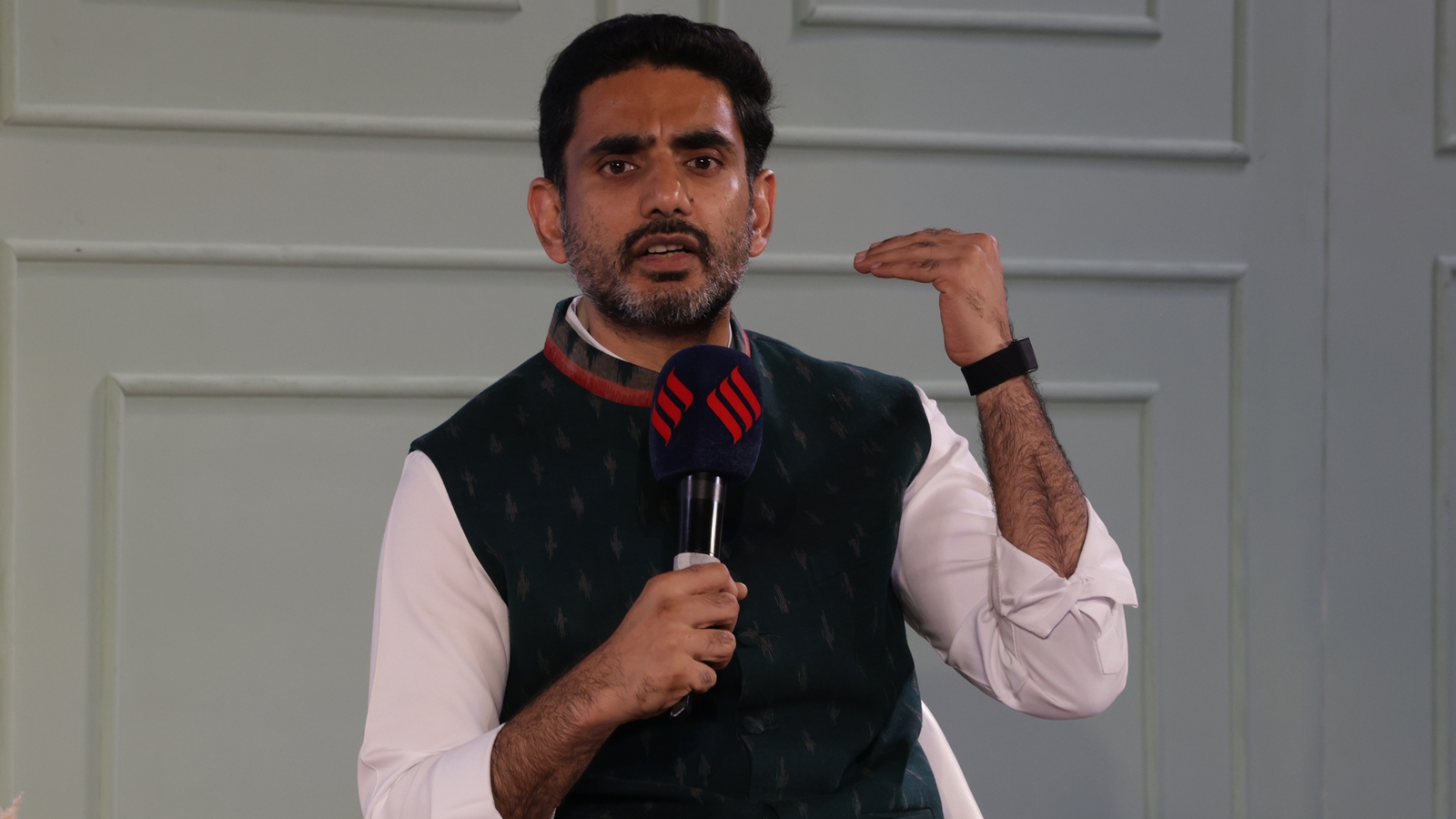
The regional parties that lose their ideological moorings after years in power inevitably run into trouble, Andhra Pradesh IT Minister and Telugu Desam Party (TDP) national working president Nara Lokesh said, citing the challenges being faced by parties such as the Trinamool Congress (TMC) and the Aam Aadmi Party (AAP).
Speaking at the Express Adda in Delhi on Monday, Lokesh, the son of Andhra Pradesh Chief Minister and TDP president N Chandrababu Naidu, said the TDP has endured political ups and downs because it remained rooted in its ideology and cadre despite facing both victories and defeats over the years.

Referring to TMC leader Abhishek Banerjee, Lokesh said he was going through a difficult phase and suggested that the TMC had become “complacent” after spending more than a decade at the helm of the West Bengal government. He claimed that both the Mamata Banerjee-led TMC and the Arvind Kejriwal-led AAP had drifted away from the principles on which they were founded.
“When I look at what is happening around me, the message is loud and clear that we stand for our ideology, as a regional party, we should stand for our workers and we have to double down on it. Parties which have lost their ideologies because of winning elections and coming to power multiple times have faced challenges,” Lokesh said. He was in conversation with Vandita Mishra, National Opinion Editor, The Indian Express.
The TDP is a key ally of the BJP in both Andhra Pradesh and at the Centre.
Lokesh rejected suggestions that regional parties were at a disadvantage within the BJP-led NDA, insisting that the alliance provided enough space for partners to express their views and shape policies. “Our support to NDA has always been unconditional. Our leader and the TDP believe that India needs stable leadership,” he said, adding that differences on policy matters were discussed within the NDA.
“I absolutely disagree with that narrative. Because whenever we wanted to voice an opinion, the doors were always open. Whenever we wanted reforms to come in certain sectors, our opinion was always heard. And things were changed,” he said.
Lokesh cited the Waqf amendment Bill as an example, saying the TDP had raised concerns that eventually led to wider consultations on it. He also referred to discussions on the delimitation issue, saying the party had closely studied the proposal before taking up its concerns within the ruling coalition.
The question of the TDP’s place in the NDA resurfaced when Anant Goenka, Executive Director, The Indian Express Group, referred to reports of a meeting involving CM Naidu, a corporate leader and a former Vice-President in Mumbai. Asked what had transpired during that meeting, Lokesh dismissed speculation that it had any political significance.
“I don’t know why this story keeps repeating. And it’s always as if the TDP has to prove itself that we are in NDA. Someone writes TDP is upset, someone says TDP is going to go away. There was never such conversation, because all the doors are open,” the TDP leader said.
“About the rumour, I met Modi ji. I told him the context in which I met the person and the conversations I have had with the person. The PM laughed and said, ‘One, no one told me. If anyone tells me, I will check. I will call you, make you sit in that chair and ask you that question. But just because there is rumour, you shouldn’t stop meeting people. You are a politician, go and meet everyone.’ That is the frankness with which you can have a conversation in this NDA dispensation. Our support to the PM is unconditional and it will continue to be unconditional because we believe he is the right leader at the right place at the right time. India needs political stability, strong leadership to take us forward,” Lokesh said.
To a supplementary question on whether he had met both the former V-P and the corporate leader, he said he had met only one person.
Lokesh also weighed in on education reforms against the backdrop of the NEET leak row, arguing that the country’s examination system needs to become more flexible and student-friendly. “Should further reforms happen in testing? Absolutely. Andhra has moved to completely computer-based testing. I believe exams should not happen only once a year. When our children are aspiring for higher education, one bad day could destroy their entire career or a year,” he said.
The TDP leader also said he has studied examination systems in India and abroad to understand shortcomings and possible reforms. “I have been reading on global practices. It was very important for me to know what went wrong, including in the CBSE. If you look at the computer-based examination system, from a minister’s perspective it looks good. But when the results came in, it was a double-edged sword. So I have to know what went wrong. What are the corrections required. There is nothing called a perfect system. We have to improvise as we go along,” he said.
On social media regulation, Lokesh said governments, parents and technology platforms were increasingly recognising the need for ensuring safeguards for children online. “We have already held consultations with all the platforms. Even they say that children below the age of 13 are not allowed. But kids find ways of getting on the platform. Platforms want it, parents want it. We need safeguards. Age-appropriate content is very, very important,” he said, adding that the Andhra government was working with Union IT Minister Ashwini Vaishnaw on the possibility of creating a national framework to address the issue.
The conversation ended on a personal note, with Lokesh reflecting on the lessons he has learnt from public life. He described his 2023 padyatra across Andhra Pradesh as the most important political experience of his career so far, saying it helped him understand the concerns of ordinary people in a way that government office never could.
“Padyatra was very important for me to understand Bharat. In the previous Chandrababu Naidu cabinet, I was a minister. So when an MLA would come and explain to me about an issue, my ability to connect with that issue would be limited. Now my ability to relate to that issue exists 100 per cent,” he said. “Stanford (from where he did his MBA) was great for business, but padyatra was great for politics. I got the IQ from Stanford and EQ from padyatra.”
Asked what was the one lesson he had learnt from his father’s “mistakes”, Lokesh replied: “Spend more time with your children.”
On what he had learnt from Congress leader Rahul Gandhi, Lokesh said: “One thing I appreciate about Rahul Gandhi is that he walked. I have done a padyatra and so I know it. But you can’t just walk, your learnings have to be imbibed. Whenever I am conflicted, I refer to my padyatra.”