Prateek Tanmay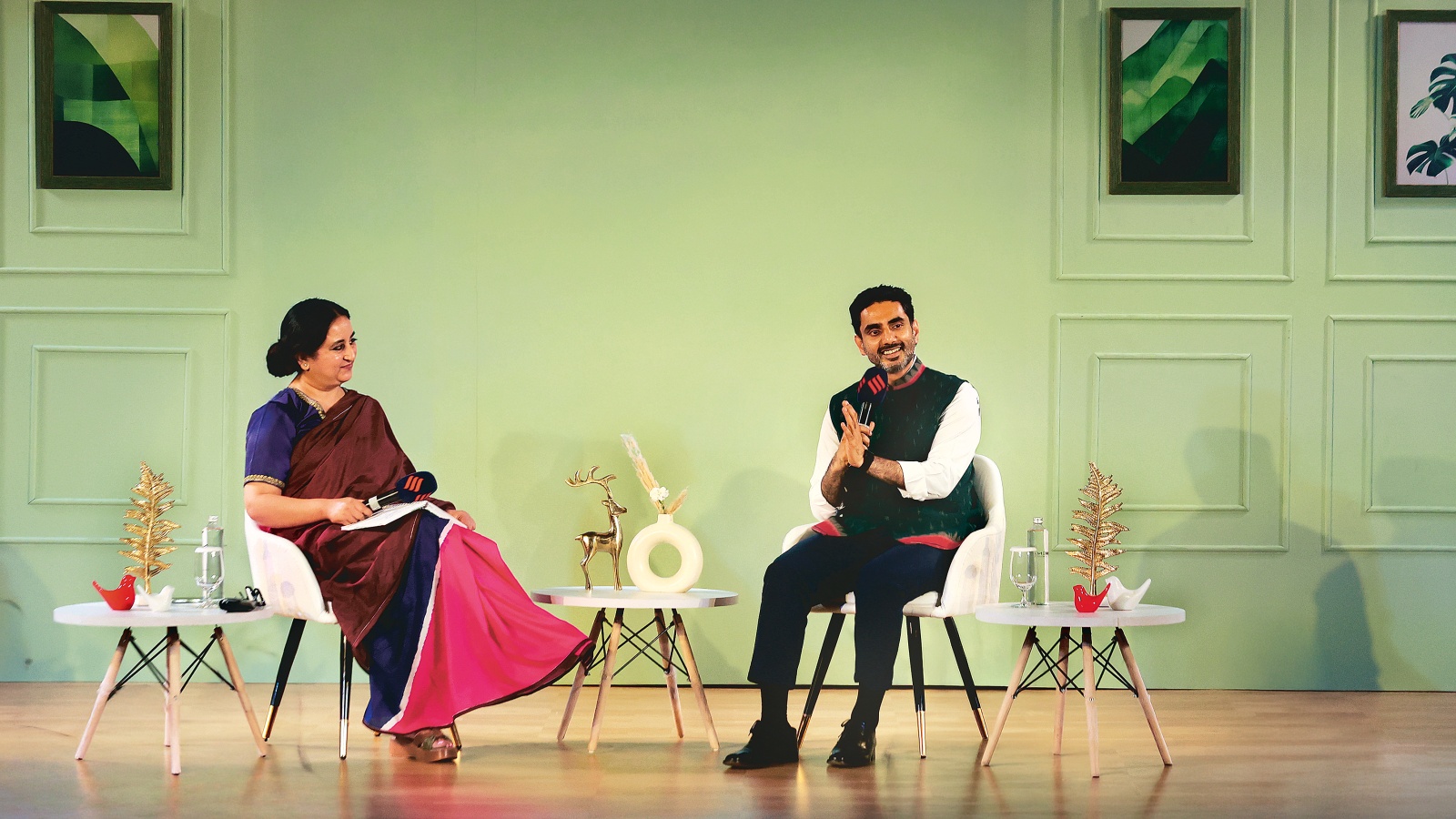
Nara Lokesh on real-time governance, delimitation, TDP’s voice within the NDA and the potential benefits of bringing data centres to the state. He was in conversation with Vandita Mishra, National Opinion Editor, The Indian Express
In Andhra Pradesh, we have started collecting data sets from across ministries and integrating them into one department to take decisions. Now, our Chief Minister, Chandrababu Naidu, has taken it one step further, where it is about the ease of living because the intersection of a citizen and the government has friction. The idea is to use technology to eliminate that friction. For example, we bring each and every government service onto a single WhatsApp number. Almost 1,000 services are available to citizens today.

Of your three portfolios, what takes up most of your time?
Honestly, everything. But what I’m most passionate about is education. Apart from the fact that I love kids, I truly believe real change can happen through education. For example, we all talk about gender parity. When I became minister, I asked my department why first- and second-grade textbooks had photos of only women doing household chores. If that is the stereotype we are teaching a child, what change are we going to bring when they are in college or join work? So we changed that. We said household chores — 50 per cent men, 50 per cent women. It might seem trivial but it’s the power of value-based education.
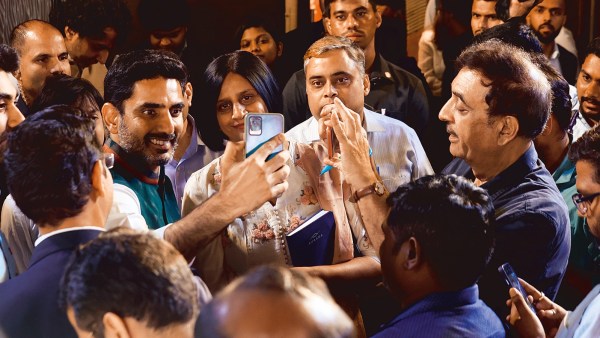 Lokesh interacting with the audience at Express Adda
The NEET re-test took place recently. This was an issue that touched not just students but entire families. When the NEET leak happened, did you speak to the education minister at the Centre? Did you give suggestions? What were your takeaways?
Should further reforms happen in testing? Absolutely. All of us accept that. As a State we have our own APSET and other examinations. Andhra has moved to computer-based testing. I want to go further and say exams shouldn’t happen only once a year. When children are aspiring for higher education, one bad day can destroy their career for a year. In my department I tell everyone: Think from your child’s perspective. I have an 11-year-old boy. When I look at reforms, I put him at the centre.
Regional parties seem to be falling like ninepins. Your grandfather NT Rama Rao brought regional parties together to challenge Congress dominance. Today, your party is crucially holding up BJP dominance. From inside the ruling coalition, how do you look at the implosion of regional parties?
As a regional party, we should stand for our ideology and our cadre. Parties that have lost their ideology after winning elections have faced challenges multiple times. The TDP has won and lost elections but after 44 years, we stand strong. Our support to the NDA has been unconditional because our leader and the Telugu Desam fundamentally believe India needs stable leadership. We walked back into NDA in 2024 unconditionally. But on policies, do we have opinions? Absolutely.
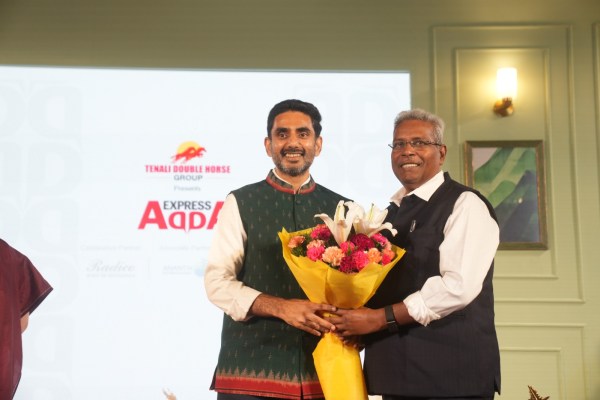 Lokesh with Munagala Mohan Shyam Prasad, Chairman and Managing Director, Tenali Double Horse group
You say you voice your opinion within the four walls of the coalition. But the coalition arrangement has changed from the time your father lent outside support to the AB Vajpayee government. At that time there were coordination mechanisms, institutionalised ways of interaction with allies. Today, there are no such mechanisms. The interaction is leader-centric, one-on-one with parties, which puts regional allies at a disadvantage.
I disagree. Whenever we have wanted reforms in sectors that are in the interest of the State, our opinion has been heard and things have changed.
Story continues below this ad
If I have an issue, I pick up the phone, call the minister concerned. Either they answer or call back within the hour. That’s how we work.
In your own trajectory, there have been ‘aha’ moments. You have spoken about entering a room full of 5,000 people when you were 20-21 and seeing everybody clap for your father when he was out of power. That made you want to join politics. But the moment you talk about most is your padyatra. You are interested in AI hubs, quantum computing and digital governance, how does the padyatra sit with them?
I have always chosen the road less travelled. I contested from a constituency my party had not won since 1985. I lost in 2019. For five years, I didn’t leave my constituency and won with a 91,000 majority, the third-highest in Andhra’s history. I chose HRD. Not many people choose education, but I was passionate about it.
The padyatra helped me understand people. Earlier, when an MLA came and explained an issue to me, my ability to connect with it was limited. After the padyatra, because I walked in that constituency, heard people and spent nights there, my ability to relate to issues became much stronger. The IQ bit I got from Stanford. The EQ bit I got from the padyatra. It taught me that if an issue comes to me through WhatsApp or any mechanism, it has already boiled over. My response has to be much faster. Whenever I feel tired after sitting in an AC room all day doing presentations, I look back and say I have no reason to be tired. I walked. There were days when I walked 24 km in the Andhra heat. That connection is what the padyatra created.
During the padyatra, you held up a little red book, in which you said you had names of police officials, YSRCP leaders and administrators who allegedly committed excesses against TDP and its cadre. Recently, there were custodial deaths and the Opposition has said this is an example of red book governance, vendetta politics. You are young, why carry this bitterness with you?
I have no bitterness. I was born soon after NTR ji became Chief Minister. I have seen how cadre works, how offices work, how IPS officers work. Between 2019 and 2024, I saw an institutional collapse. They forced 23 cases against me, including an attempted murder case and an SC/ST atrocities case. If I don’t put a stop to this and don’t take people to task who broke the law, where is the end? Isn’t that why we are elected — to uphold the Constitution? Between 2019 and 2024, there were days when Mr Naidu was not allowed to leave his house because police tied ropes to his gate. Today, Jagan is travelling wherever he wants. Was there a custodial death? Yes. We have taken action. There is a murder case against the person responsible and he will face the law. Did Jagan do the same when he was in power? No. When our cadre was killed, there was no action.
Story continues below this ad
You are the face of Andhra Pradesh’s investment push. You brought Google, which has committed one of its largest investments outside the US. But there are questions around land acquisition, environment, energy and water requirements of data centres and subsidies.
Data is the new oil and data centres are the new refineries. The quicker we accept this, the closer we are to reality. All our phones are powered by data centres. Do we stop using them? The question is: Will data centres alone create jobs? Data centres are catalysts but it is not just about attracting data centres. I want the entire ecosystem in Andhra. We are building it — servers, racks, power electronics, everything around it.
Between Andhra and Karnataka, the competition for investment has been edgy. Recently, a CEO tweeted about traffic jams and potholes in Bengaluru and you invited him to Andhra Pradesh, saying you would provide better infrastructure and safer cities for women. But many point out that you have an advantage because the Centre is on your side and this could deepen the industrial skew between states.
If you don’t lay roads, what will the Government of India do? If you don’t provide 24-hour power, if you charge industrial customers Rs 15 per unit, and I as a State say I will compete and do better, how can you blame me? The Prime Minister came up with a data centre policy that applies to India. There are no special terms and conditions only for Andhra Pradesh. When States compete, India wins. Is there an advantage of having a double-engine government? Absolutely. We have a voice at the table. In Andhra, we call it a double-engine bullet train government because in Andhra Namo means Naidu ji and Modi ji ki jodi.
At one time, Mr Naidu was seen as a prime ministerial candidate. Nitish Kumar, too, was seen as someone who could lead at the Centre. Today, both are under the Modi umbrella in the NDA. Does the ‘Namo’ image also evoke a sense of loss?
If Naidu ji wanted to be PM, he would have become during the United Front period. He was offered the post twice, he chose not to take it. His agenda was his State. Today, our work is cut out in Andhra Pradesh. Naidu ji played an important role in telecom deregulation and public-private partnerships in airports. He was a catalyst because he wanted to build a greenfield private airport in Hyderabad. That is how GMR built a world-class airport. Today, we are doing the same with data centres and other policies. But Mr Naidu never aspired for higher office.
Story continues below this ad
In your family, there are two models of governance. NTR laid the foundations of the social welfare model — Rs 2 rice, property rights for women. Your father became identified with the IT revolution, building Hyderabad as a global hub. How do you balance the two?
Both go hand in hand. If you look at agriculture in the West, it is highly subsidised by governments. The farmer is protected. Here, we say farmers should not be given anything. I disagree with that. But we also have to invest in education, healthcare, infrastructure and lower-cost energy. Governments have to find that balance.
On delimitation, Chandrababu Naidu supported the government’s proposal. But concerns have been raised that southern states may be at a disadvantage even if the ratio is maintained.
Article 81 says the number of seats will not increase and based on the 2026 Census, delimitation will happen. The Amendment was meant to safeguard southern states. Today, we are 1.5 billion people. Some Assembly constituencies have close to 3,00,000 voters. Even Pranab Mukherjee ji said India needs around 1,000 MPs to effectively represent such a large population. But the proportion of distribution has to be maintained.
Andhra Pradesh is considering a law for a social media ban for those under 13 and age-appropriate content between 13 and 16 years.
We have held consultations with all platforms. According to their own terms, children under 13 are not allowed on platforms. But children find ways around it. As parents, we want safeguards. We need a framework to regulate content. It is challenging for a State because of boundaries, VPNs and platform cooperation. We are working with Ashwini Vaishnaw ji to see how this can be done nationally.
Many Andhra students and professionals are vulnerable to changing US immigration policies. What are you doing for them?
We are opening new avenues. While there is a debate about three languages, we are saying if children want to learn Japanese, here is an ITI or degree college. If they want German, here is the opportunity. Learning languages opens new boundaries. The US was built on immigration. While a crisis exists, there is also an opportunity.
Story continues below this ad
Does the BJP’s ‘one nation’ idea worry you as a regional party in a federal structure?
Andhra Pradesh’s Assembly and Parliament elections are already synchronised. It does put more power in the federal system but the idea that the Centre will hold back money is not the reality. BJP also understands that southern states are part of India and Bharat. The only challenge for a regional party is complacency.
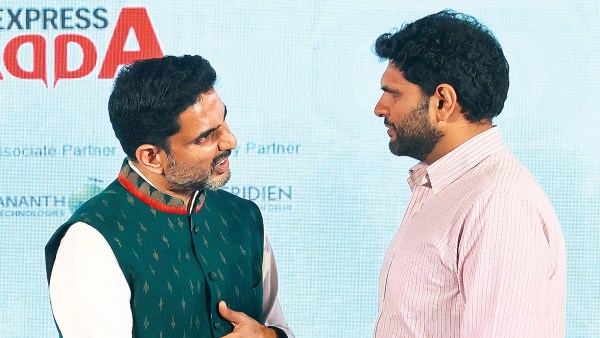 Nara Lokesh with Anant Goenka, Executive Director, The Indian Express Group
With the benefit of hindsight, one mistake you think your father has made that you have learned from.
Spend more time with my son.
One political heir of your generation you think has played his or her cards right.
I’m the one.
One political lesson you would like to offer or like to learn from the following people:
🔴 Udhayanidhi Stalin
Always be closing.
🔴 Himanta Biswa Sarma
I would love to get some energy from him.
🔴 C Joseph Vijay
Story continues below this ad
His ability to capture the imagination of youth through social media.
Is there anything common between Tamil Nadu, Sri Lanka, Nepal, Bangladesh?
It’s important to understand the aspirations of the youth and not take them for granted.
🔴 Prashant Kishore
What I have learnt is to not take elections for granted till the last vote is pulled. One advice I would give him? Keep at it.
🔴 Nishant Kumar
I don’t know him so it will be unfair to pass a judgment.
Story continues below this ad
🔴 Rahul Gandhi
I appreciate that he walked during the padyatra. I know the kind of impact it has on a politician. My advice? That you can’t just walk and forget.
🔴 Abhishek Banerjee
I have learned that we should not steer away from the core ideology you stand for. Advice: You can never take your electorate for granted.
100 years of RSS made a lot of news a few months ago. What is the one thing you think will change and one that will remain the same in the RSS for the next 100 years?
Nation first will remain. As an institution they continue to reform themselves and bring in newer charters based on how India is going to transform.
The one thing young politicians should learn from Donald Trump.
Take a private jet from Qatar then have the government spend public money and paint it and take it back after you lose an election (laughs). One thing you can definitely learn is creating a sense of pride for your nation.
Story continues below this ad
In 2024, the buzz in Andhra Pradesh was that it was the most expensive state to fight an election in. Is that true? Also, as a third-generation politician, do you see this inflation rate of election financing ever stopping?
Are elections expensive? Absolutely. This is a global phenomenon, and reforms are required. As a third-generation politician, at times, even I get disillusioned. I don’t know whether I’m right or wrong that large denominations should be removed but Mr Naidu has also been saying this since 2012-13. But there is also a contrarian view that you will have to start giving gold ornaments soon. But it’s also important that the electorate matures and understands who is right and who is wrong. You have one benchmark for the politician, another for the electorate. Is that fair? As a third-generation politician, it is important that we have this conversation and take it to the grassroots.
We have heard about a meeting that apparently happened between your father, a corporate leader and a former vice president… the story keeps popping up.
I don’t know why the story keeps repeating. And TDP always has to prove that we are with NDA. Every three-six months, I hear a story that TDP is upset and may go its own way. But there’s no reason to be upset because the doors are always open. I met Modi ji because in that rumour Lokesh was also evidently there. And I told him the context in which I met the person. The PM laughed and said, ‘Just because there is a rumour, it doesn’t mean you stop meeting people.
You’re a politician. Go meet everyone.’
But the rumor was that there were two people — a former VP and a corporate leader.
I only met one person that time.
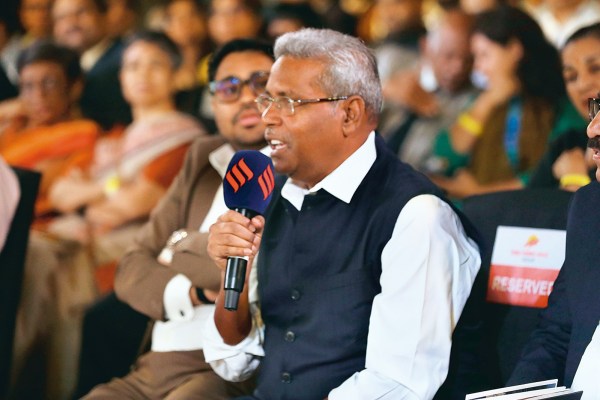 Munagala Mohan
Munagala Mohan
Shyam Prasad, Chairman and Managing Director, Tenali Double Horse group
Middle-class families in Andhra Pradesh struggle to afford education for their children. What is your vision for them?
we should build an ecosystem like the Nordic countries, where everyone is happy to send their children to government schools. I want that a day should come when government schools have to say, ‘Sorry, admissions are full.’ We are already seeing signs of that. In my own constituency, a parent asked me for a recommendation to get her child into a government school. I told her I couldn’t interfere because the headmistress had introduced an entrance test. That kind of demand is possible only when people trust the system. Infrastructure matters, but hardware without software is useless. The operating system of a school is its teachers. We have focused on restoring teachers’ pride and confidence. We are among the few states with a Teacher Transfer Act that eliminates political interference in transfers.
We also celebrated government-school students who performed well. They were given a front-page newspaper advertisement without photos of the CM or any politician. Students themselves became ambassadors for their schools.
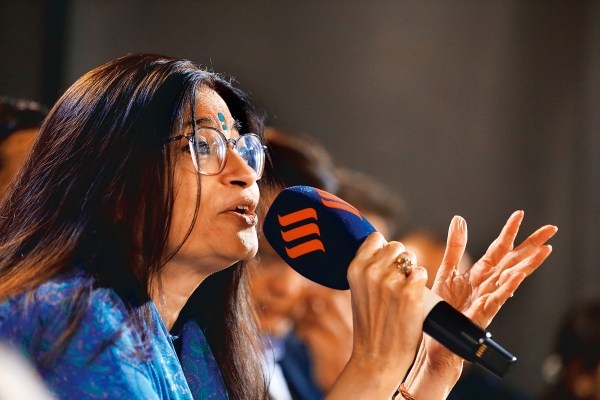 Ananya Mukherjee
Ananya Mukherjee
Vice Chancellor, Shiv Nadar Institute of Eminence
Beyond attracting universities, what are the qualitative changes you are focusing on to better higher education in the State?
My focus is on research. We have adopted a model, where each cluster focuses on a specific sector — glass, space, drones, medical devices, quantum technologies and more. We have around 20-22 such clusters. We are now connecting higher education institutions with industry. Companies are setting up labs, centres of excellence, rapid prototyping and research facilities, funding academic chairs and working directly with universities. That’s how we strengthen higher education. The second is governance. We now have a Commissioner of Higher Education to handle administration, allowing vice-chancellors to focus on academics. We are introducing courses in quantum computing, AI, data science, medical devices and material sciences. As new industries come up, universities must evolve. The key is integration between universities, industry and government so that education aligns with future opportunities.We are also using technology to improve outcomes. Vocational education is also a priority.
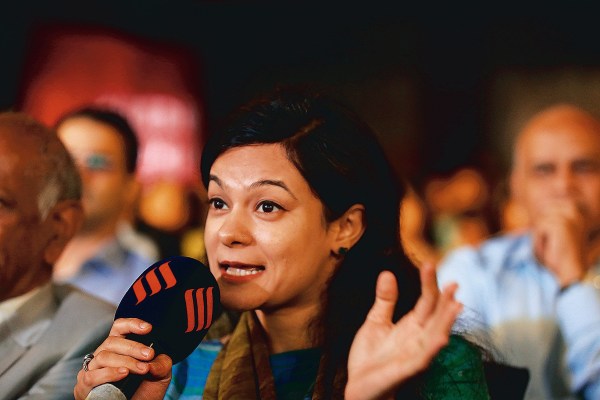 Shikha Salaria
Shikha Salaria
Journalist, New India Abroad
You compared power consumption of data centres with thermal plants but they also produce electricity. Isn’t comparing consumption with production unfair?
You’re saying it is acceptable to have 1 GW of thermal power capacity, but not 1 GW of data-centre capacity. A thermal plant uses roughly seven times more water than a data centre and emits carbon, whereas our data centres will run on renewable energy. Technology is also evolving. Air-cooled data centres can dramatically reduce water use, and energy efficiency is improving every year. If we are going to reject data centres because they consume power, then we should also stop using AI tools or even our mobile phones. Interestingly, nobody questions data centres in Hyderabad, Chennai, Navi Mumbai or NCR. Yet, there seems to be a campaign specifically against investments in Vizag. More broadly, data sovereignty will become one of India’s biggest strategic challenges. Countries are already restricting access to advanced AI models. If India doesn’t build compute capacity, cable landing stations, renewable power and server manufacturing domestically, we will become dependent on others. Imagine, if one day India could no longer access ChatGPT or Gemini. That’s why this is a strategic priority for both the Centre and the state. Our policy caps data-centre capacity at 6 GW because that’s the right balance. Unlike the US, where many data centres rely on gas-fired power, we are using solar, wind, pumped-storage and battery storage through a unified national grid. That’s what makes our approach fundamentally different.
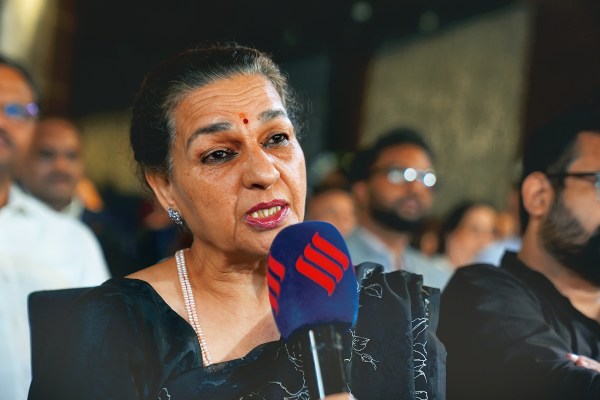 Poonam Dabas
Poonam Dabas
Founding Trustee, Centre for Media & Strategic Studies
What are the jobs you are creating? Also, we have long spoken about India’s demographic bulge becoming a demographic dividend. What has changed?
After bifurcation, we became a long coastal state with India’s second-longest coastline, so we are building a port-led economy. We have identified 22 industrial clusters, focusing on sectors such as shipbuilding, data centres, horticulture, aquaculture, quantum technologies, electronics and manufacturing. The investments we have signed are expected to generate around 25 lakh jobs over the next five to eight years. So far, we have created about 5.3-5.4 lakh jobs. Manufacturing is a major driver. Andhra Pradesh already produces 60 per cent of India’s air conditioners, and we expect that to rise to 85 per cent by 2028. We are also attracting investments in wafer manufacturing, automotive, EV batteries and steel. On the services side, companies like Cognizant have already created around 3,000 jobs, while Infosys is expanding in Visakhapatnam. Agriculture remains another major focus through horticulture, sustainable aquaculture and zero-budget natural farming. On the demographic dividend, we shouldn’t look at India as one homogeneous economy. There is one India with incomes comparable to middle-income countries, another that’s highly aspirational, and nearly a billion people still living on less than $1,000 per capita. That’s the real challenge. Our response is targeted intervention through the P4 mission — a public-private-people partnership that helps families break out of intergenerational poverty.