Prateek Tanmay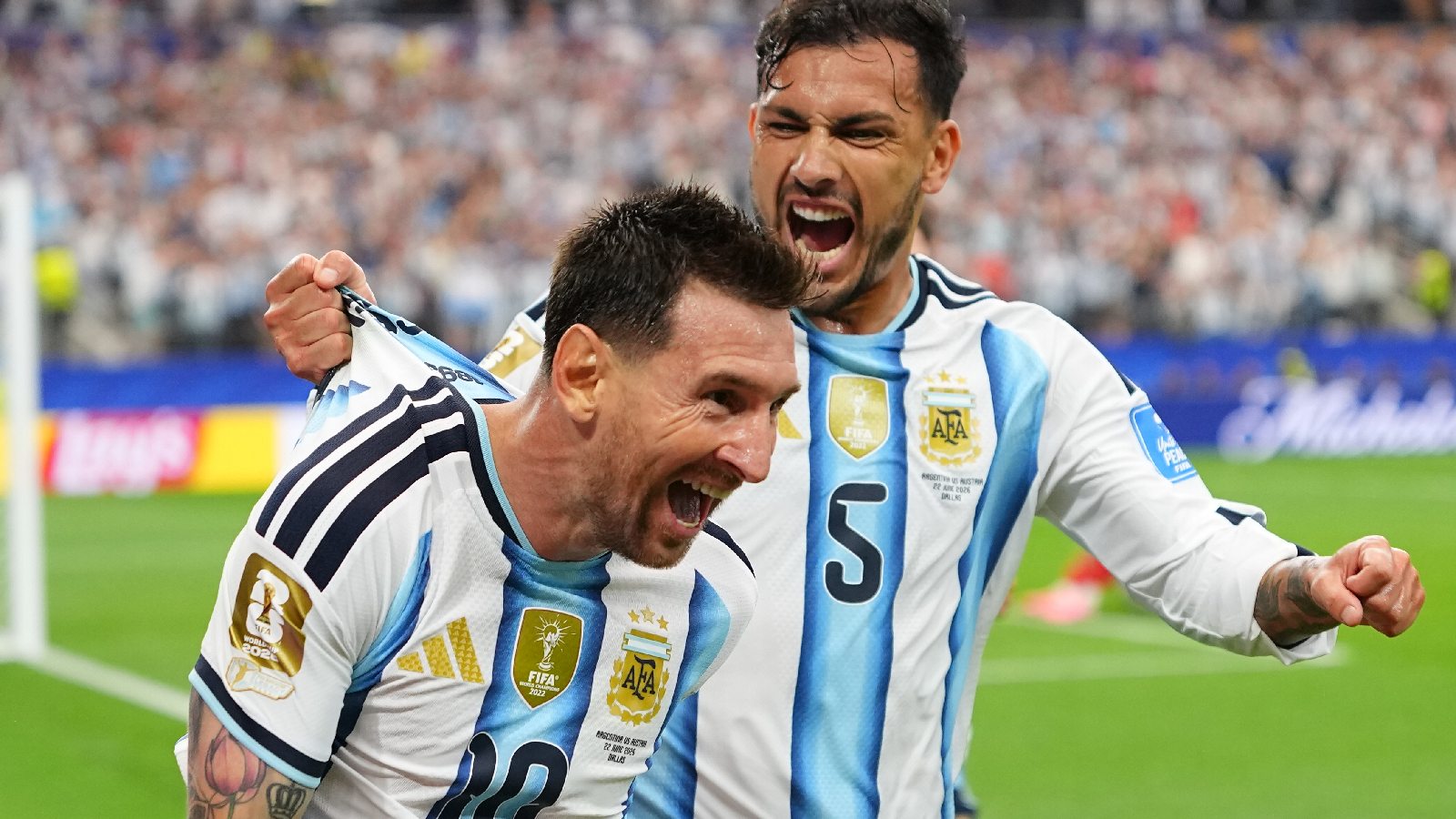
Before the match, the giant screen at Dallas Stadium showed all 16 of Lionel Messi’s previous World Cup goals one by one. The crowd cheered each one. By the time the last appeared, the stadium was already his. Two more followed. They always do.
In the ninth minute, Messi walked up to a penalty spot and missed. Not by much. He tried to curl it against the post. Schlager dived, guessed right, but the ball passed a few centimetres wide without him needing to touch it. Messi covered his face with both palms, looked up at the Texas sky, and walked back. An Austrian fan in the stand had painted MESSI WHO? on his stomach. It felt, briefly, like a reasonable question.

Twenty-nine minutes later he answered it.
Almada released Medina down the left. Medina cut the ball back. Almada, reading something only he and Messi knew, let it run through without touching it. And Messi, who had been walking — as he does, as he always does, conserving something the rest of us cannot name — suddenly was not walking. He broke into the box at full speed, arrived at the near post before any Austrian defender could react, and placed the ball to the right of Alexander Schlager with his left foot. First time. Bottom corner. Seventeen World Cup goals. Thirty seconds. One touch. Miroslav Klose’s record, held since a July night in Belo Horizonte in 2014, was gone.
The penalty miss made the goal necessary. Without the ninth minute, the 38th minute is just another Messi goal. With it, the story has a shape: the miss, the resistance, the wait, and then the moment arriving not from the penalty spot but from open play, from instinct, from a run that began in his own half and ended at the near post.
Austria had earned their reprieve and used it well. It was Messi’s third missed penalty at a World Cup. They knew it, and pressed. Ralf Rangnick’s side pushed David Alaba forward from defence and found dangerous areas through Marcel Sabitzer and Konrad Laimer. Before the first goal, Alaba had blocked a Messi shot virtually on the line. Their xG at half time was 0.24, against Argentina’s 1.05. The pressure was real. The threat was not.
The second half was functional rather than dramatic. Argentina sat deep when needed, pressing when they saw the chance. Scaloni used his bench methodically — Romero off at 57, Lautaro and Almada replaced by Alvarez and Gonzalez at 64. Rangnick threw everything at it: a triple substitution at 67, Arnautovic on to chase the equaliser, Chukwuemeka introduced at 85. Austria’s best chance fell to Gregoritsch — Sabitzer crossing from the left, the striker heading over under pressure from Medina — but it came before Rangnick’s changes, not after. Arnautovic never got his moment.
Then, in the fifth minute of stoppage time, a stray ball fell to Messi on the right flank from a failed Austrian counter. He sprayed it left to Alvarez, whose shot Schlager saved. The ball came back to Messi. First effort blocked. Second shot driven into the centre of the goal. 2-0. Eighteen World Cup goals. Two clear of Klose. Every single Argentina goal at this tournament, all five of them, scored by one man.
Story continues below this ad
He even had time to curl a free kick just wide in search of a third. That would have been something else.
With his first goal Messi had joined Just Fontaine and Jairzinho as the only players to score in six consecutive World Cup matches. With his second he simply kept going.
Before the tournament, asked about the record he had held for twelve years, Miroslav Klose had said only that it was always going to fall to someone, and that he was glad, if it had to be anyone, that it might be Messi. The record fell in the 38th minute. Then Messi scored again in the 95th. Klose had been generous about it in advance.
Messi hugged his teammates. Then he hugged the opposition. Argentina are through to the knockout rounds. Their 38-year-old captain has 18 World Cup goals, is still walking, still conserving, still finding a way.