Prateek Tanmay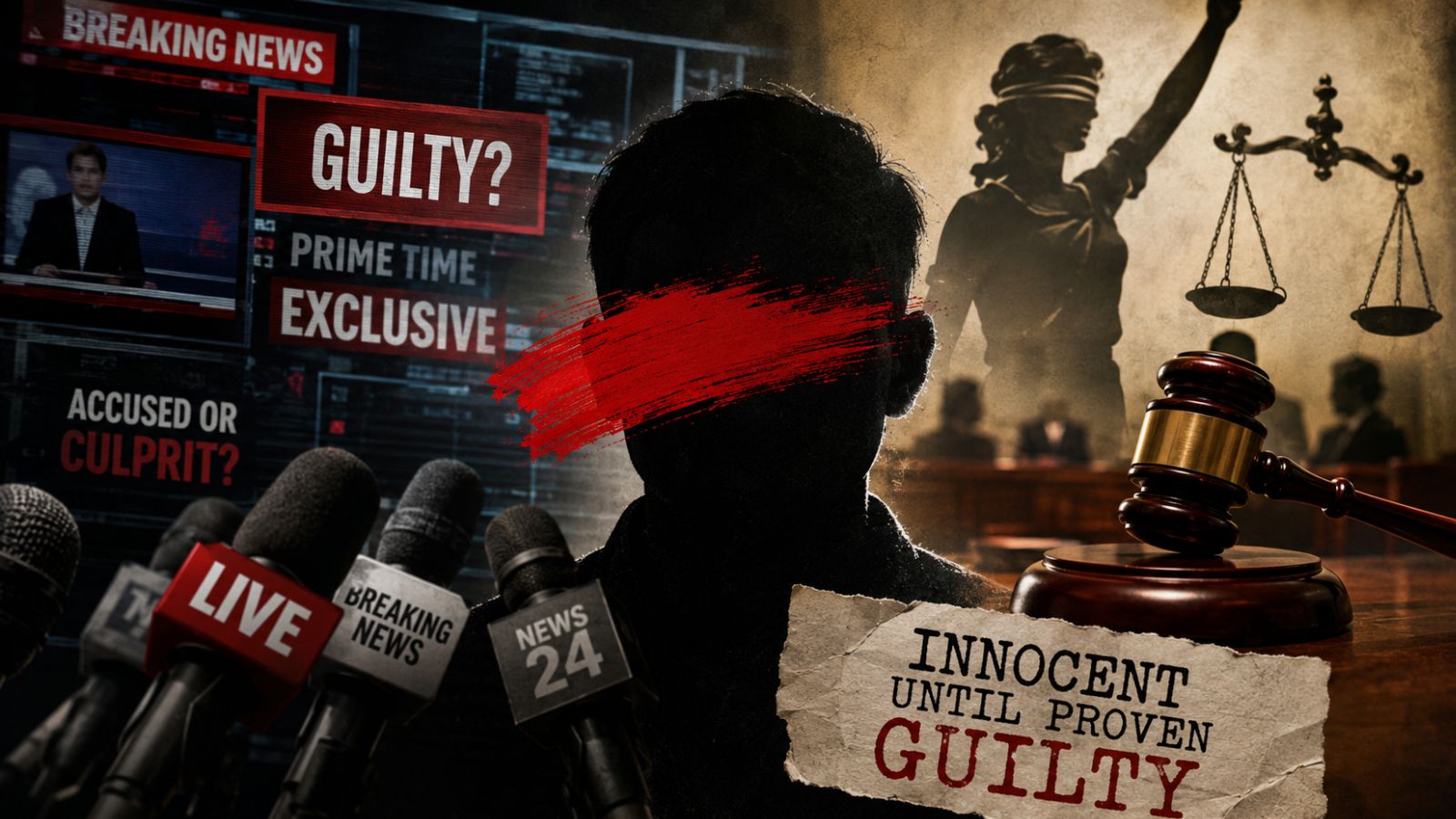
6 min readNew DelhiUpdated: Jul 25, 2026 04:43 PM IST
Written by Yash Giri

In a courtroom, guilt must be proven. On television, however, it often arrives with the opening headline. Long before evidence is tested, witnesses are examined, or a judge delivers a verdict, public opinion may already have convicted the accused.
In India, television and digital news reaches every household regularly, consequently making it the fourth pillar of democracy. It is the eyes and ears through which the public watches the functioning of the courts, police as well as the government. The line between the media being a watchdog for society and becoming an adjudicator is often crossed, particularly in recent years. News channels have had the power to influence public opinion for decades. A responsible media can shape public opinion by just running its 9 AM primetime.
When an accused person is named and is discussed at length on prime-time television, it not only damages their image but their family’s reputation often suffers even before the verdict is delivered. This is not just a matter of hurt feelings, it strikes at one of the foundational principles of criminal law: every accused person is presumed innocent until proven guilty. This presumption is often inverted by the media, portraying suspects as criminals from the very first line.
The consequences then ripple outwards. Investigations are compromised when media narratives leak details, contaminate evidence, or pressure the police into premature conclusions.
When narrative overtakes evidence
The judicial process is built on the careful weighing of evidence. What evidence can be admitted and relied upon is determined by the court. Media trials, however, often substitute evidence with narrative.
When authorities feel that news coverage has “solved” a case ahead of them, the pressure to match the media narrative can compromise the integrity of a genuine investigation. As the Supreme Court noted in Harijai Singh v. Vijay Kumar (1996), no individual or institution outside the judiciary can assume the role of an investigator.
Story continues below this ad
India is not new to the debate over how media trials can destroy both a case and the life of an accused person. In Sahara India Real Estate Corporation Ltd. v. SEBI (2012), the Supreme Court acknowledged the media’s right to report on court proceedings, since this transparency builds public confidence in the justice system. At the same time, it recognised that unrestricted reporting may sometimes require restraint to protect the fairness of ongoing proceedings.
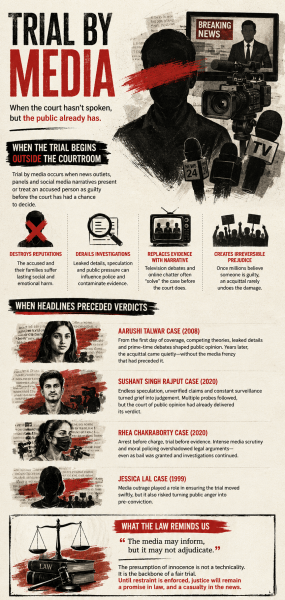 When narrative overtakes evidence (Infographic generated by AI)
Where the law draws the line
In State of Maharashtra v. Rajendra Jawanmal Gandhi, the Court was more direct, describing trial by press, electronic media, or public agitation as antithetical to the rule of law because such coverage tends to influence judges and prejudice the right to a fair trial. Similarly, in R. Rajagopal v. State of Tamil Nadu—the well-known “Auto Shankar” case—the Court held that the right to privacy protects an individual’s family life and personal matters from publication unless the information comes from public records, drawing a clear line between legitimate public-interest reporting and an unwarranted invasion of privacy.
The Press Council of India has echoed these concerns through its Norms of Journalistic Conduct, urging restraint from sensationalism, while the Kerala High Court has recently reiterated that the press, though entitled to freedom of speech, cannot assume the role of a court under the guise of that freedom. As the case of Indian Express Newspapers v. Union of India (1985) established decades earlier, the freedom of the press in India has never been absolute.
The core tension, then, is not whether media should cover criminal cases, but how that coverage is conducted. Reporting that informs the public without pre-judging outcomes serves democracy well; it is the “eyes and ears” role this paper opened with. But reporting driven by television ratings, viral engagement, or a commercial hunger for the “breaking story” tends to sacrifice the rights of the accused, the integrity of investigations, and ultimately public trust in both media and the judiciary.
Story continues below this ad
What emerges from this body of case law is not confusion but consensus. From Harijai Singh’s insistence that investigation remains the exclusive domain of the judiciary, to Rajendra Jawanmal Gandhi’s explicit warning against trial by press, to R. Rajagopal’s protection of private life from unwarranted publication, the judiciary has consistently drawn the same line: the media may inform, but it may not adjudicate. And yet this line is redrawn, violated, and redrawn again with every high-profile case that dominates a news cycle. The gap is not one of legal clarity but of enforcement.
This is what makes the problem urgent rather than merely academic. Every time a suspect’s name and face are broadcast as settled fact before a chargesheet is filed, the presumption of innocence is not just weakened in theory, it is inverted in practice before an audience of millions, in real time. Unlike a wrongful conviction, which can at least in principle be appealed and overturned, a media-constructed guilt is rarely undone. An acquittal, when it comes, seldom receives the reach or urgency of the original headline.
Until restraint becomes enforceable rather than aspirational, the presumption of innocence will remain, for many accused, not merely a legal principle, but a constitutional promise contradicted nightly by the very institution meant to safeguard public trust in the rule of law.
(The author is an advocate at the Supreme Court)