Prateek Tanmay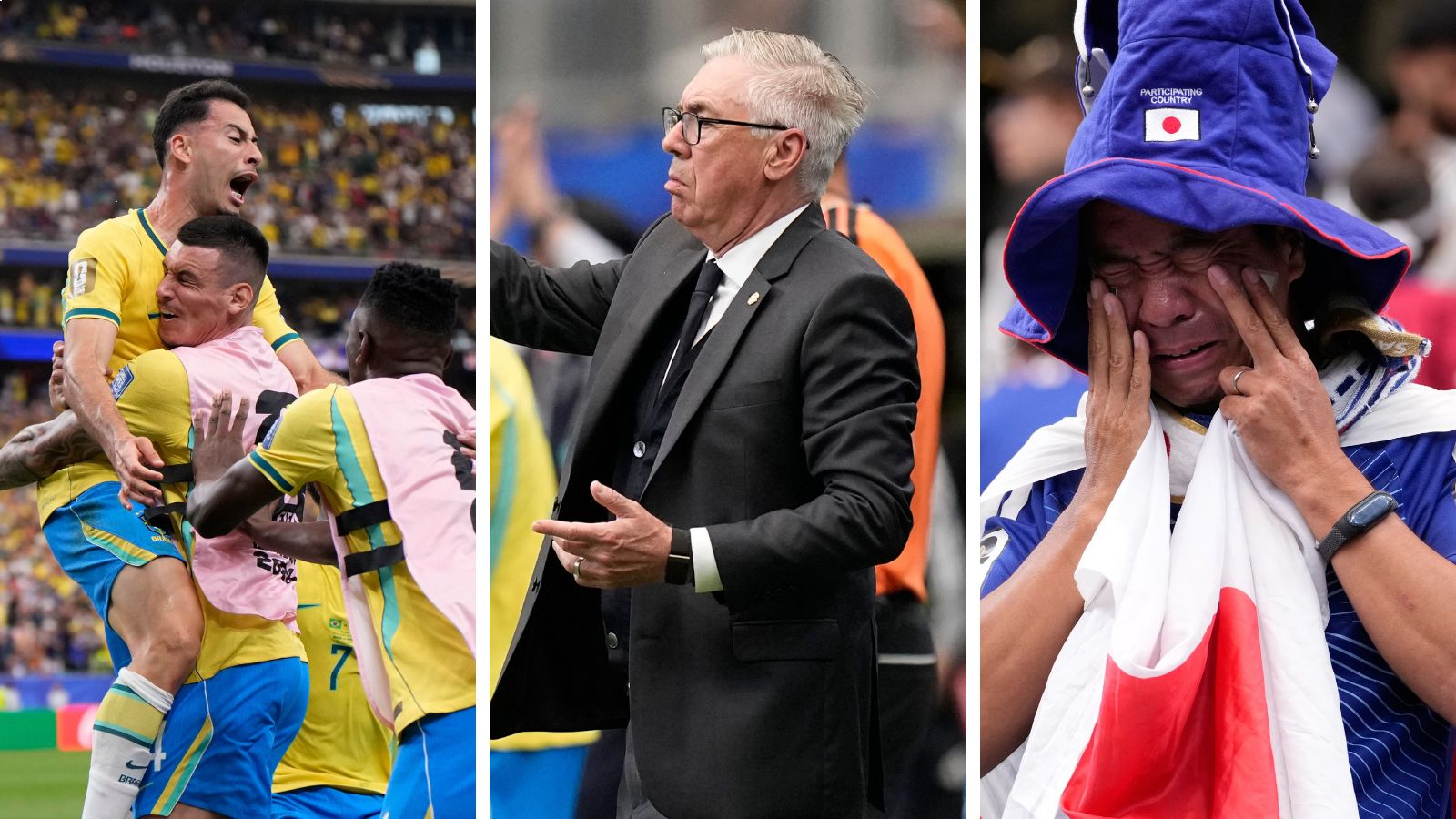
Nearly 70,000 people filled the stadium in Houston. Most were in euphoric delirium, some distraught. The moment demanded it. Brazil had scored the latest goal in regulation time of a World Cup knockout game, and the seemingly inevitable embarrassment of an early exit had been averted. Gabriel Martinelli, the substitute who had scored it, was mobbed. Players. Coaches. Support staff. Photographers. Amid all of them, Carlo Ancelotti. Stoic. Impassive. Calm.
Around him, football dissolved into chaos. Carlo Ancelotti, as ever, refused to join it.
Behind the stolid facade, though, lay relief. It had worked again, as it so often does. Substitutes Martinelli and Endrick both played decisive roles in the 95th-minute winner as Brazil overturned a first-half deficit to beat Japan 2-1. The second-half performance contrasted as sharply with the first as Ancelotti’s reaction did with those around him after the final whistle, and the difference came down to one thing: Ancelotti admitting a mistake, mid-tournament, in public, and reverting to default before it cost his team the World Cup.
ALSO READ | Orlando Gill: The goalkeeper who sold his clothes, then stopped Germany
Kaishu Sano had put Japan ahead in the 29th minute, ghosting past Casemiro after a loose Danilo pass and driving a low finish past Alisson from 20 yards. Brazil had not won a World Cup knockout game after trailing since they lifted the trophy in 2002. Despite enjoying 68 per cent possession in the first half, Brazil tested goalkeeper Zion Suzuki only twice, both from distance. Three hundred and thirty-three passes yielded just 0.35 expected goals. Something had to give.
The mistake was Vinicius Junior. Brazil’s leading goal-scorer had an underwhelming campaign opener, deployed against one of the best right-backs currently active, Achraf Hakimi, and rendered anonymous save for one moment of brilliance. Before the match against Haiti, Ancelotti had asked him to play centrally. Vinicius resisted initially before relenting. A goal and an assist followed, along with an admission. “I need to listen to him more. He will tell me now that he knows a lot about football.”
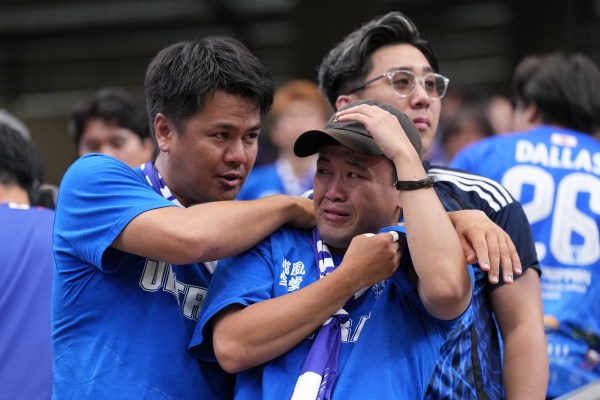 Japanese fan cries after the World Cup round of 32 match between Brazil and Japan in Houston. (AP Photo/Karen Warren)
Against Japan, the same instruction failed. A centrally stationed Vinicius was impotent against a mid-block built to swallow him, Brazil’s sluggish midfield unable to match the relentless industry of Sano and Daichi Kamada. Japan’s structural discipline made the central corridor almost impenetrable. Ancelotti watched it happen for 45 minutes and changed it.
Story continues below this ad
Barely any manager in history has a résumé as illustrious as Ancelotti’s. Seven Champions League titles. All of Europe’s top five leagues. Yet he insists there is no such thing as the Ancelotti style of football. He yearns to be boundless. “To have only one identity of your team is a limit.” That boundlessness, at half-time in Houston, meant correcting himself.
The flanks were where football is often reduced to individual duels, and that was where Japan’s discipline broke down. Vinicius hugged the left after the break. His involvement increased, 40 touches in the second half, as opposed to 22 in the first, and with it, Brazil’s threat in attack.
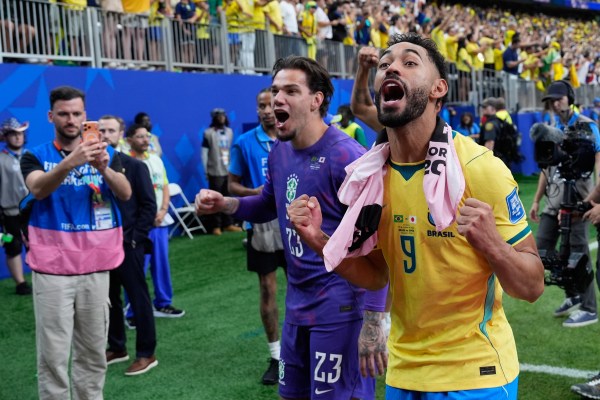 Brazil’s Matheus Cunha (9) celebrates after the World Cup round of 32 match between Brazil and Japan in Houston, Monday. (AP Photo/David J. Phillip)
Ancelotti had another lever to pull. Japan’s aggressive press is built around one of their three centre-backs advancing down the pitch, the feasibility of which depends on the number of opposition strikers. With Matheus Cunha isolated in the first half, the trio of Takehiro Tomiyasu, Shogo Taniguchi and Hiroki Ito breathed easy. Endrick was the antidote. Operating as a shadow striker, he pinned the back three into place.
ALSO READ | Gabriel Martinelli is Brazil’s saviour as last-gasp goal breaks Japanese hearts
Story continues below this ad
With Vinicius and Rayan winning their 1-v-1s comfortably, Ancelotti banked on crosses and second-wave runs into the box by midfielders. It was a targeted response to Japan’s one obvious weakness, aerial duels. They had won fewer than half their aerial duels against the Netherlands and Sweden. The vulnerability was exploited again, by an inundation of crosses. One nearly earned Brazil the equalizer, a Tomiyasu clearance hacked off the line. Two minutes later, Casemiro, who has scored more headed goals than anyone in the Premier League this season, rose highest to meet a Gabriel Magalhaes delivery. 1-1, in the 56th minute.
Martinelli, though a winger by trade, was deployed primarily as an attacking midfielder to flood the penalty area. That he was in the right place to receive Guimaraes’ pass for the winner was not fortuitous. Every adjustment Ancelotti made after that mistake at half-time, Vinicius’ position, Casemiro’s late runs, the substitutions, shifted the game in Brazil’s favour.
Ancelotti learned to embrace change the hard way. He stymied Parma’s move to sign Italian icon Roberto Baggio in 1997. Baggio had asked to play as a number 10. “I don’t play number 10s,” Ancelotti told him. Baggio joined Bologna instead and scored 23 goals in 33 games. Never again, said Ancelotti.
Ahead of his fifth Champions League final, Ancelotti had said: “Football has changed, but I adapt to the changes because I have a passion for this sport.”
Football is grateful that he does.