Prateek Tanmay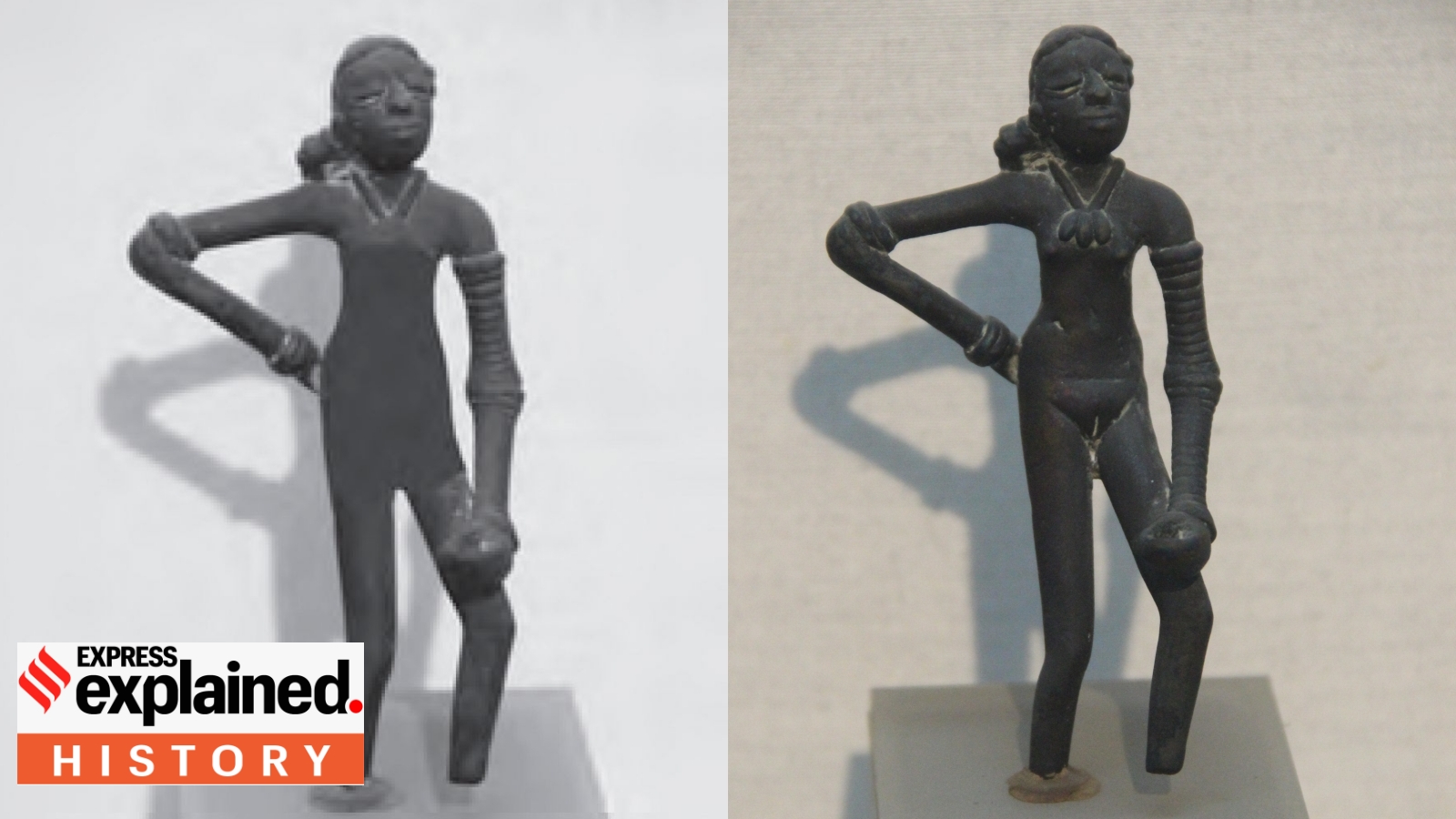
This was not the first time an attempt had been made to cover up the Harappan-era bronze figurine. In 2023, a fully clothed “contemporized version” of the ‘Dancing Girl’ was unveiled as the mascot of the International Museum Expo.
The story of “vulgarity” being attached to the bronze statue found at Mohenjo-daro, however, dates back several decades. It is largely associated with archaeologist John Marshall choosing to interpret it as the image of a “nautch girl” or “dancing girl” — an act some scholars believe was done without compelling evidence.
Competing claims
The government of Pakistan also had similar reservations when it was trying to acquire Harappan artefacts from India in the 1950s, arguing that Mohenjo-daro and Harappa were both in Pakistan. India, however, contended that the legacy of the Harappan civilisation belonged to South Asia and not Pakistan alone.
An academic paper by Panjab University historian Ashish Kumar, Sahib’s Nautch Girl, brings out interesting details. Around 12,000 Harappan objects from Mohenjo-daro were in Delhi when Partition took place. These had been brought to the capital from the Lahore Museum by Mortimer Wheeler, who was Director General of the Archeological Survey of India between 1944 and 1948, for an exhibition.
“Owing to partition, almost all of the Harappan sites including Mohenjodaro and Harappa went to Pakistan leaving with India only two minor sites (Rangpur in Gujarat and KotlaNihang Khan in East Punjab) of the first urban civilization of the Indian subcontinent,” Kumar writes. “Since the Harappan artifacts had been found in the territory of Pakistan at Mohenjodaro, the Pakistani officials demanded all these artifacts back from India. But the Indian officials refused to entertain this demand and put forth an equal claim over the Harappan civilization.”
Finally, India and Pakistan agreed to a 50:50 division of the Harappan artifacts “found at Mohenjodaro and Chanhu-daro with the help of Mortimer Wheeler”.
Story continues below this ad
While Pakistan wanted both the “Dancing Girl” and the “Priest King”, India was willing to hand over just one of the two.
“The Pakistani officials chose the priest king to avoid any backlash at home that a figure of a naked teenager could have invoked from religious quarters,” Kumar writes. “Here the ‘nudity’ of a teenager girl impacted the decision of the Pakistani officials, who considered its sexuality as a threat to their moral beliefs.”
However, the clamour to acquire the “dancing girl” statue continued in Pakistan till recently too. In 2016, a writ petition by barrister Javed Iqbal Jaffrey in the Lahore High Court sought directions to the Pakistan government “to bring back the famous ‘Dancing girl’ bronze statue from India”, Kumar states.
“Since this bronze girl statue had been discovered from Mohenjo-daro in 1926, Pakistan was held to be the real owner of this five thousand years old Harappan artifact. In Jaffrey’s words, this statue retains the same historic significance for Pakistan that Leonardo da Vinci’s Mona Lisa in Europe has,” the paper goes on. “The same views are endorsed by Jamal Shah (director general of the Pakistan National Museum of Arts), Qasim Ali Qasim (director of the provincial archaeology department), and several others in Pakistan. In response to this Pakistani claim, Vasant Shinde (then Vice-chancellor of Deccan College, Pune) questioned Pakistan’s exclusive claim over the Harappan civilization… since this civilization was considered a common heritage of South Asia.”
“Nautch girl”
Story continues below this ad
Significantly, even the identification of the statue as that of a dancing girl by John Marshall is contested. Marshall wrote about the statue: “The only other sculpture in the round from Mohenjo-daro that claims notice here is the bronze dancing-girl… This is a small figurine of rather rough workmanship with disproportionately long arms and legs. Almost, indeed, it is a caricature, but, like a good caricature, it gives a vivid impression of the young aboriginal nautch girl, her hand on hip in half-impudent posture, and legs slightly forward, as she beats time to the music with her feet.”
He added: “Small, too, as this figurine is, the modeling of the back, hips, and buttocks is quite effective, and in spite of obvious defects shows sound observation on the part of the artist.”
However, Gregory L Possehl, in his book The Indus Civilisation, expressed doubt whether the statue represents a female dancer. Historian Upinder Singh also said in A History of Ancient and Early Medieval India: “The dancing girl may not have been dancing at all, and even if she was, she may not represent a professional dancer.”
Ashish Kumar also says that there is no evidence to suggest that she was a dancer. The fact that colonial officials, who stayed in India alone, would often find comfort in the company of nautch girls, may have led to the instant association, he says. Marshall also associated the bronze statue with the devdasi tradition, thus suggesting continuity from Harappan times to recent times.
Story continues below this ad
Significantly, while many nude terracotta representations of the female body were found from Harappan sites, these were identified as a marker of the Mother Goddess cult, while the bronze statue was identified as a nautch girl.
The colonial value system also found nudity in art as “immoral” and “vulgar”, and thus looked at Indian art as morally deficient. It also held the Greek and Roman art as refined art as it captured the anatomy more “accurately”, and saw Indian representations with multiple heads or limbs as “irrational” and “unreasonable” — something that went well with their belief that the west is more civilised and superior to the “natives”.