Prateek Tanmay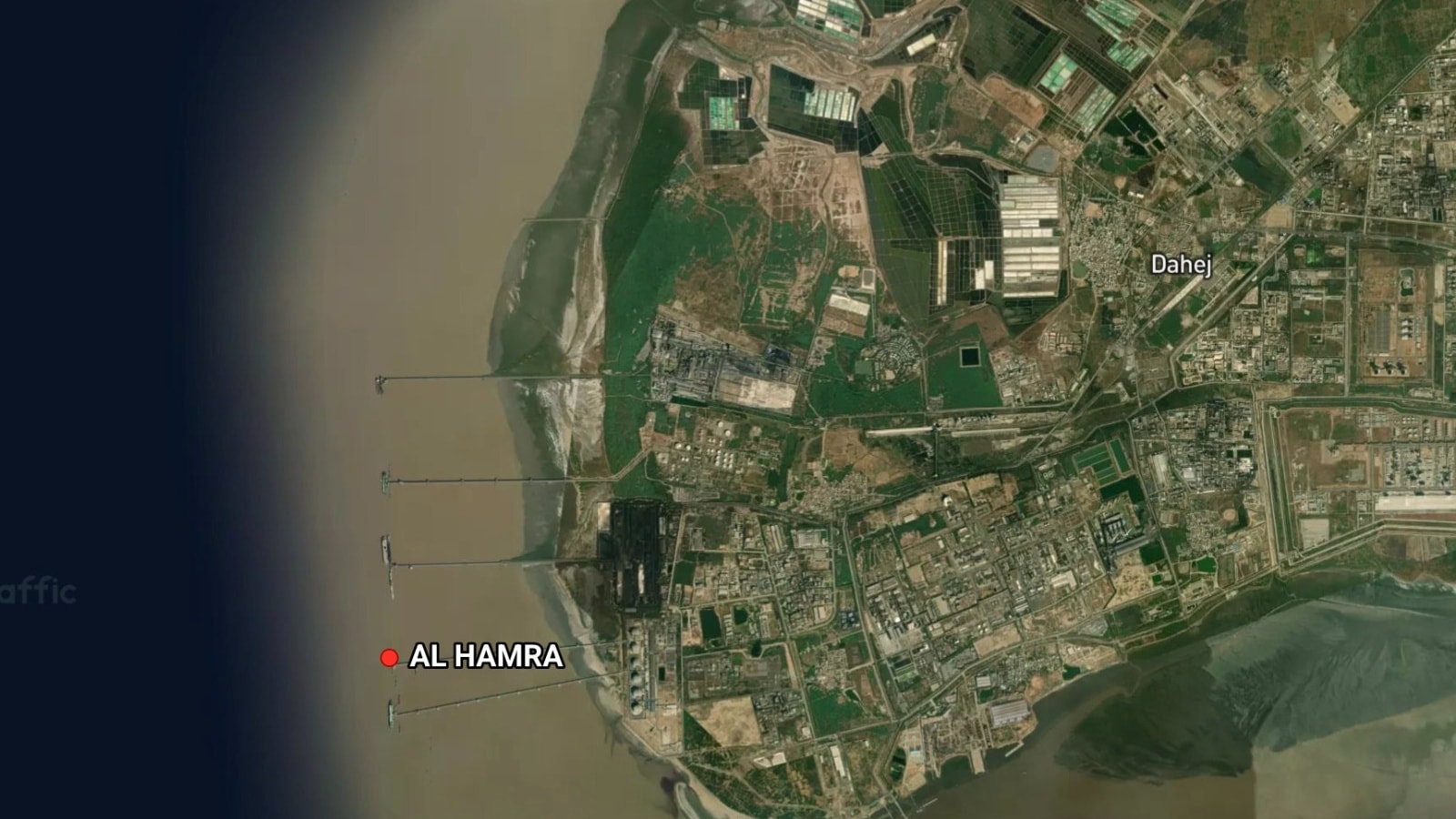
A liquefied natural gas (LNG) tanker that crossed the Strait of Hormuz over the weekend arrived at Gujarat’s Dahej on Tuesday, marking the first LNG cargo to reach India from the Persian Gulf in over two-and-a-half months of the strait’s effective closure due to the West Asia war, ship tracking data shows.
The Liberia-flagged tanker Al Hamra, carrying about 62,000 tonnes of LNG from Abu Dhabi National Oil Company’s (ADNOC) Das Island export facility in the Persian Gulf will be discharging its cargo at Petronet LNG’s Dahej terminal, the largest LNG import terminal in India. As of 2 pm Tuesday, the tanker was stationed at one of the LNG discharge jetties of the Dahej terminal, according to data and visuals from ship tracking and maritime intelligence firm MarineTraffic.

As per trade sources, the cargo belongs to government-owned gas major GAIL. The tanker is owned and operated by an ADNOC arm—ADNOC Logistics and Services—as per global shipping databases. While the cargo is equivalent to about a day’s worth of India’s LNG imports, Al Hamra’s arrival has built hopes of more LNG supplies coming to India from the Persian Gulf, which lies to the west of the Strait of Hormuz.
Trade sources indicated that Al Hamra was not transmitting its location for days by turning off its transponder. In shipping parlance, this behaviour is referred to as “going dark” and is used by vessels to avoid detection. Many of the vessels that have successfully crossed the Strait of Hormuz since early March have done so by going dark for varying periods, with only a few transmitting their location while passing through the chokepoint.
According to commodity market analytics firm Kpler, Al Hamra is one of three LNG tankers that crossed the critical maritime chokepoint over the weekend despite elevated geopolitical risk. The other two tankers—Fuwairit and Al Rayyan—carried QatarEnergy cargoes bound for Pakistan and China, respectively.
In the nearly three months of the West Asia conflict, which began with US-Israeli strikes on Iran, only seven vessels laden with LNG are estimated to have transited the fraught waters of the Strait of Hormuz. While about one-and-a-half dozen liquefied petroleum gas (LPG) and oil tankers have made their way to India from the Persian Gulf since early March, Al Hamra is the first LNG tanker to have arrived from there. New Delhi has been engaged with Tehran to get safe passage for India-bound vessels, particularly energy cargoes.
Vessel movements through the Strait of Hormuz—the narrow waterway between Iran and Oman that connects the Persian Gulf with the Gulf of Oman and the Arabian Sea—are all but halted due the West Asia conflict. The Strait is a major chokepoint for global energy flows, accounting for a fifth of international oil and LNG shipments.
Story continues below this ad
India depends on LNG imports to meet about half of its natural gas requirement, and about 60% of those imports came through the strait, primarily from Qatar and the UAE. The two Gulf countries are major LNG exporters at the global level as well. With hardly any LNG cargoes from the Persian Gulf making their way to India, importers have been scrambling for LNG from alternative geographies amid a global price surge.
India’s LNG imports rebounded a bit in April after faltering in March, as importers turned to suppliers that don’t depend on the Strait of Hormuz to secure emergency spot cargoes. As a result, while not one LNG cargo reached Indian shores in March from the country’s largest supplier Qatar and another major supplier, the UAE, the likes of Oman, Nigeria, Angola, and the United States (US) stepped in to partially bridge the gap.
According to Kpler data, LNG imports in April were 1.95 million tonnes, up from 1.67 million tonnes in March. The country’s 2025 average monthly LNG imports stood at 2.08 million tonnes. On a year-on-year basis, April LNG imports were down 9.3% from 2.15 million tonnes in the year-ago period, which reflects that the supply shock was not fully offset and market conditions remained tight.
In 2025, the average monthly LNG import volumes from Qatar stood at 0.95 million tonnes, followed by imports from the UAE at 0.27 million tonnes. In March-April, the Strait of Hormuz closure meant that just 0.06 million tonnes came from Qatar and 0.13 from the UAE during the two months. These were cargoes that had transited the strait before the West Asia war broke out.
Story continues below this ad
Supplies from Oman, which was the fourth largest supplier of LNG to India in 2025 with an average monthly flow of 0.18 million tonnes, jumped to 1.2 million in March-April, or 0.6 million tonnes a month on average. While Oman is located in West Asia, it has a sizable coastline facing the Arabian Sea and the Gulf of Oman, and doesn’t depend on the Strait of Hormuz for the transit of its cargoes.
Imports from the US, India’s third-largest LNG supplier in 2025, rose to 0.31 million tonnes a month on average in March-April. The average monthly LNG imports from the US in 2025 were at 0.24 million tonnes. Average monthly imports from Nigeria and Angola jumped to 0.41 million tonnes and 0.24 million tonnes in March-April, respectively; the monthly average of imports from the two suppliers in 2025 was 0.14 million tonnes apiece.
The month-over-month growth in LNG imports in April over March was likely due to higher gas use in a few sectors, particularly fertilisers. Following the disruption in LNG supplies due to Strait of Hormuz closure, the government had initially reduced gas allocation to the fertiliser sector to 70% of average consumption over the previous six months. It was part of a larger effort to manage natural gas supplies in order to prioritise the most critical sectors.
But by early April, the allocation to the fertilisers sector was hiked to about 95%, and earlier in May, it was hiked further to about 98%. This has been done to ensure uninterrupted urea production ahead of the crucial Kharif season.