Prateek Tanmay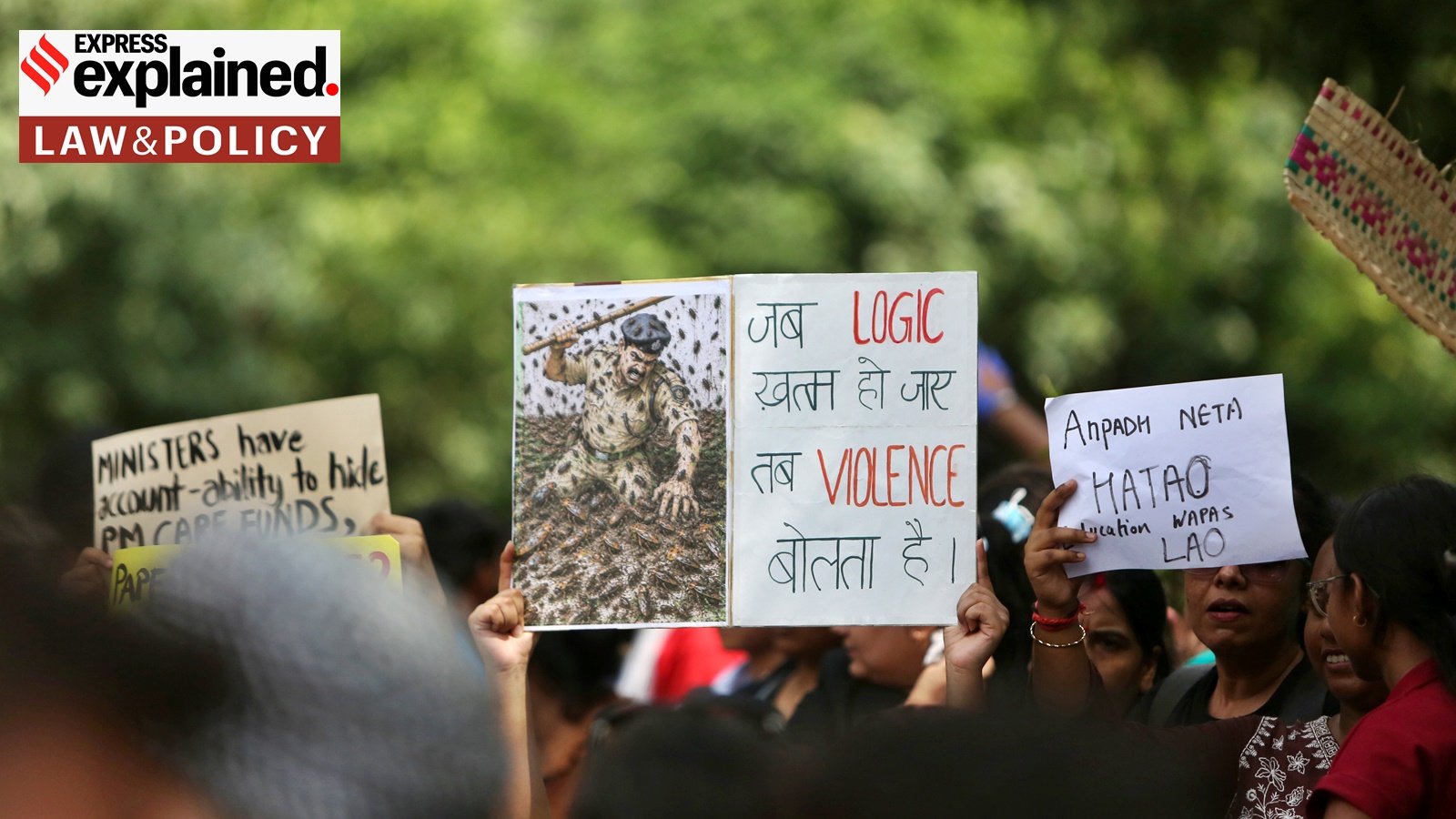
On Wednesday (July 29), Noida Police registered a Zero FIR against a 25-year-old woman, Ruchika Singh, over remarks made about Prime Minister Narendra Modi during a protest at Delhi’s Jantar Mantar. The FIR invokes Sections 352, 353(1) and 356(1) of the Bharatiya Nyaya Sanhita (BNS) — covering insult, public mischief and defamation.
The case has triggered a public debate, veering into moralistic notions about profanity, especially against public leaders. Is crude language a crime in India?

Obscenity as an offence
The provision most commonly reached for in such disputes is Section 296 of the BNS (Section 294 of the Indian Penal Code). It punishes “whoever, to the annoyance of others, (a) does any obscene act in any public place, or (b) sings, recites or utters any obscene song, ballad or words, in or near any public place” with up to three months in jail.
It is the default charge for loud, crude public behaviour. But “obscene” carries a precise legal meaning that courts have read narrowly.
The test for determining obscenity
The legal doctrine for defining obscenity in India was tested by the ban on DH Lawrence’s final novel, Lady Chatterley’s Lover, published in the 20th century. In the 1965 landmark ruling in Ranjit D. Udeshi v. State of Maharashtra, the Supreme Court upheld the book ban and the constitutionality of Section 292 of the IPC, which allows the “sale of obscene books”.
In doing so, the court also laid down the test for obscenity: an 1868 English rule called the Hicklin test. The test asked whether isolated passages of a work could corrupt the most vulnerable reader, and the court determined that Lady Chatterley’s Lover did that.
While even English law had moved on from this archaic notion of not offending the most vulnerable reader, courts in India applied this test for a few decades. In 2006, the SC opened a window in Doordarshan v Anand Patwardhan, where the state broadcaster had refused to air Patwardhan’s documentary Father, Son and Holy War over its adult censor certificate. The SC cleared the telecast, holding that obscenity must be judged by viewing a work as a whole, through the eyes of an average, healthy viewer and not by isolating scenes.
Story continues below this ad
The test changed significantly in 2014 with Aveek Sarkar v State of West Bengal, where the SC held that a nude photograph of tennis player Boris Becker and his fiancée was not obscene, and formally discarded Hicklin for a “community standards” test. This test stated that the allegedly problematic material is obscene only if it “tends to arouse sexual feelings, judged by an average person applying contemporary standards.”
“Only those sex-related materials which have a tendency of “exciting lustful thoughts” can be held to be obscene, but the obscenity has to be judged from the point of view of an average person, by applying contemporary community standards,” the court had said.
Legal scholar Gautam Bhatia has flagged a problem with the “community standards” language, which was borrowed from the American case Roth v United States (1957). He argued in a 2014 blog post that Roth prescribed a three-part test requiring community standards, patent offensiveness, and an absence of redeeming social value, but the SC adopted only the first prong. Bhatia termed this “worse than vague”, since the SC never explains why sexual arousal alone should be criminal, and risks letting majority sensibility decide what counts as decent in a deeply plural country.
Profanity or vulgarity as a crime
In 2024, TVF’s web series College Romance landed in legal trouble under the Information Technology Act over an expletive-heavy episode. Essentially, a ban was sought because the content was obscene. The SC, however, quashed the FIR, holding that vulgarity and profanity are not, by themselves, the same as obscenity.
Story continues below this ad
“While the literal meaning of the terms used may be sexual in nature and they may refer to sexual acts, their usage does not arouse sexual feelings or lust in any viewer of ordinary prudence and common sense. Rather, the common usage of these words is reflective of emotions of anger, rage, frustration, grief, or perhaps excitement,” the court had said.
Two other minor rulings this year, both by benches headed by Justice PS Narasimha applied the same logic to ordinary individuals. In Sivakumar v State (April 2026), the SC acquitted a man under Section 294 since calling someone a “bastard” during a heated argument did not meet the threshold for obscenity. Similarly, in Mani v State (July 2026), the court said: “Let’s be clear, legally, obscenity is not synonymous with vulgarity, abuse or profanity. Use of mere swear words, profanities and vulgar expletives, however distasteful or uncivil they may be, cannot be equated with obscenity.”
Court rulings on this issue frequently state that for an utterance to be considered obscene, it must be shown that it was lascivious. Lascivious is an adjective that means feeling, showing, or expressing a strong, often inappropriate desire for sex. Anything that falls short of that yardstick is likely not to be considered “obscene” in criminal law.
The Noida case
The sections actually cited in the zero FIR (insult, public mischief and defamation) sit in an entirely different chapter of the BNS, each with its own, narrower test. Section 352 requires proof that the accused intended, or knew it was likely, that the insult would provoke an actual breach of public peace and not simply that someone felt insulted.
Story continues below this ad
Public mischief under Section 253 is aimed at incitement: mutiny within the armed forces, fear likely to push people toward offences against the state, or enmity between communities. This is a considerably higher bar than sharp criticism of a leader. Defamation, too, carries long-standing exceptions for good-faith comment on a public figure’s conduct in their public role.
In September 2025, the Telangana High Court held that social media posts describing a political party as a “scourge” and a “pest” might be harsh, even nasty language, but cannot attract Sections 352 or 353 if there is no real threat to public order. The court said that at best it fell within the “limited ambit” of defamation, itself cushioned by constitutional protections for political speech.