Prateek Tanmay

Fertiliser subsidy burden set to double on global supply crunch
Syllabus:
Preliminary Examination: Economic and Social Development
Mains Examination: General Studies III: Issues related to direct and indirect farm subsidies
What’s the ongoing story: Rising global costs of fertilisers amid a supply crunch is likely to result in a subsidy burden of almost Rs 3.4 lakh crore, or an almost 100 per cent increase compared with the Budget estimate of Rs 1.7 lakh crore, according to top government sources.
Key Points to Ponder:
• What is fertiliser?
• What data and statistics tells about fertiliser consumption in India?
• What is fertiliser subsidy?
• How much is the fertilizer subsidy in India?
• How is the subsidy paid and who gets it?
• What is the fertiliser requirement of a typical farmer?
• How much subsidy does a farmer really get per acre?
• Know in detail about ‘Pradhan Mantri Bhartiya Jan Urvarak Pariyojan (One Nation, One Fertiliser) highlights, features, significance, issues, challenges and other alternative to this proposed scheme
• Why ‘Pradhan Mantri Bhartiya Jan Urvarak Pariyojan assumes significance in view of the sharp increase in the overall fertiliser requirement in the country during the last five years?
• What is integrated fertiliser management system?
• Soil Health Card and neem-coated urea-know about them
• Know more about Fertiliser Sector in India and Related Policies
• Fertiliser comes under Union List, State List or Concurrent List?
• Subsidy Mechanism in the form of Direct Benefit Transfer (DBT)-know more in detail
• Primary (Macro) Nutrients and Secondary (Micro) Nutrients in Fertiliser-Know the difference
• What is the fertiliser requirement of a farmer?
• What is Di-ammonium phosphate (DAP)?
• NPK in Fertilisers-Have you heard of ‘NPK’? What is NPK and Its Ideal Ratio in Fertilisers?
Key Takeaways:
• “We are still selling fertiliser at a subsidised price of around Rs 300 per sack even though the cost has gone up from around Rs 2,900 post Covid to around Rs 4,500 now. So, the subsidy (bill) may be 100% more than the Budget estimate,” a source, who did not wish to be named, said.
• “It’s a very complex situation. Global suppliers, including China, are holding on to their stock due to the Iran war. The government is looking at Russia to meet more of its imports,” another senior government official told The Indian Express.
• Another concern that the government is keen to address relates to diversion of fertilisers meant for farmers to the industry. The official said this issue is being discussed at the highest levels of ministries concerned — agriculture, fertilisers and finance.
• On May 27, state-owned National Fertilizers Ltd issued a global tender to buy 17 lakh metric tonnes (LMT) of urea. Before that, in early April, Indian Potash Ltd had issued a tender to import 25 LMT of urea.
• According to sources, the government does not see signs of fertiliser prices coming down and is trying to ramp up domestic production.
• The government had estimated it would need to spend Rs 1.71 lakh crore on fertiliser subsidy in 2026-27. Latest data from the Controller General of Accounts shows the Centre spent Rs 22,033 crore as subsidy in April for urea and nutrient based fertilisers, roughly 13% of the full-year estimate.
Do You Know:
• The war in West Asia and the closure of the key waterway of the Strait of Hormuz has led to a huge jump in fertiliser prices, with India’s latest purchases of urea from abroad having been at a cost-plus-freight price of $935-$959 per tonne, more than double the year-ago figure of $410-$420.
• Fertiliser was one of the ‘3 Fs’ cited by Finance Minister Nirmala Sitharaman last month – along with fuel and foreign exchange to buy gold – that required a focus amid pressures exerted on the rupee by the ongoing conflict as all these three items had to be paid for in foreign currencies and not rupees on account of them being imported.
• India is one of the largest importers of fertiliser in the world, while China, Russia, and Morocco count among the biggest exporters. In mid-March, China banned the export of fertilisers to secure domestic supplies. Prior to the West Asia war, the Gulf nations of Oman, Qatar, Saudi Arabia, United Arab Emirates (UAE), and Bahrain had a share of around 40% in India’s urea imports.
Other Important Articles Covering the same topic:
📍Explained: How fertiliser subsidy works
Previous year UPSC Prelims Question Covering similar theme:
1) In India, in the overall Index of Industrial Production, the Indices of Eight Core Industries have a combined weight of 37.90%. Which of the following are among those Eight Core Industries? (UPSC CSE, 2012)
1. Cement
2. Fertilizers
3. Natural Gas
4. Refinery products
5. Textiles
Select the correct answer using the codes given below
(a) 1 and 5 only
(b) 2, 3 and 4 only
(c) 1, 2, 3 and 4 only
(d) 1, 2, 3, 4 and 5
2) With reference to chemical fertilizers in India, consider the following statements: (UPSC CSE, 2020)
1. At present, the retail price of chemical fertilizers is market-driven and not administered by the Government.
2. Ammonia, which is an input of urea, is produced from natural gas.
3. Sulphur, which is a raw material for phosphoric acid fertilizer, is a by-product of oil refineries.
Which of the statements given above is/are correct?
(a) 1 only
(b) 2 and 3 only
(c) 2 only
(d) 1, 2 and 3
Previous year UPSC Prelims Question Covering similar theme:
📍How do subsidies affect the cropping pattern, crop diversity and the economy of farmers? What is the significance of crop insurance, minimum support price and food processing for small and marginal farmers? (UPSC CSE (M), 2017)
NDA turns 12 today, meets to mark Modi crossing Nehru stint
Syllabus:
Preliminary Examination: Current events of national and international importance.
Main Examination: General Studies II: Parliament and State legislatures
What’s the ongoing story: Leaders of NDA constituents will meet at the Bharat Mandapam in New Delhi Wednesday to celebrate the completion of 12 years of the BJP-led government and Prime Minister Narendra Modi reaching a personal milestone by becoming the longest continuously serving elected Prime Minister, bettering the record of Jawaharlal Nehru.
Key Points to Ponder:
• First Prime Minister of independent India and Present Prime Minister of India-compare and Contrast
• Which Prime Minister is most closely associated with the policy of Non-Alignment?
• Which Prime Minister emphasized the concept of “Atmanirbhar Bharat”?
• What are the contribution of Jawaharlal Nehru to post-independence nation-building?
• What are the major achievements of the Modi government?
• Compare the economic vision of Nehru and Modi.
• Compare the institution-building efforts of Nehru with the governance reforms of Modi.
• The evolution of India’s foreign policy from Non-Alignment to Multi-Alignment-know in brief
• How did Nehru and Modi seek to enhance India’s global standing?
Key Takeaways:
• On Wednesday, Modi will complete 4,399 consecutive days in office as Prime Minister, one more than the 4,398 days of Nehru as a directly elected Prime Minister who entered office on May 13, 1952 and served until his death on May 27, 1964. The 1952 general election was the first since Independence when Nehru was chosen Prime Minister.
Do You Know:
Neerja Chowdhury in Modi’s challenges: Diversity, dissent, delimitation Writes–
• On June 10, Modi overtakes Nehru as India’s longest continuously serving “elected PM”, completing 4,399 days in office, as opposed to Nehru’s 4,398 days — counting from 1952, when he was formally elected in the first general election, to May 1964, when he died in office. The ruling dispensation does not count his years as PM from 1947 to 1952, when he was “appointed” under a transitional constitutional arrangement and not through a general election.
—Given the dramatically different contexts, it wouldn’t be fair to compare India’s first PM with its 14th, although both have been mass leaders who brought far-reaching changes.
—That India accepted both Nehru and Modi at different times shows the country’s own journey. Nehru’s appeal lay in his background as a Harrow-Cambridge educated, aristocratic figure who gave up his privileges for the rough and tumble of the freedom struggle. Modi’s appeal is in his humble beginnings as a figure who rose up the ranks to the pinnacle of power. That he has retained the trust of a large section of people even after 12 years in power is a formidable achievement.
• Nehru laid the foundations of modern, democratic, secular institutions, and tried to make the minorities feel secure in a country wracked by Partition and the exchange of 14 million refugees — while helping craft a liberal Constitution that was to guide the Republic. Modi, who fulfilled the core agenda of his party — the construction of the Ram Temple, the abrogation of Article 370 and the enactment of a ban on triple talaq as part of the exercise to legislate a uniform civil code, which the BJP-ruled states are opting for — is now set to pursue the “1,000-year civilisational project” that his party and its mentor, the RSS, are committed to.
• Modi is the helmsman of a nation of 1.4 billion, most of whom are under 35. They are politically assertive, as seen in Tamil Nadu, where actor C Joseph Vijay became chief minister. It has led to the unprecedented digital phenomenon of the Cockroach Janta Party; its offline impact may be limited, but it is a wake-up call to the established parties to take note of what young India is saying.
• Few people are catapulted to power by historical forces to shape the destiny of their nations. Modi is one of them. So was Nehru. Applaud him or criticise him, Narendra Modi is not done yet — he can still spring surprises. History, for him, is a work in progress.
Other Important Articles Covering the same topic:
📍Milestone in history, long road to future
Previous year UPSC Prelims Question Covering similar theme:
3) The Ninth Schedule was introduced in the Constitution of India during the prime ministership of (UPSC CSE, 2019)
(a) Jawaharlal Nehru
(b) Lal Bahadur Shastri
(c) Indira Gandhi
(d) Morarji Desai
NATION
Shiv Shakti Point soil chemically close to lunar meteorite that hit Antarctica
Syllabus:
Preliminary Examination: Current events of national and international importance.
Main Examination: General Studies III: Awareness in the fields of IT, Space, Computers, robotics, nano-technology, biotechnology and issues relating to intellectual property rights.
What’s the ongoing story: Data collected by India’s moon mission Chandrayaan-3 has established a close chemical relationship between the soil found at Shiv Shakti Point, the landing site near the Moon’s South Pole, and a lunar meteorite that had hit Antarctica’s Allan Hills region of Victoria land about a million years ago.
Key Points to Ponder:
• Which point is called Shiv Shakti?
• What is meteorite?
• What is lunar meteorite?
• Know these terms-meteorite, meteor, meteoroid, regolith and asteroid
• Where is Antarctica located?
• Why is Antarctica so special?
• A new study led by a team of researchers from the Physical Research Laboratory (PRL) noted few observations-what are those?
• What exactly Lunar soil analysis reveals?
• Why Moon’s south polar region is considered scientifically valuable?
• How similarities between lunar meteorites and lunar soil samples help scientists?
Key Takeaways:
• A new study led by a team of researchers from the Physical Research Laboratory (PRL) noted that the iron and magnesium-rich and aluminium-deficient soil found at the Shiv Shakti point came closest chemically to the lunar meteorite ALHA 81005 discovered in Antarctica in 1982.
• Dwijesh Ray, lead author and PRL scientist, told The Indian Express: “The Chandrayaan-3 landing site occupies a compositional space between traditional ferroan anorthosite and Mg-suite lithologies (names of different types of rocks), and closely resembles the lunar meteorite ALHA 81005.” Both ferroan anorthosite and Mg-suite lithologies are typical lunar rock types composed of specific elements, like calcium and magnesium.
• The lunar surface has suffered numerous micro-meteorite and meteorite hits in the past, as a result of which the regolith layers (the top layers) on its surface have a certain chemical composition. But the possibility of deeper lava and mineral layers mixing with the surface soil as a fallout of these events were not scientifically established yet.
• The latest results have emerged from the data gathered by the Alpha Particle X-ray Spectrometer (APXS), a scientific probe onboard the Pragyaan rover on Chandrayaan-3, had landed on the Moon’s South Pole in August 2023. The APXS is designed to unravel the chemical composition of the soil at the Chandrayaan-3 landing site.
• The PRL team, in a new publication in the journal Nature, described the soil at the landing site to be a mix composition of a number of chemicals.
Do You Know:
• The meteorite found on Antarctica is composed 25.8% of aluminium oxide and 13.7% iron and magnesium oxides. And this specific chemical composition is an almost exact match to the soil measured by Chandrayaan-3 on the Moon, the publication noted.
Moreover, the soil composition at Shiv Shakti Point was found not only distinct from the other mountainous regions of the Moon but its composition indicated contributions from deeper layers that are enriched in iron and magnesium-bearing minerals.
• In addition to ALHA 81005, the team also compared lunar meteorites found on Earth in northwest Africa, Libya and Oman and analysed their chemical composition. These sites were chosen as they have been known to possess high magnesium and iron concentrations with closer representation of the lunar farside crust.
The emerging results have not only confirmed the lunar magma ocean theory, but also proven with scientific evidence the chemical traces found within deep molten layers.
• The results highlight the compositional diversity that exists within the lunar highlands and demonstrate that different impact histories can expose and redistribute distinct crustal materials across the Moon. For upcoming rover missions, such geochemical information could help prioritise locations that are likely to contain materials excavated from deeper layers, that could prove valuable in providing insights into early evolutionary histories of the Moon.
Other Important Articles Covering the same topic:
📍Chandrayaan-3: All you need to know about the mission and what happens after its successful Moon landing
Previous year UPSC Prelims Question Covering similar theme:
4) Which of the following is/are cited by the scientists as evidence/evidences for the continued expansion of universe? (UPSC CSE, 2012)
1. Detection of microwaves in space
2. Observation of redshirt phenomenon in space
3. Movement of asteroids in space
4. Occurrence of supernova explosions in space code
Select the correct answer using the codes given below:
(a) 1 and 2 only
(b) 2 only
(c) 1, 3 and 4
(d) None of the above
EXPLAINED
Across world, why fewer people are having children
Syllabus:
Preliminary Examination: Economic and Social Development
Mains Examination: General Studies I: Population and associated issues
What’s the ongoing story: From India to Sweden to Japan, despite varied economic and social conditions, fewer people want kids. Reasons range from polarisation to shift in values to income to smartphones.
Key Points to Ponder:
• Why fertility rate is going down?
• What are long-term consequences?
• Is it declining worldwide?
• What is Total Fertility Rate (TFR)?
• What does Total Fertility Rate (TFR) of 2.0 mean?
• What is Replacement Fertility Rate?
• How is the Total Fertility Rate calculated?
• What is the difference between birth rate and Total Fertility Rate (TFR)?
• Does an increase in births mean that TFR will go up?
• What is demographic dividend?
• Family Planning in India-Issues and Challenges
• Population growth brings what sort of challenges for Indian public policy?
• Do you think that massive growth in population in India is blessing in disguise?
Key Takeaways:
• Financial incentive of Rs 30,000 to a couple upon the birth of their third child. More state-funded IVF attempts for first-time parents. A plan to orient around 300,000 units of public housing towards households raising children.
• These are just some of the many policies introduced by governments across the world in recent years to encourage childbearing. Last month, Andhra Pradesh became one of the first Indian states to announce payments for having more than two children. Sweden and Japan have also proposed various solutions to the common concern of demographic decline.
• In some ways, the transition has been expected. Many societies see smaller population increases over time, owing to improvements in health, education and economic indicators. But the pace and scope of this transition are unexpected.
• Among the most important figures in population growth is the total fertility rate, or TFR. It is the average number of children that a woman is expected to bear in her lifetime. A “replacement rate” of 2.1, that is, an average of two children per woman to replace the mother and father, is considered ideal to ensure population stability.
• As of 2023, in over two-thirds of the total global population, TFRs were below 2.1.
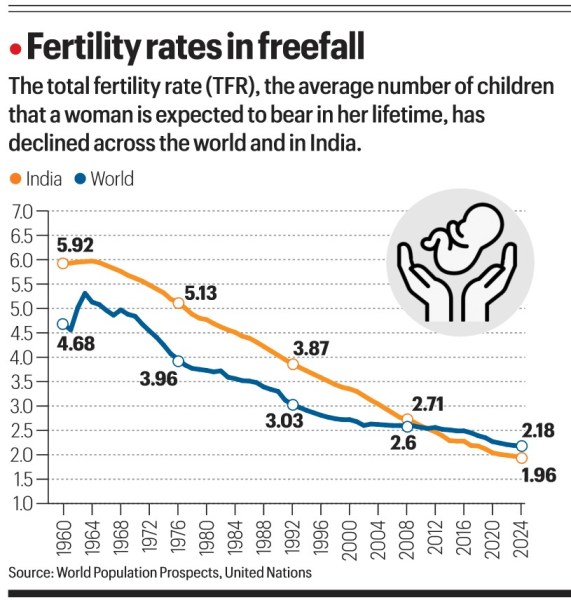 Global fertility rates.
• From a global average of 5.3 in the early 1960s, TFR stood at 2.2 in 2024 — just above the replacement rate. In the same period, the TFR in India declined from 5.9 to 2 — just under the replacement rate. Pronouncements like Andhra Pradesh’s thus mark a stark reversal from just a few generations ago, when population boom was counted among the biggest crises facing the nation, and family planning policies were introduced.
Do You Know:
• Moradhvaj Dhakad, a scientist and Marie Curie Research Fellow at the Max Planck Institute for Demographic Research (MPIDR) in Rostock, Germany, told The Indian Express, “The decline has happened much faster than UN projections from around a decade ago, which expected TFR to fall to under 2.1 between 2030 and 2035, but India achieved this level around 2020.”
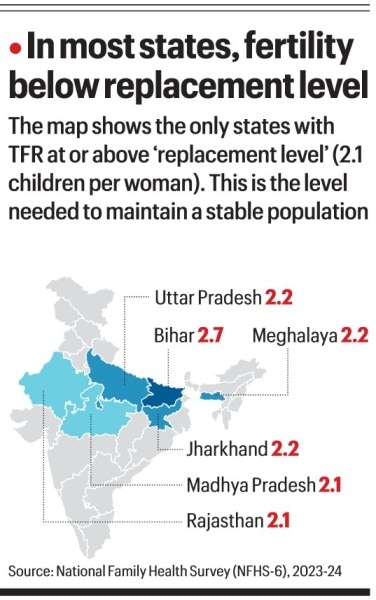 The TFR of India.
• According to the demographic transition theory, as societies move from low economic growth and education levels to prosperity, both birth and death rates fall, with little overall change in population as a result. But the widespread shift in just a few decades has prompted the search for other factors.
• Income is often a starting point. Martin Kolk, an Associate Professor at the Stockholm University Demography Unit and Department of Sociology, told The Indian Express that in the past, people with smaller incomes had more children in many countries.
• Women’s increased educational attainments, participation in the workforce and ability to make reproductive decisions also matter. In sub-Saharan Africa, with TFRs still as high as 4 and 5, high levels of teen pregnancies have been attributed to the limited use of contraception, lower education levels, and early marriages.
Other Important Articles Covering the same topic:
📍1 in 3 adult Indians face unintended pregnancies, shows UNFPA report
Previous year UPSC Prelims Question Covering similar theme:
5) Consider the following specific stages of demographic transition associated with economic development: (UPSC CSE, 2012)
1. Low birth-rate with low death rate
2. High birth-rate with high death rate
3. High birth-rate with low death rate
Select the correct order of the above stages using the codes given below:
(a) 1, 2, 3
(b) 2, 1, 3
(c) 2, 3, 1
(d) 3, 2, 1
Previous year UPSC main Question Covering similar theme:
📍Critically examine the effect of globalization on the aged population in India. (UPSC CSE, 2013)
In HC relief for Airtel and Vi, the lengthy row over spectrum charge
Syllabus:
Preliminary Examination: Current events of national and international importance.
Main Examination: General Studies II: Government policies and interventions for development in various sectors and issues arising out of their design and implementation.
What’s the ongoing story: The judgment is expected to materially improve the financial position of both Airtel and Vodafone Idea by eliminating a sizable contingent liability that had remained unresolved for more than a decade.
Key Points to Ponder:
• What is the ongoing broader legal battle over one-time spectrum charge (OTSC)?
• Why Bombay High Court struck down the Centre’s one-time spectrum charge (OTSC) demands?
• What is airwave in communication and broadcasting?
• How airwaves are governed in India?
• What is one-time spectrum charge (OTSC) demands?
• What is revenue-sharing model?
• What is National Telecom Policy (NTP) of 1994?
• What changes were made in National Telecom Policy (NTP) of 1999?
• What is retrospective spectrum charge? Why it was controversial?
• What the verdict means for Airtel, Vodafone Idea?
• Telecom Regulatory Authority of India (TRAI)-know in detail
Key Takeaways:
• In a significant boost for telecom operators Bharti Airtel and Vodafone Idea (Vi), the Bombay High Court on Monday (June 8) struck down the Centre’s one-time spectrum charge (OTSC) demands, quashing a long-running liability estimated at more than Rs 24,000 crore.
• The court also set aside all consequential actions taken by the government based on the disputed demands,
delivering a major financial and regulatory reprieve to the two telcos.
• Devices such as phones require signals to connect. These signals are carried on airwaves, which must be sent at designated frequencies to avoid interference.
The Union government owns all publicly available assets within the country, which includes airwaves. These airwaves are called the spectrum, which is subdivided into bands with varying frequencies. To sell airwaves to private players, the Department of Telecommunications (DoT) under the Ministry of Communications regularly holds auctions.
The current dispute traces its origins to the telecom licensing regime of the 1990s. Under the National Telecom Policy (NTP) of 1994, private operators such as Airtel and Idea Cellular were granted licences to offer mobile services, paying a fixed licence fee as well as separate charges for the use of spectrum.
• However, the policy was overhauled in 1999 after the government found that the original framework had failed to generate the expected growth in the sector. Under NTP-99, operators were allowed to migrate to a revenue-sharing model, under which licence fees and spectrum-related payments were linked to a share of their revenues rather than fixed annual charges.
Do You Know:
• Over the following years, the government and the Telecom Regulatory Authority of India (TRAI) introduced a series of changes governing the allocation of additional spectrum.
• Operators that received bandwidth beyond the initial allocation were required to pay higher revenue-share-based spectrum charges. Industry bodies accepted this framework and withdrew several legal challenges, while successive policy documents and committee reports largely favoured recurring spectrum usage charges rather than upfront one-time levies.
• The debate shifted in 2008, when the DoT began exploring the idea of imposing a one-time charge on spectrum holdings beyond 6.2 MHz. A committee headed by then Additional Secretary at the DoT, Subodh Kumar, recommended an upfront payment mechanism for excess spectrum, and in 2010, the TRAI formally recommended a one-time spectrum charge for holdings above the threshold. The move gained momentum after the Supreme Court’s 2012 judgment in the 2G spectrum case intensified scrutiny of spectrum allocation and pricing.
• In November 2012, the Union Cabinet approved the levy of one-time spectrum charges on existing operators, including retrospective charges on spectrum held beyond 6.2 MHz from July 2008 onwards. The DoT subsequently issued demand notices to operators such as Airtel and Vodafone Idea, prompting them to approach the Bombay High Court in January 2013.
Other Important Articles Covering the same topic:
📍Airtel’s 5G priority tier: What is network slicing and how does it work?
Previous year UPSC Prelims Question Covering similar theme:
6) A layer in the Earth’s atmosphere called ionosphere facilities radio communication. Why? (UPSC CSE, 2011)
1. The presence of ozone causes the reflection of radio waves to earth.
2. Radio waves have a very long wavelength.
Which of the statements given above is/are correct?
(a) 1 only
(b) 2 only
(c) Both 1 and 2
(d) Neither 1 nor 2
Can a political party use cockroach as symbol? What EC rules say
Syllabus:
Preliminary Examination: Indian Polity and Governance-Constitution, Political System, Panchayati Raj, Public Policy, Rights Issues, etc.
Mains Examination: General Studies II: Salient features of the Representation of People’s Act.
What’s the ongoing story: Ever since Chief Justice of India Surya Kant remarked during a hearing last month that a section of unemployed youth had become “cockroaches”, the image of the insect has come to be used by those protesting against the statement as well as the satirical Cockroach Janta Party (CJP).
Key Points to Ponder:
• What is the Cockroach Janta Party?
• How election symbols are allotted?
• Election Symbols (Reservation and Allotment) Order, 1968-Know key highlights
• Election Symbols (Reservation and Allotment) Order, 1968-What the rules say?
• What are the Election Commission’s powers in allocating the election symbol?
• What kinds of symbols are allowed?
• Can the cockroach be an election symbol?
• What is Pressure Group?
• What are the techniques used by pressure groups?
• Pressure Groups in India and youth-connect the dots
• Election Commission of India and Article 324 of the Constitution-Know in detail
• The independent and impartial functioning of the Election Commission-How it is ensured?
• Election Commission of India- Powers and Functions
Key Takeaways:
• CJP is not a political party but a “youth pressure group”, according to its founder Abhijeet Dipke. Dipke has not ruled out applying for registration as a political party with the Election Commission (EC) in the future, but for now, the group has an online presence and held its first protest at Jantar Mantar in New Delhi on June 6.
• The EC allots election symbols to parties and independent candidates as per the Election Symbols (Reservation and Allotment) Order, 1968. According to the Symbols Order, the recognised national and state parties’ candidates are allotted the reserved symbol of their respective parties — for instance, the lotus for the BJP, or the raised hand for the Congress.
• For unrecognised parties, which are registered parties that have not met the electoral performance criteria for the national or state party tag, or independent candidates, the EC allots symbols from a list of “free symbols”. These candidates and unrecognised parties can request for their choice of symbol from the list, but they are not assured of getting the same.
• In the list of free symbols, which the EC revises from time to time, images include fruits, vegetables, household appliances, farm equipment, sports equipment, etc. The latest list, which was published by the EC on May 23, 2025, has 184 symbols, including air-conditioner, balloon, doorbell, dustbin, frying pan, jackfruit, and grapes.
Do You Know:
• Following representations from animal welfare activists in the 1990s, the Election Commission stopped allotting
animals as election symbols.
• Former Union Minister and founder of People for Animals (PFA) Maneka Gandhi wrote in a post on the PFA website that for the 1989 Tamil Nadu Assembly election, the All India Anna Dravida Munnetra Kazhagam faction led by J Jayalalithaa was allotted the rooster as its election symbol. According to her, thousands of roosters were tied to the top of fast-moving vehicles during the state election. She claimed that this resulted in the deaths of thousands of roosters, whose bodies were “strewn all over Tamil Nadu every evening”.
• The Bahujan Samaj Party, which was formed prior to the ban, still retains its election symbol, the elephant, making it one of the few exceptions. With the EC’s prevailing stand against allotting animals as election symbols, the cockroach symbol is unlikely to be granted if anyone seeks the same, EC officials said.
Other Important Articles Covering the same topic:
📍Explained: From birth to ban, all that has happened with the Cockroach Janta Party so far
Previous year UPSC Prelims Question Covering similar theme:
7) Consider the following statements: (UPSC CSE, 2017)
1. The Election Commission of India is a five-member body.
2. Union Ministry of Home Affairs decides the election schedule for the conduct of both general elections and bye-elections.
3. Election Commission resolves the disputes relating to splits/mergers of recognised political parties.
Which of the statements given above is/are correct?
(a) 1 and 2 only
(b) 2 only
(c) 2 and 3 only
(d) 3 only
ECONOMY
Why higher interest rates may be needed to bring in NRI dollars
Syllabus:
Preliminary Examination: Current events of national and international importance.
Main Examination: General Studies III: Indian Economy and issues relating to planning, mobilization, of resources, growth, development and employment.
What’s the ongoing story: The Reserve Bank of India (RBI) last week announced the special dispensation that allows banks to mobilise fresh three- to five-year Foreign Currency Non-Resident (Bank), or FCNR(B), deposits until September 2026. It also permitted them to swap these deposits with the RBI at a concessional rate, effectively covering the entire hedging cost.
Key Points to Ponder:
• What is Foreign Currency Non-Resident (Bank), or FCNR(B)?
• Why FCNR(B) deposits are significant in India’s external sector management?
• What is the role of NRIs in strengthening India’s foreign exchange position?
• What is the current account deficit?
• What is the interest rates and capital inflows?
• How can FCNR(B) deposits contribute to exchange rate stability?
Key Takeaways:
• By absorbing the hedging burden, the RBI has made FCNR(B) deposits a more attractive source of overseas funding for lenders. Experts believe the steps announced may attract an additional $50 billion to $70 billion in foreign capital into Indian markets, provided the banks offer the right interest rates after considering the hedging sops.
• Bankers say the regulatory incentive alone, however, may not be sufficient to trigger large inflows. With US dollar deposit rates in major markets such as the US still offering returns of over 4%, Indian banks may need to raise FCNR(B) deposit rates by at least 100 basis points (equals 1%, 1 basis point = 0.01%) to remain competitive and persuade non-resident Indians (NRIs) to shift funds to India.
• In the financial year 2025-26 (FY26), FCNR(B) deposit inflows plunged by 86% to $946 million from $7.1 billion in FY25, with the amount outstanding rising to $33.8 billion at the end of March. Unless banks offer a meaningful rate premium over overseas alternatives, the response from depositors could remain muted despite the RBI’s support.
Do You Know:
• FCNR(B) deposits are fixed-term bank deposits that can be opened in India by NRIs, Overseas Citizens of India (OCIs), and Persons of Indian Origin (PIOs). These deposits allow overseas Indians to maintain their savings in designated foreign currencies such as the US dollar, pound sterling, euro, Japanese yen, Australian dollar, and Canadian dollar, rather than converting their funds into Indian rupees.
• Interest earned on FCNR(B) deposits is exempt from income tax in India as long as the depositor qualifies as a non-resident under Indian tax laws. Under the current framework, banks can offer rates linked to internationally accepted benchmark rates.
Other Important Articles Covering the same topic:
📍No need to raise foreign deposits through FCNR(B)-like measures, says RBI MPC’s Ram Singh
Previous year UPSC Prelims Question Covering similar theme:
8) Consider the following: (UPSC CSE, 2021)
1. Foreign currency convertible bonds
2. Foreign institutional investment with certain conditions
3. Global depository receipts
4. Non-resident external deposits
Which of the above can be included in Foreign Direct Investments?
(a) 1, 2 and 3 only
(b) 3 only
(c) 2 and 4 only
(d) 1 and 4 only
|
PRELIMS ANSWER KEY |
|
1.(c) 2.(b) 3.(a) 4.(a) 5.(c) 6.(d) 7.(d) 8.(a) |
For any queries and feedback, contact priya.shukla@indianexpress.com
Subscribe to our UPSC newsletter. Stay updated with the latest UPSC articles by joining our Telegram channel – IndianExpress UPSC Hub, and follow us on Instagram and X.