Prateek Tanmay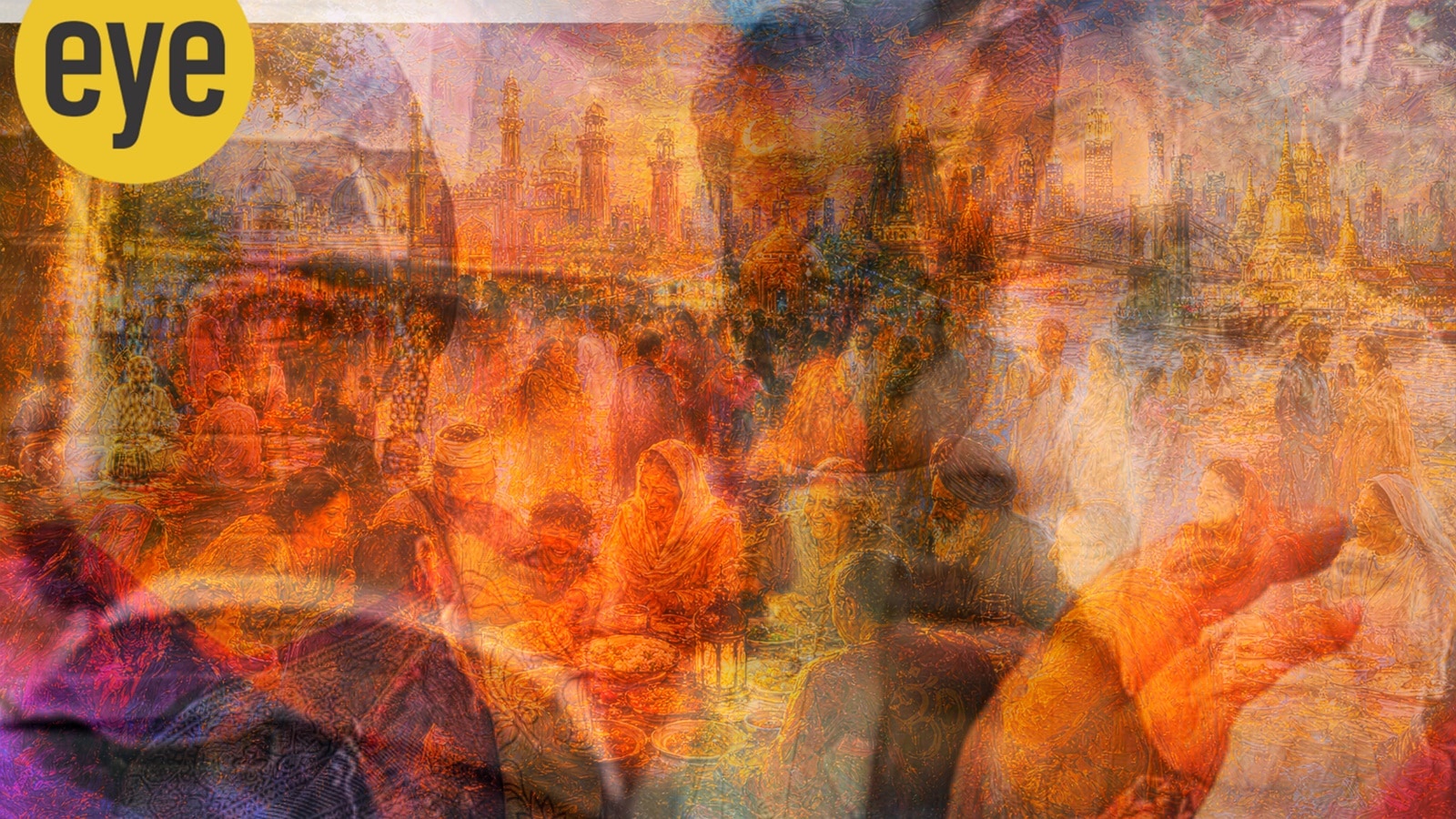
Eid arrives not only with prayer, but with perfume. With memory. With the smell of simmering sevaiyaan slipping under doors and down stairwells. With crisp white kurtas swaying in monsoon wind. With the soft clang of serving spoons against copper pots. With children rehearsing joy before dawn. With goats blinking calmly in crowded gullies while cities stretch awake beneath green crescent moons and tangled electric wires. In India, festivals do not merely occur. They arrive like weather. They enter the bloodstream. They stain the spirit with scent and sound and story.
And this Eid—Bakrid, Eid al-Adha, Eid-ul-Zuha—has always meant more to me than doctrine. It has never been only about sacrifice. It has been about surrender. About softness. About the mysterious miracle of human beings choosing one another despite history, despite borders, despite politics, despite pain.

That miracle, to me, has always tasted like India.
Not the India of headlines and hashtags, but the older, deeper India. The quieter India. The India that still remembers how to feed first and argue later. The India where faith is less fortress and more fragrance—carried gently between neighbours through bowls of biryani and plates of mithai crossing thresholds without suspicion. The India, where a festival belongs not only to the people who celebrate it, but also to those who live beside it.
I did not grow up Muslim. But Eid belonged to me anyway.
How could it not?
In Delhi, festivals were never private property. They leaked gloriously into each other. Diwali lights flickered in Muslim homes. Hindu children waited breathlessly for Eid sevaiyaan. Sikh kitchens sent trays of sweets to Christian neighbours at Christmas. Someone was always feeding someone. Someone was always insisting you eat more. India’s secularism was never cold constitutional language to us. It was culinary. Emotional. Intimate. It smelled of cardamom and coal smoke and wet earth.
Eid, especially, carried tenderness.
Perhaps because its central story is itself so heartbreakingly human.
The story of Ibrahim and Ismail is not merely about sacrifice. It is about trust. A father asked to surrender what he loves most. A son willing to walk beside him in faith. And finally, mercy intervening before loss becomes irreversible. The true sacrifice was never flesh. It was ego. Attachment. Possession. Pride.
Story continues below this ad
The Arabic word qurbani itself comes from nearness—closeness to the divine through surrender.
And perhaps that is what India, at her best, has always understood instinctively: that the holiest acts are not performed in isolation but in relationship. That God arrives most fully when human beings make room for one another.
I think first of my music teacher, Marina Ahmed.
Born in Dhaka. Trained in India under my Bade Guruji, the legendary Sangeet Martand Pandit Jasraj. A woman who carried ragas across oceans and made a life in America without ever abandoning the soul of the subcontinent. She now lives in a beautiful home in Westchester after years in Manhattan, though “living” is perhaps too static a word for someone who seems permanently suspended between continents and compositions. She keeps a home in Dhaka, another in India, and moves endlessly between New York, Bangkok, Delhi, Dhaka, and whichever city next calls her spirit into song.
In her voice lives Bhairav at dawn, Bageshri after dusk, and centuries of longing between notes. She did not merely teach me music; she taught me listening. She taught me that surrender is the beginning of sound.
Story continues below this ad
Panditji himself would stay in her New York home, that space becoming less residence and more refuge—a floating gurukul suspended above Manhattan traffic and winter loneliness. There, amid tanpuras and tea cups, one could hear India breathing thousands of miles from home. Hindu ragas flowed through Muslim lungs. Urdu met Sanskrit without quarrel. Bhakti touched Sufism, and neither demanded the other diminish itself.
That was the genius of the subcontinent: we borrowed beauty from one another without fear.
And Marina Ahmed herself carries that same spirit. Forever moving between Dhaka, Delhi, Westchester, Manhattan, Bangkok, and the spaces between cultures, she calls my mother “Ammi” with the kind of affection that dissolves geopolitics entirely. Her own mother gone, she found echoes of maternal warmth in my mother’s quiet presence.
And what does this extraordinary woman—raised amid fish, feasts, and the robust culinary traditions of Bengal and the Muslim world—crave most at our home in Delhi?
My mother’s simple vegetarian food.
Story continues below this ad
Light dal. Soft vegetables. Humble sabzis. Everyday Hindu ghar ka khana, prepared without spectacle, without excess, without performance. Marina eats at our table with the kind of contentment that reminds you that food is not merely about appetite. It is about affection. About memory. About safety.
Watching her savour a vegetarian meal in our home feels like watching the subcontinent heal itself softly, spoonful by spoonful.
And then there was another Marina entirely: Marina Fareed.
Elegant, warm, impossibly gracious Marina Fareed, wife of Shaukat Fareed—Pakistani diplomat, raconteur, citizen of the world. Raised between Lahore and Karachi, they carry within them the elegance, sophistication, and emotional intelligence of those cities at their finest. Together, they built lives suspended between continents. Part of the year they spend in Manhattan, and part in Lahore, returning each winter to Pakistan like migratory birds carrying memory across borders.
Their magnificent Upper East Side brownstone home in New York—among the carriage-trade families and old established households of Manhattan—has become something far greater than an address.
It is a sanctuary.
A republic of homesickness.
Story continues below this ad
A soft landing for the wandering children of the subcontinent.
And they are still doing it. Still entertaining. Still opening their doors with astonishing generosity to every lost, lonely, bewildered, brilliant soul arriving from somewhere between Karachi and Kolkata, Dhaka and Delhi, Lahore and Lucknow.
Every vagabond eventually finds their way there. Students bewildered by American winters. Diplomats weary of diplomacy. Artists aching for Urdu. Lonely boys pretending they are not lonely. Homesick Indians. Homesick Pakistanis. Bangladeshis carrying inherited grief. Sri Lankans carrying inherited silence. Hindus. Muslims. Sikhs. Christians. Agnostics. Labels dissolve somewhere between the kebabs and the chai.
Their dining table has become the unofficial embassy of emotional survival.
If you arrive hungry, you are fed.
If you arrive broken, you are held.
If you arrive uncertain, the room steadies you eventually.
Story continues below this ad
That is the genius of the Fareeds: they practice hospitality not as performance, but as philosophy.
And when my mother, my sister Seema, and I sit at their table in New York, we gorge not on extravagance, but on familiarity. On ghar ka khana. Food served with precisely the same warmth and tenderness that defines my mother’s table in Delhi. Yes, there is meat at the Fareeds’ table, where my mother runs an entirely vegetarian home. But the emotional language is identical.
The same insistence on second helpings.
The same concern over whether you have eaten enough.
The same softness.
The same love.
That is what binds the subcontinent more deeply than politics ever can.
And in that home, Eid becomes larger than religion. It becomes reunion.
Story continues below this ad
I remember the laughter first. Always laughter. The kind that rises only when people feel safe enough to become children again. Urdu floating through rooms fragrant with cardamom, roasted spices, perfume, and memory. Old ghazals humming beneath conversations about visas, poetry, politics, mothers, partition, cricket, heartbreak, and home. Someone inevitably quoting Faiz. Someone else insisting on second helpings.
And somehow every gathering ends with music.
Because music, too, refuses borders.
I still hear Pandit Jasraj’s voice carrying across those years:
“Mero Allah meherbaan…”
When the Divine is merciful, who can truly diminish you?
What extraordinary civilisation produced a Hindu classical maestro whose devotion could embrace Allah with such effortless reverence? What confidence of culture allows spiritual vocabularies to intermingle instead of compete?
Story continues below this ad
This layered, listening India still exists—in kitchens, in classrooms, in music rooms, in shrines, in friendships, in the soft diplomacy of shared meals.
Listen closely to the great inheritors of our shared spiritual imagination, and you will hear India’s pluralism breathing through them still.
Abida Parveen sings Bhakti and Sufi poetry with equal surrender, invoking Kabir as naturally as Bulleh Shah. Nusrat Fateh Ali Khan turned qawwali into global prayer, carrying Persian, Punjabi, Urdu, Hindi, and Hindustani classical influences together like rivers joining the same sea. A R Rahman moves effortlessly between Allah, Venkateswara, Christ, and the cosmos itself, proving devotion need not shrink to remain sincere.
And then there is cinema—not merely entertainment, but emotional education for generations of Indians learning how to live beside one another. Songs that remind us that humanity can exist before hierarchy.
“Tu Hindu banega na Musalman banega, insaan ki aulaad hai, insaan banega.” You will become neither Hindu nor Muslim — you are born of humanity, become human first.
That song still matters because it speaks not against religion, but against reduction. Against shrinking human beings into singular labels.
Then came Mohammed Rafi singing bhajans with tears in his throat. Manna Dey embracing qawwalis with classical abandon. Jagjit Singh carrying Urdu poetry into Sikh households and Hindu drawing rooms alike. Lata Mangeshkar singing with the same spiritual surrender whether the lyric invoked Allah, Ram, Krishna, or love itself.
Music in the subcontinent rarely cared about the boundaries people later tried to sharpen.
Even Islamic practices in South Asia absorbed the fragrance of India itself. Visit Sufi shrines, and you will see flowers offered the way Hindus offer flowers in temples. Hear qawwals sing in raags born from ancient Hindu musical traditions. Watch devotees tie threads at dargahs, seeking blessings in rituals shaped as much by the soil of India as by Arabia or Persia. In Ajmer Sharif Dargah, at Hazrat Nizamuddin Dargah, and at countless shrines across the subcontinent, Islam did not erase local culture; it conversed with it.
This was never weakness.
This was civilization.
Only insecure cultures fear exchange.
Strong cultures absorb, adapt, adopt, and still remain themselves.
I think of Nusrat Durrani and his family, who celebrate a vegan Bakrid. To some, this may appear contradictory. To me, it appears deeply Indian—the willingness to reinterpret tradition through ethics and compassion while remaining rooted in reverence. The courage to ask difficult questions without abandoning faith. The understanding that sacrifice can also mean sacrificing excess, cruelty, environmental harm, or rigid certainty.
That elasticity is culture.
That confidence is civilization.
That tenderness is faith.
And then there are the families that become woven into your bloodstream so deeply that religion becomes irrelevant beside relationship.
Wahid ul Hassan uncle and Anjum aunty were those for us.
My father and Hasan uncle both belonged to the Indian Revenue Service, bureaucrats shaped by a generation that still believed public service carried dignity. Their friendship began in Nagpur and deepened further when both families eventually moved to Delhi. We children grew up threaded into one another’s lives so naturally that memory itself struggles to separate where one family ended and another began.
Bushra and Asif eventually made homes in Boston. My mother visited them there years later, carrying with her all the warmth and continuity of old India. And even now, across decades and continents, the children remain in touch, because some relationships refuse erosion.
When I think of Eid tables from childhood, I think immediately of Anjum aunty’s sheer khurma—fragrant with cardamom, dates, vermicelli, nuts, and the kind of love no recipe can teach. I think of her egg curry too, rich and deeply comforting, arriving at the table with rotis and stories and laughter.
Food in homes like theirs was never just nourishment.
It was belonging—served hot.
And then there is my beloved friend, the artist Aamir Rabbani.
One of the gentlest men I know. One of the most brilliant artists living on the planet. A soul so filled with grace that even his silences feel kind.
When Aamir returns from Bihar, he carries with him not merely food, but memory. The flavours of Muzaffarpur. The fragrances of family. The culinary inheritance of his mother’s kitchen. Sometimes he brings kebabs inspired by her cooking—smoky, tender, unforgettable things layered with spices so nuanced they seem to hold entire histories inside them.
When I think of Eid now, I often think of the photographs Aamir shares: family members gathered together in celebration, faces glowing with joy, generations leaning into one another, laughter suspended midair like prayer itself. Looking at those pictures, one realises again that festivals are not about spectacle. They are about continuity. About people returning to one another despite the distances the world imposes.
His food, like his art, reminds me that Bihar too carries an extraordinary Muslim culinary and cultural legacy—refined, earthy, generous, profoundly Indian.
Love defines Aamir’s story.
Art defines it.
Friendship defines it.
Because that is the India I know too.
The India where Aamir is not “other” but brother.
Where his mother’s kebabs become part of my own emotional memory.
Where Eid from Muzaffarpur reaches my table and expands my understanding of home.
No television debate can achieve what one shared meal does.
No slogan can compete with tenderness.
That tenderness is the true theology of Eid.
Not fear.
Not spectacle.
Not performance.
But hospitality.
The act of opening your home before opening your mouth.
And perhaps food remains our final diplomacy. Because when someone feeds you, truly feeds you, hierarchy dissolves momentarily. At the table, there is no majority or minority. Only hunger and its healing.
Today, the world is retreating into smaller certainties. Nations are becoming nervous about differences. Communities everywhere are boxing themselves into silos of sameness—linguistic sameness, religious sameness, ideological sameness. Algorithms reward outrage. Public life increasingly rewards certainty over conversation. Fear travels faster than friendship.
And yet India still carries another possibility.
Not merely in constitutional paperwork or political speeches, but in lived culture. In the millions of ordinary intersections where people continue to share food, language, lullabies, rituals, music, grief, and celebration across faiths and regions. In the Hindu child who still waits for Eid sevaiyaan. In the Muslim ustad teaching a Sanskrit bhajan. In Sikh langars feeding strangers without interrogation. In Christian schools, where Urdu poetry competitions thrive. In the ragas, recipes, and relationships that continue to refuse narrowness.
India’s genius has never been purity.
It has been permeability.
For centuries, this land absorbed languages, gods, cuisines, caravans, conquerors, refugees, philosophies, and faiths—not without friction, not without failure, but with remarkable resilience. India’s deepest inheritance is not homogeneity. It is hospitality of spirit.
And perhaps that is why Eid matters beyond religion here.
Because in India, at its most luminous, festivals become rehearsals for coexistence.
A bowl of sevaiyaan crossing a doorway.
A qawwali sung in Raag Bhairav.
A Hindu mother becoming “Ammi.”
A Pakistani diplomat opening his Manhattan home to wandering Indians.
A vegan Bakrid celebrated with reverence instead of rigidity.
An artist from Bihar carrying the flavours of Muzaffarpur into the hearts of friends.
A classical maestro singing of Allah’s mercy with complete devotion.
These are not contradictions.
They are civilization.
And in a century exhausted by polarisation, India still has the potential to remind the planet that plurality is not weakness.
It is wisdom.
It is resilience.
It is survival.
It may even be humanity’s last, best hope.
Eid Mubarak, then, not only to Muslims but to every soul still willing to believe humanity is holier than hatred.
May we sacrifice what hardens us.
May we surrender what separates us.
May we feed one another before we fear one another.
And may India—vast, vibrant, forever evolving India—remember the wisdom she has long offered the world: that the divine lives most fully not in dominance, but in dignity shared.