Prateek Tanmay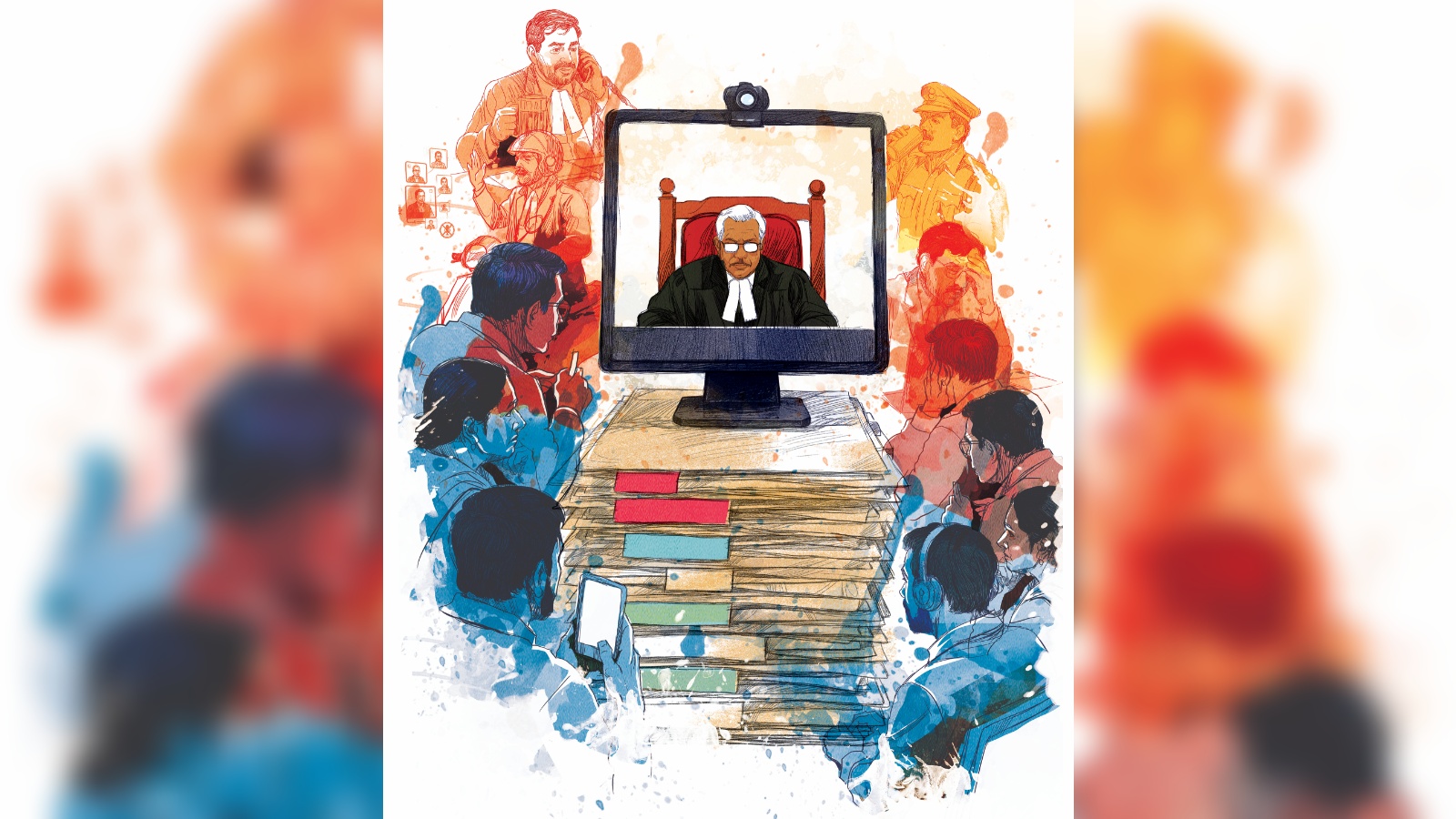
FOR DECADES, India’s judicial system was built around physical files, crowded courtrooms and colonial-era systems. That began changing around six years ago as courtrooms adopted virtual hearings, turning what was a pandemic necessity into a key part of India’s justice delivery system.
Virtual hearings have not only made it easier for litigants to follow their cases but also for lawyers to practise across cities and for citizens to access court proceedings. In the process, they have opened courtrooms to unprecedented scrutiny and transparency, changing how justice is observed and understood.

In February 2026, Law Minister Arjun Ram Meghwal told Lok Sabha that as of December 31, 2025, High Courts and district courts across the country had conducted 3.93 crore cases via video conferencing. E-filing (cases filed digitally) crossed 1.03 crore and 29 virtual courts processed over 94.5 lakh challans, collecting more than Rs 973 crore — figures the minister cited as evidence to say that digitisation of courts has kept the system moving even as courts struggle with case pendency (five crore and counting).
‘People like to come to court’
Fifteen years before courtrooms moved online, the judiciary had begun an overhaul. In 2005, the Supreme Court’s e-committee proposed a blueprint for digitising court administration.
When the project was rolled out in 2007, the focus was on basic digital infrastructure. District and taluka courts were equipped with computers, server rooms and local area networks. Courts adopted Case Information Software, a national case management platform that digitised filing, case records and court administration. Millions of pending cases were entered into electronic databases.
Then, in 2008, came a turning point. India’s first district-level paperless e-court was inaugurated at Karkardooma in Delhi. It was an ambitious shift: touchscreens on the judge’s dais, LCD monitors for viewing digitised records, e-filing to reduce paperwork and facilities for video-linked testimony from jails, forensic laboratories and government hospitals.

Retired Justice Talwant Singh, then the nodal officer overseeing the initiative, recalls, “People were laughing at us… They said, nobody will go for it. Why has so much money been spent? People like to come to court.”
Story continues below this ad
Till 2020, virtual hearings remained an exception. Then, Covid hit, followed by the lockdown. Courts shut almost overnight. And all of a sudden, the question was not whether to go online, but how fast.
The Delhi High Court made the move first. Within 10 days, Justice Talwant Singh conducted what became the country’s first Covid-era virtual hearing on WhatsApp.
The case was a high-stakes anti-suit injunctive action against an emergency arbitration in Singapore. A senior counsel appeared from London, and others from across India. “Within two or three weeks, it became normal to hold hearings through VC (video calling),” says Justice Talwant.
Eventually, the Delhi HC moved to Cisco Webex under a proper licensing arrangement and extended it to the district courts.
Story continues below this ad
‘The camera catches all of it’
Confined to a coffee plantation in Coorg during the lockdown, Senior Advocate Sajan Poovayya appeared before courts across the country. “There would be eight or ten screens,” he recalls. Each screen connected him to a different courtroom.
In the initial days, Poovayya remembers how accidental muting or unmuting, frozen screens and lawyers unfamiliar with virtual appearances became a running joke. “Counsel, you are on mute” became the era’s most repeated phrase.
Senior Advocate Menaka Guruswamy recalls that at first, some senior lawyers underestimated how much a webcam can reveal. “Some didn’t realise that you could be seen very clearly,” she laughs. “If you are a little dishevelled, it captures all of it.”
There were other hurdles. In September 2021, advocate Pratul Pratap Singh, who practises in the Supreme Court, was to speak before a bench, but realised that he could not intervene even after correctly logging in. His senior eventually had to physically go to the court. “I could not unmute,” he recalls. Under the virtual system, those whose names do not appear with a designated item number are treated as viewers and cannot unmute and make interventions.
Story continues below this ad
Years later, the system continues to be hobbled by some of these technical challenges.
Often, the virtual system does not keep pace with what’s happening. “It has happened quite a number of times that the judge has gone from case number 10 to 15, and the number on the display board has not been updated by the court staff, and it is still at 7,” says advocate Advait Tamhankar, a criminal lawyer practising in the Bombay High court. “When we go to the court and say we missed the hearing, they say that there’s no proof that we were online,” Tamhankar says.
In a more sobering episode, a person appearing without a lawyer before a Supreme Court bench was muted by a moderator unfamiliar with the proceedings, just as the bench began dictating a 10-minute order. For at least eight minutes, the man kept speaking, unheard, “even pleading with folded hands,” unaware he’d been cut off, remembers Pratul Pratap Singh.

Delhi ahead of the rest
Advocate Abhinav Sekhri, a criminal lawyer who practises primarily in the Capital, says that during Covid, “in most other states, at best you could have this facility at the High Court level, whereas in Delhi, the focus was on onboarding the trial courts”.
Story continues below this ad
By the end of 2021, he says, virtual hearings had become routine in most of Delhi’s courts. The contrast was stark with Mumbai, where, well into the pandemic, many trial courts remained largely offline and where, advocate Tamhankar says, lawyers still find themselves moving between video conferencing platforms.
Gujarat had been experimenting with live streaming of court proceedings on and off since 2020, when Covid struck. The Gujarat High Court formally went live on YouTube in July 2021 — a first across the country. By February 2023, Gujarat district courts were also live on YouTube.
Since 2022, the Supreme Court has been live-streaming key Constitutional bench hearings on YouTube. Gauhati, Karnataka, Madhya Pradesh, Jharkhand and Orissa High Courts are also live on YouTube.
However, vast differences remain in the adoption of digital infrastructure. In Karnataka, district courts have followed the High Court and embraced technology with surprising flexibility, says Poovayya.
Story continues below this ad
Telangana falls on the other side of the spectrum. “District courts in our state… not much,” says advocate Asad Hussain, a Hyderabad-based advocate.
Data submitted by the Ministry of Law and Justice to the Rajya Sabha in February 2026 underscores that while district courts under the Allahabad High Court had digitised nearly 169 crore pages of records by December 2025, Madhya Pradesh had digitised 66 crore pages, and Punjab & Haryana 62 crore pages. In contrast, Calcutta’s district courts and Nagaland reported no digitised district court records.
‘I speak freely online’
Guruswamy says live streaming and virtual access have fundamentally altered the relationship between courts and the public, “democratising the practice of law”. Technically, courts have been open to everyone for decades, but most litigants had never heard their lawyers argue, and students outside major cities had rarely witnessed constitutional litigation. “Now, students come up and say they watched the arguments on YouTube before they joined law school,” says Guruswamy.
For lawyers, virtual hearings have cleared logistical obstacles.
Hussain says that earlier, lawyers appearing outside their home jurisdictions often depended on local counsel, clerks and other arrangements, but now, “with a Microsoft Word document, a PDF viewer and a laptop, you are good to go,” he says.
Story continues below this ad
For litigants and clients, the information gap has narrowed. “Clients can see exactly what happened,” Hussain says, explaining that they do not have to rely on the lawyer’s version of events.
That visibility has changed behaviour on all sides. Poovayya credits “a greater number of eyes” with bringing “a level of maturity” to court hearings.
For decades, Pratul says, “what happened inside stayed inside.” Today, a stray observation travels far beyond the courtroom, he says, pointing to CJI Surya Kant’s widely discussed “cockroach” remark.
Poovayya says his work now comes with a different tool kit. He began practising decades ago, when lawyers worked with typewriters, carbon copies and stacks of papers that had to be physically transported between courts. “As the most junior lawyer, you got the last carbon copy, and it was barely legible,” he says.
Story continues below this ad
Today, his chambers have moved almost entirely to digital files, following what he calls a “zero paper policy”. “Now, I have multiple copies of these files on my handheld device that moves with me,” he says.
Also, research on a case happens amid arguments now. Juniors search for points and upload material directly into shared digital files. “Sometimes, in the middle of an argument, my files are getting updated as I speak,” Poovayya says.
Younger lawyers have adapted to the changes more easily. “Six briefs of a thousand pages you can’t carry to court. iPads and laptops have taken care of that,” advocate Tamhankar says.
For Delhi-based Maryam Junaid, who graduated from law school in 2024, virtual appearances are less intimidating. “Because I know nobody is watching me, I can just speak freely.”

For litigants, virtual courts have eliminated the costs of going to courts. Pratul, who is from Badaun in Uttar Pradesh, says this has encouraged more litigants to pursue remedies before higher forums.
Yet, many still believe that something is lost when advocacy moves entirely online. As Guruswamy wonders, “What happens to the introspective quality of a courtroom when everything is being broadcast? There is that element of persuasion in a physical courtroom — nothing can substitute it,” Guruswamy adds.
Pratul says that in a physical courtroom, “if judges are talking among themselves while you are arguing, even hearing one word can tell you what concerns them.”
Some judges say that in a physical court, it is easier for them to understand the issue, ask back-and-forth questions, and understand body language.
“Hearings are especially difficult when government lawyers appear virtually… They have to submit status reports or records, and often, this is done across the bench. For judges, tallying the online documents becomes difficult,” says a Delhi HC judge.
Individual judges can also lay out the manner and mode of conducting proceedings. For example, Justice C Hari Shankar has specified, “Presence of Advocates/ parties who appear virtually would not be marked if their camera is switched off.” Justice Girish Kathpalia has requested all those appearing virtually to “maintain proper decorum”. The Chief Justice’s court, too, has similar standing instructions.
What often tests the patience of judges are unmuted conversations seeping in mid-hearing, cross-communication, lawyers appearing from vehicles or without neck bands, and patchy Internet.
Earlier this year, a court clip from the Gujarat High Court went viral when, mid-argument, a lawyer was heard instructing, presumably his colleague, on the phone, “Tell them my father has had a heart attack and his surgery is going on — I can’t be present.” A brief pause later, he adds, “Let the court order whatever it wants, I will get it changed from the Supreme Court.”
For Poovayya, though, provided the technology works well, virtual hearings can sometimes offer lawyers a clearer view of a judge’s reactions. “Body language, mannerisms and thought process of a judge are often visualised in closer quarters,” he says.
Hussain recalls deliberately joining a hearing in a politically sensitive matter virtually, as the lawyers and counsel frequently spoke over one another. “If the bench wanted to hear our submissions, everyone else had to be quiet because we were the ones appearing online,” he says.

A reality check
The virtual infrastructure has worked with relatively little friction inside jails. The e-Mulakat system allows lawyers and family members to schedule video meetings with undertrial prisoners without physically queuing at a gate.
“No hassles,” Tamhankar says. “You don’t have to physically go to the jail, stand in line, fill out the form, and argue with the jail staff who are absolutely uncooperative. All this is avoided. You sit in your office and, before court hours, talk to the prisoner.”
The next frontier that lawyers are approaching is evidence recording. Sekri describes a recent case where his client in Chennai travelled to a court facility to give a statement to a judge in Madhya Pradesh via a video link. “It was fascinating,” says Sekri. “But these are few and far.”
But for every digital stride, there is a reality check.
India’s first district-level paperless e-court, in Delhi’s Karkardooma Court Complex, is a case in point, offering a glimpse into both the promise and fragility of judicial digitisation. Of the two LCD screens installed in 2010 to view digitised records, neither functions. The server crashed in 2016 and has not been restored since. The system, even today, continues to run on a 2G connection.