Prateek Tanmay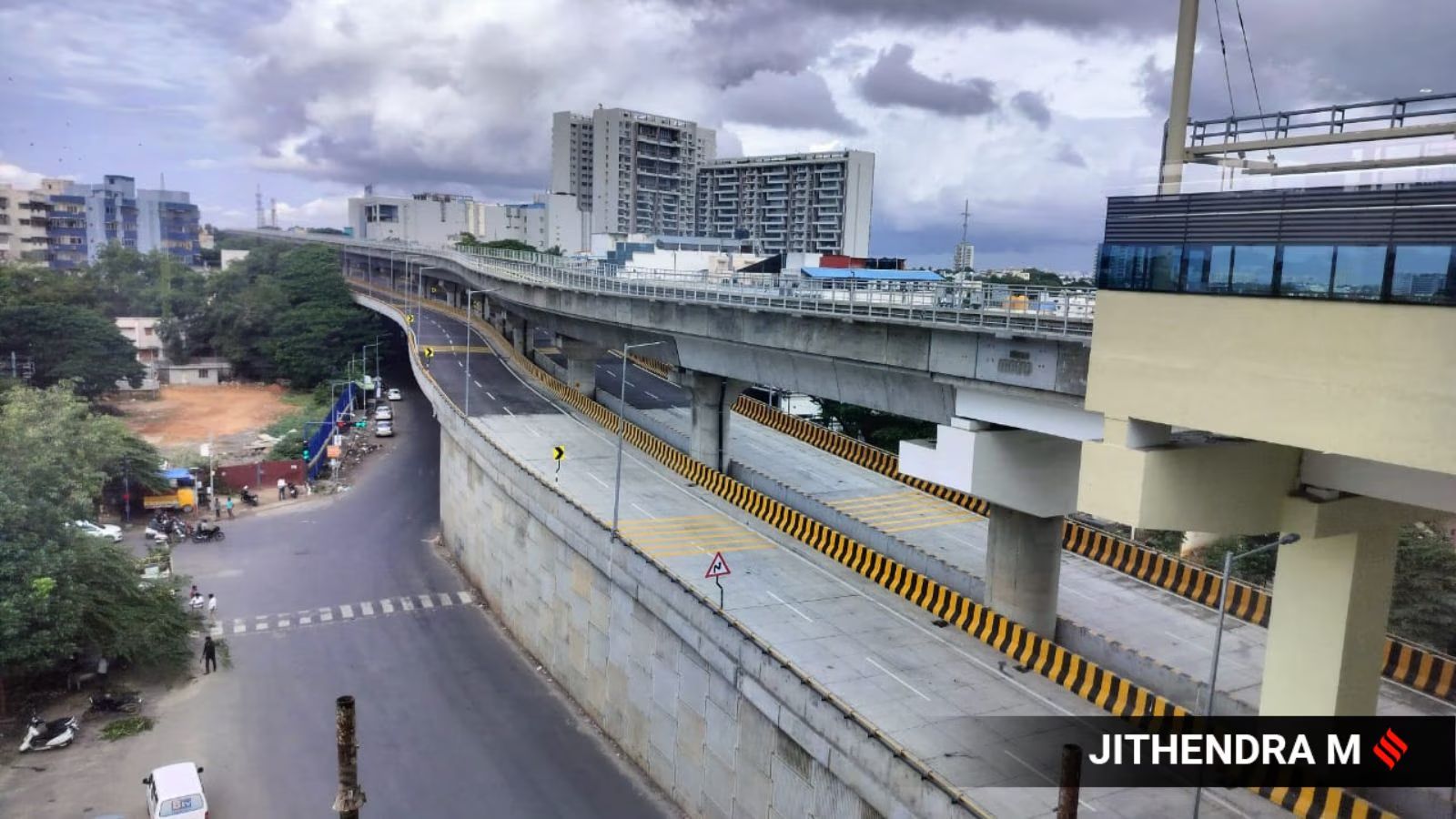
A technical assessment conducted by the Indian Institute of Science (IISc) on integrating elevated road infrastructure with Bengaluru Metro’s Phase-3 corridors has suggested that it would bring more private vehicles on the road and reduce metro ridership.
In an interactive session held on Sunday by the Citizens Voluntary Initiative for the City (CIVIC), Bengaluru, and Bengaluru Praja Vedike in view of the Union government considering approval for Namma Metro’s phase 3, Prof Ashish Verma, convenor of the IISc’s Sustainable Transportation Lab, opined that a double-decker corridor is fundamentally incompatible with metro rail’s objectives and with Bengaluru’s sustainable mobility and livability goals.

Besides reducing ridership, the report said a double-decker corridor would lead to an increase in pollution, inflate costs by nearly Rs 2,864 crore, and violate binding conditions attached to central funding approvals. The double corridor will have both the metro line and an elevated road built on the same pillars.
The report, prepared by Prof Ashish Verma, compares two scenarios expected in 2041: a metro-only configuration and one that combines the metro with a double-decker elevated road along the same corridor. Phase-3 covers two corridors—JP Nagar 4th Phase to Kempapura (29.2 km) and Hosahalli to Kadabagere (11.45 km).
According to the report, under the double-decker scenario, daily metro ridership on the two corridors drops from 8.09 lakh to 7.98 lakh passengers. The share of bus mode falls by 6.4 per cent and the metro share by 1.4 per cent, while car usage rises by 3.8 per cent, two-wheeler usage by 1.28 per cent, and autorickshaw/taxi by 2.8 per cent. With the additional road capacity prompting people to shift from high-occupancy public transport to private vehicles, total vehicle kilometres travelled would jump, adding 17,012 kg of carbon dioxide (CO2), 85.9 kg of carbon monoxide (CO), and 1.1 kg of PM2.5 to daily emissions.
While fuel consumption during the West Asia conflict became a national concern, the report says that it would increase by 7,000 litres a day under the double-decker scenario.
Rs 2,863.53 crore additional cost for BMRCL
Double-decker integration would increase phase-3 capital costs by Rs 2,863.53 crore for Bangalore Metro Rail Corporation Limited (BMRCL) over the metro-only project. Cost increases arise from larger pier diameters, deeper foundations, elevated stations, and higher multimodal integration costs. These expenditures deliver no public transport benefit and impose a long-term financial burden on BMRCL and the State Government, the report read.
Story continues below this ad
The report thus underscores the importance of carefully evaluating road-based capacity enhancements in transit-oriented corridors, as they may contradict public transport investments and sustainability objectives.
The report also raises legal red flags. Sanction letters for Bengaluru Metro Phases 1, 2, 2A, and 2B require the Karnataka government to adopt traffic rationalisation measures that promote metro ridership, prioritise multimodal integration, and implement the project strictly as per the approved detailed project report.
In what is considered a dream project of Chief Minister D K Shivakumar, he announced in February 2025 that all upcoming metro lines in Bengaluru would be constructed as part of double-decker corridor projects at a cost of Rs 9,800 crore.
Phase 3 of the project, which includes the Orange Line, was approved in August 2024 for Rs 15,611 crore and includes two elevated corridors totalling 44.65 km. While the Ministry for Housing and Urban Affairs is yet to approve the double-decker project, Shivakumar met Union minister Manohar Lal Khattar after becoming the chief minister. He sought approvals for the metro’s phase 3 project including double-decker flyovers, which the Centre has stalled, and for cost overruns in Phase 2.
Story continues below this ad
Entrepreneur T V Mohandas Pai reacted to the report on X. “The @iiscbangalore view is one sided. Human behavior will change with convenience. We must build surplus capacity into public transport- 15000 EV buses, 500 kms of metro. Frequency every 2 minutes. This will bring about change. In Tokyo almost every household has a personal vehicle but most use public transport on all working days,” he wrote.
Construction cost under double-decker scenario
Corridor 1 cost goes up from Rs 4,972 crore to Rs 7,030 crore
Corridor 2 cost goes up from Rs 1,711 crore to Rs 2,517 crore
Total additional burden on BMRCL: Rs 2,863.53 crore
Economic and environmental hazards
CO2: 17,012 kg/day
CO: 85.9 kg/day
NOx: 12.6 kg/day
PM2.5: 1.1 kg/day
Fuel wasted: 7,000+ litres/day
Extra fuel cost: Rs 6.45 lakh/day