Prateek Tanmay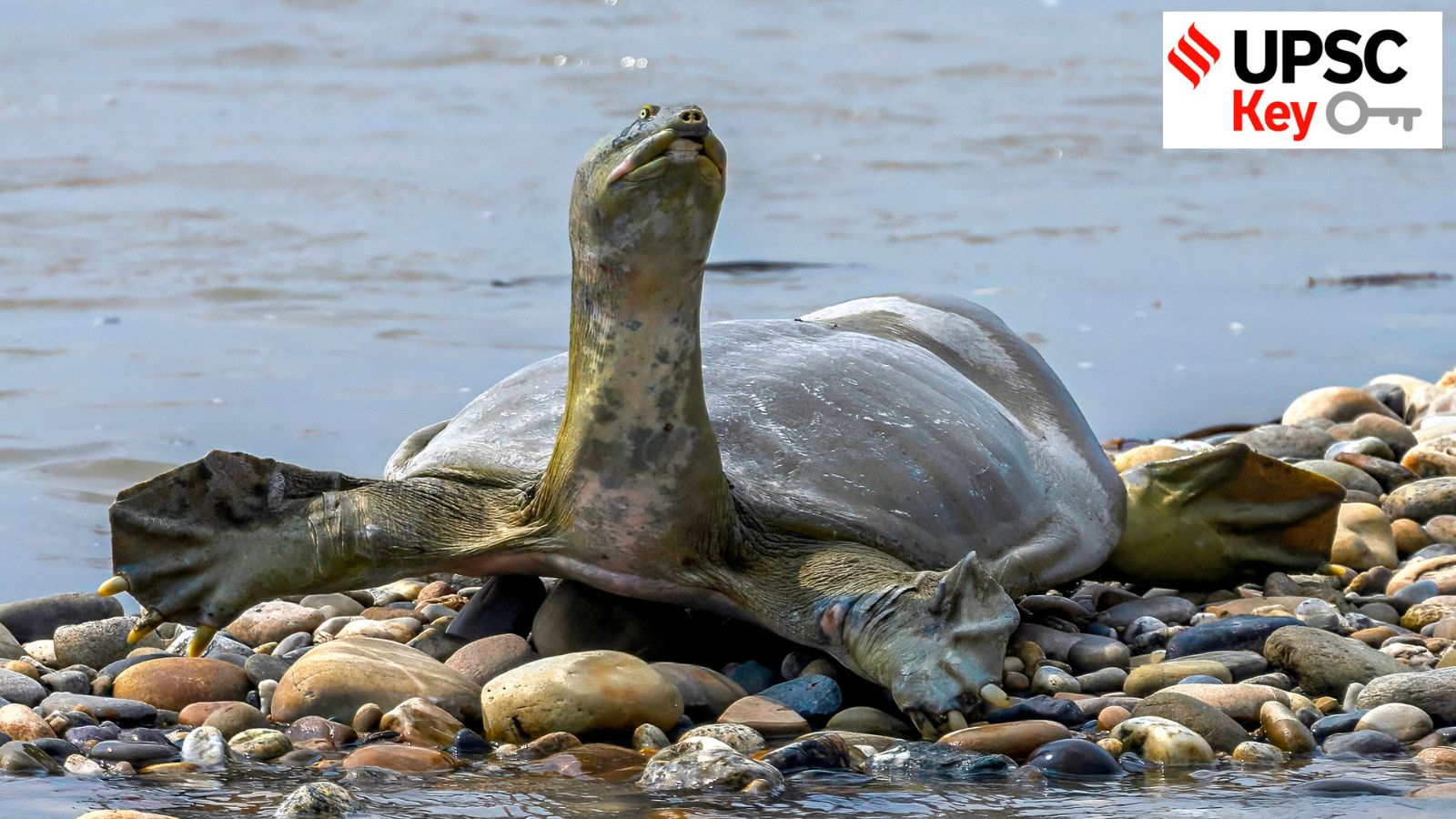

Preliminary Examination: General issues on Environmental Ecology, Biodiversity and Climate Change – that do not require subject specialisation
Mains Examination: General Studies-III: Conservation, environmental pollution and degradation, environmental impact assessment
What’s the ongoing story: Police in Madhya Pradesh are preparing their first coordinated crackdown on wildlife trafficking through the state’s railway network after an analysis of six years of seizure data uncovered organised interstate networks smuggling protected freshwater turtles from northern India’s river systems to markets in Southeast Asia and the Middle East, The Indian Express has learnt.
Key Points to Ponder:
— What is the protection status of freshwater turtles?
— What are the various provisions under which animals are protected in India?
— What are the challenges of wildlife trafficking? How are states acting against it?
— Learn about sea turtles and other protected species
— Know the difference between a turtle and a tortoise
— What are the steps taken for the conservation of turtles?
— What are the laws against the trafficking of endangered species?
— What are the challenges in controlling the trafficking?
Key Takeaways:
— Between 2020 and 2026, the State Tiger Strike Force (STSF) and Government Railway Police recovered 654 protected animals from passenger trains crossing the state — 647 turtles and seven vultures — across what enforcement records describe as four organised interstate networks.
— Senior police officials said the analysis has convinced them that the animals seized over six years represent only a fraction of the wildlife being trafficked through Madhya Pradesh’s rail network. They said repeat offenders appearing across multiple cases indicate established rackets may have been operating along the same corridors for years.
— Based on that analysis, Madhya Pradesh is now preparing its first coordinated crackdown on wildlife trafficking through the railway network, moving beyond isolated interceptions towards a structured enforcement response.
— The seizures suggest traffickers overwhelmingly rely on passenger trains rather than railway cargo systems. All 654 animals recovered during the six-year period were found concealed in passengers’ luggage.
Do You Know:
— The Indian softshell and Indian flapshell turtle — both listed under Schedule I of the Wildlife Protection Act, 1972, in the same protection category as tigers and elephants — inhabit the river systems of the Gangetic basin.
— Turtles and tortoises often get lumped together in casual conversation, but they’re actually quite different animals.
— While both belong to the same scientific order (Testudines), they’ve evolved in unique ways depending on where they live and how they survive. Think of them like distant cousins who took very different paths in life.
— Turtles spend most (or all) of their time in or around water. Whether it’s a pond, river, or ocean, turtles are built for life in the wet stuff. Their bodies are streamlined for swimming, and they’ve got webbed feet, or in the case of sea turtles, full-blown flippers, to help them glide through the water with ease.
— Tortoises, on the other hand, are strictly land-dwellers. You won’t find them paddling around lakes or rivers. Their legs are chunky and strong, built more for slow, steady walking and digging than swimming.
Other Important Articles Covering the same topic:
📍Turtles vs tortoises: What is the difference?
📍How 16 Indian Softshell turtles were rescued in Greater Noida
Previous year UPSC Mains Question Covering similar theme:
(1) Consider the following statements: (UPSC CSE 2019)
1. Some species of turtles are herbivores.
2. Some species of fish are herbivores.
3. Some species of marine mammals are herbivores.
4. Some species of snakes are viviparous.
Which of the statements given above are correct?
(a) 1 and 3 only
(b) 2, 3 and 4 only
(c) 2 and 4 only
(d) 1, 2, 3 and 4
Now, Maharashtra teacher exam paper leaked, 3 arrested
Syllabus:
Preliminary Examination: Current events of national and international importance
Mains Examination: General Studies-II: Issues relating to development and management of Social Sector/Services relating to Health, Education, Human Resources.
What’s the ongoing story: The Maharashtra Teacher Eligibility Test (TET), scheduled for Sunday, was postponed Saturday after a question paper leak was detected in the Bhiwandi area of Thane district.
Key Points to Ponder:
— What is TET?
— How does the paper leak impact the mental health of students?
— Suggest measures that need to be taken.
— How to establish accountability and integrity of paper leak during these examinations?
— Discuss the importance of examination integrity in ensuring fairness and equality of opportunity.
— “Technology can strengthen examination systems, but accountability and institutional ethics remain equally important”-discuss
— What were the recommendations of the committee led by former ISRO Chairman K Radhakrishnan for exam reforms?
Key Takeaways:
— While Thane police have arrested three persons in this connection, a Special Investigation Team has been formed to probe the question paper leak.
— According to a press note issued by the Secretary of the Maharashtra State Council of Examination, a raid was conducted early Saturday morning in the Bhiwandi area based on information received by police. Police found a few individuals in alleged possession of pages from the sealed TET 2026 question paper packet.
— The TET in Maharashtra has been held since 2013. There is no limit on the number of attempts. In-service teachers, unable to clear the test until August 2028, will have to take retirement. The TET is mandatory for appointment as a teacher in primary and secondary schools.
Do You Know:
— The Teachers Eligibility Test is the minimum qualification required for appointment as a teacher for Classes I to VIII.
— While the Central Teacher Eligibility Test (CTET), introduced by the National Council for Teacher Education in 2011, is conducted at the national level, Maharashtra introduced its own state-level examination, Maha TET, in 2013.
— In the aftermath of a controversy over the evaluation of NEET answers, two years ago, the government was asked by the Supreme Court to constitute a high-level committee headed by former ISRO chief K Radhakrishnan to examine the functioning of the National Testing Agency (NTA) — the body that conducts some of India’s most consequential exams, including NEET — and recommend reforms.
— The committee’s report pointed to inadequate institutional capacity, poor risk assessment, weak technological safeguards, insufficient accountability mechanisms, and the absence of a culture of continuous review.
— It recommended professionalising test administration, improving cybersecurity protocols, creating robust audit systems, and ensuring greater transparency in decision-making. A Parliamentary Standing Committee, too, has criticised the NTA for relying on private vendors and pointed out that firms blacklisted in one state continue to operate in another.
— It should, therefore, not have required the cancellation of one of the country’s most important entrance examinations, the despair of lakhs of students, and another Supreme Court intervention, to force the agency to acknowledge the problems that have been flagged repeatedly.
Other Important Articles Covering the same topic:
📍Explained: Why the postponement of Maha TET has left 6 lakh candidates in limbo
📍‘Where do I go from here?’: The anxiety, anger and cost of a cancelled exam
Previous year UPSC Prelims Question Covering similar theme:
(2) Which of the following provisions of the Constitution does India have a bearing on Education? (UPSC CSE, 2012)
1. Directive Principles of State Policy
2. Rural and Urban Local Bodies
3. Fifth Schedule
4. Sixth Schedule
5. Seventh Schedule
Select the correct answer using the codes given below:
(a) 1 and 2 only
(b) 3, 4 and 5 only
(c) 1, 2 and 5 only
(d) 1, 2, 3, 4 and 5
Previous year UPSC main Question Covering similar theme:
📍How have digital initiatives in India contributed to the functioning of the education system in the country? Elaborate on your answer. (UPSC CSE, GS2, 2020)
PM arrives in Seychelles, to mark 50 years of relations, chart future
Syllabus:
Preliminary Examination: Current events of national and international importance
Mains Examination: General Studies-II: Bilateral, regional and global groupings and agreements involving India and/or affecting India’s interests
What’s the ongoing story: Prime Minister Narendra Modi landed in Victoria on Saturday to start his three-day state visit to Seychelles, during which he will hold talks with President Patrick Herminie and attend the golden jubilee celebrations of the archipelago nation’s National Day celebrations as Guest of Honour.
Key Points to Ponder:
— Know about the location of Seychelles
— What are the areas of cooperation between India and Seychelles?
— How significant is Seychelles for India’s maritime security in the Indian Ocean?
— What is the significance of diaspora?
— What is Vision Mahasagar?
— What is the Colombo Security Conclave?
— Know about India’s Island diplomacy?
Key Takeaways:
— At Seychelles International Airport, Modi was welcomed by Herminie and the two leaders drove together to Seychelles’ National Botanical Garden. The PM received a ceremonial Guard of Honour, in the presence of Seychelles Cabinet ministers and senior dignitaries.
— Ahead of his departure from New Delhi, Modi said Seychelles is a valued maritime neighbour and a key partner in the Vision Mahasagar (Mutual and Holistic Advancement for Security and Growth Across Regions) and India’s shared commitment to the Global South.
— Later in the day, the PM handed over Fast Patrol Vessel Lespwar, ambulances and utility vehicles to the Seychelles Coast Guard.
— On Sunday evening, PM Modi will participate in the country’s 50th national day celebrations as Guest of Honour. When Seychelles attained freedom on June 29, 1976, a contingent from the Indian Naval Ship, INS Nilgiri, took part in the Independence Day celebrations. This year as well, an Indian Armed Forces contingent and two Indian Navy ships are participating in the event.
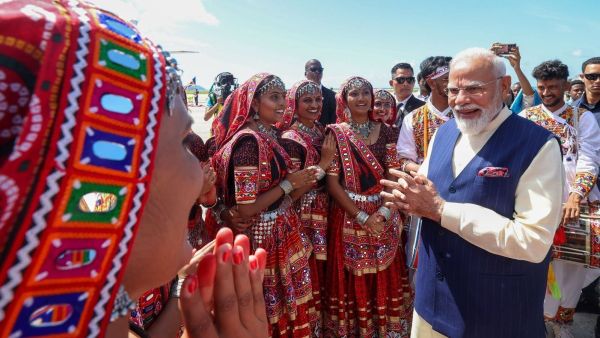 Prime Minister Narendra Modi was welcomed by the Indian diaspora in Seychelles at the airport on Saturday. (Photo: X/Narendra Modi)
— PM Modi last visited Seychelles in 2015, while President Herminie visited India earlier this year.
— Seychelles is a cornerstone of India’s Global South strategy, serving as a critical maritime partner in the Western Indian Ocean. The island nation also helps India combat seaborne terrorism, piracy, and illegal fishing. Situated close to Africa, Middle East, and Asia, Seychelles serves as a vital counterweight against expanding influence in the Indian Ocean.
— Seychelles’s recent full membership in the Colombo Security Conclave further strengthens this shared commitment to a stable, secure Indo-Pacific. India is also a security provider in the Indian Ocean.
— Around 5 percent of the Seychelles population comprises people of Indian origin (about 6,000); while another 9,000 non-resident Indians work in Seychelles, mostly in the construction sector, as shop assistants and professionals, according to government statistics. A majority of them belong to the Gujarati and the Tamil communities.
— India has emerged as a key development partner of Seychelles through grants, concessional credit and capacity-building initiatives. India continues to be a premier medical tourism destination for Seychelles, with institutional tie-ups connecting island hospitals with facilities in Chennai.
Do You Know:
— India’s Island diplomacy with Seychelles and its outreach to ASEAN (Association of Southeast Asian Nations) through deepening ties with countries like Malaysia further consolidates its position in the Indian Ocean Region (IOR).
— Seychelles, a strategically located archipelago of 115 islands in the Western Indian Ocean, relies on external state actors for its security and economic interests. India’s engagement with the island nation underlines its commitment to the Indian Ocean region (IOR).
— In this context, island diplomacy comes into play. Island diplomacy is widely referred to as a country’s strategic engagement with small island nations through defence cooperation, climate support, economic assistance, and infrastructure projects.
— Securing sea lanes of communication is a key aspect of Delhi’s Indian Ocean strategy, which makes Seychelles an important nation as it is located near critical shipping lanes. Cooperation between the two countries spans maritime domain awareness (MDA), coastal surveillance radar systems, and defence training.
Other Important Articles Covering the same topic:
📍How Delhi’s IOR vision combines security, connectivity, and digital governance
Previous year UPSC Mains Question Covering similar theme:
📍Why is maritime security vital to protect India’s sea trade? Discuss maritime and coastal security challenges and the way forward. (UPSC CSE 2025)
📍In 2012, the longitudinal marking of the high-risk areas for piracy was moved from 65° East to 78° east in the Arabian Sea by the International Maritime organisation. What impact does this have on India’s maritime security concerns? (UPSC CSE 2014)
OPINION
When Court No. 24 became the legal preface to Emergency
Syllabus:
Preliminary Examination: Indian Polity and Governance – Constitution, Political System, Panchayati Raj, Public Policy, Rights Issues
Mains Examination: General Studies-II: Functions and responsibilities of the Union and the States, issues and challenges pertaining to the federal structure, devolution of powers and finances up to local levels and challenges therein.
What’s the ongoing story: Shubham Kumar writes: Before the Emergency became a midnight story, it had a courtroom preface. On the night of 25-26 June 1975, Opposition leaders were arrested, the presses were censored, and freedoms began to shrink. But the political chain of events that led to that night had been triggered two weeks earlier through a judge’s verdict in Allahabad. The Emergency is remembered through Delhi’s darkness. Its legal pre-history unfolded in daylight.
Key Points to Ponder:
— What are the constitutional provisions related to the Emergency?
— What were the events leading up to the proclamation of Emergency?
— What are the provisions of the Representation of the People Act, 1951?
— How National Emergency Impact Fundamental Rights?
— What was the impact of the National Emergency in 1975?
— Officials, police, and public facilities belong to the Republic, not to a ruling party’s campaign. Elaborate.
— What was the 39th constitutional amendment?
— What is judicial review? What is its significance?
Key Takeaways:
— That daylight can be traced to two rooms of the Allahabad High Court. Justice Jagmohanlal Sinha sat in Court No. 5. When Indira Gandhi came to give evidence in the election petition filed by Raj Narain, challenging the then-PM’s Rae Bareli victory, the proceedings were held in Court No. 24.
— The story began in the 1971 general elections. After the Congress split of 1969 and the early dissolution of the Lok Sabha in December 1970, the Opposition tried “Indira Hatao” and she answered with “Garibi Hatao”. In Rae Bareli, Indira Gandhi polled 1,83,309 votes, Raj Narain received 71,499.
— For most candidates, that margin would have closed the matter. Raj Narain carried it to court. In April 1971, he filed an election petition under the Representation of the People Act, 1951, alleging misuse of official machinery, campaign expenditure, and the role of Yashpal Kapoor, who had worked in the PM’s Secretariat before joining Indira Gandhi’s campaign.
— Over time, the case narrowed around Kapoor and a set of dates. Kapoor had resigned from government service in January 1971. Election law treats assistance from government servants, deployed to advance a candidate’s prospects, as a corrupt practice.
— Officials, police, and public facilities belong to the Republic, not to a ruling party’s campaign. In Rae Bareli, this ordinary rule had become historic because the candidate under scrutiny was also the PM.
— For three years, the case moved slowly until Justice Sinha took charge after the 1974 summer vacation and pushed it forward. In March 1975, Indira Gandhi’s appearance as a witness enlivened the case.
— By the time Justice Sinha entered, the courtroom was packed. Raj Narain was present after he assured his counsel Shanti Bhushan that he would remain silent. Bhushan didn’t want Raj Narain because he was known to be temperamental and outspoken.
— The court accommodated the dignity of office. She was not made to stand in the witness box. After consultation with Shanti Bhushan, Justice Sinha allowed her to sit on a chair placed on a raised platform to the right of the judge. Her counsel, S C Khare, examined her first. Then Shanti Bhushan cross-examined her.
— On 12 June 1975, Justice Sinha set aside Indira Gandhi’s election and found her guilty of corrupt practices on limited grounds, connected with Yashpal Kapoor and official arrangements. The court granted a short stay for appeal. But the political crisis had begun. Congress rallied behind her. The Opposition treated the verdict as a crisis of legitimacy.
— On 24 June, Justice V R Krishna Iyer of the Supreme Court allowed her to continue as PM but restricted her rights as an MP. The next day, Jayaprakash Narayan and other leaders demanded her resignation at a Delhi rally. That evening, Indira Gandhi advised the President to proclaim a state of emergency. On the night of 25 June 1975, just before midnight, President Fakhruddin Ali Ahmed signed the proclamation.
— The Rae Bareli case still did not disappear. Parliament changed the election law retrospectively. The 39th Amendment attempted to place the election of the PM beyond judicial challenge.
— In November 1975, a Constitution Bench upheld several election-law changes but struck down the attempt to immunise the PM’s election from judicial review, applying the basic structure doctrine articulated in Kesavananda Bharati.
Do You Know:
— Generally, the term “emergency” refers to the period from June 25, 1975, to March 21, 1977, during which the government of Prime Minister Indira Gandhi used special provisions in the Constitution to impose sweeping executive and legislative consequences on the country.
— However, emergency provisions contained in Part XVIII of the Constitution of India, from Articles 352 to 360, talk about the three different types of emergencies.
— The national emergency of 1975 brought about numerous changes in various aspects of India’s democracy. From constitutional amendments to the emergence of a coalition government, the aftermath of the national emergency introduced new social forces and led to the decentralization of power.
— The Janata government reversed many of the constitutional changes effected by the 42nd Amendment Act of 1976. It did not do away with the provision of the emergency, but made it extremely difficult to impose for the future.
Other Important Articles Covering the same topic:
📍UPSC Issue at a Glance | Understanding Emergency: 4 Key Questions You Must Know for Prelims and Mains
📍Knowledge Nugget | Emergency back in focus: What UPSC aspirants should know
Previous year UPSC Prelims Question Covering similar theme:
(3) If the President of India exercises his power as provided under Article 356 of the Constitution in respect of a particular State, then (UPSC CSE 2018)
(a) the Assembly of the State is automatically dissolved.
(b) the powers of the Legislature of that State shall be exercisable by or under the authority of the Parliament.
(c) Article 19 is suspended in that State.
(d) the President can make laws relating to that State.
(4) Which of the following are not necessarily the consequences of the proclamation of the President’s rule in a State? (UPSC CSE 2017)
1. Dissolution of the State Legislative Assembly
2. Removal of the Council of Ministers in the State
3. Dissolution of the local bodies
Select the correct answer using the code given below:
(a) 1 and 2 only
(b) 1 and 3 only
(c) 2 and 3 only
(d) 1, 2 and 3
Previous year UPSC Mains Question Covering similar theme:
Under what circumstances can the Financial Emergency be proclaimed by the President of India? What consequences follow when such a declaration remains in force? (UPSC CSE 2018)
ECONOMY
EU carbon tax: Govt to shoulder 90% compliance bill of MSMEs
Syllabus:
Preliminary Examination: Current events of national and international importance
Mains Examination: General Studies-III: Indian Economy and issues relating to planning, mobilisation of resources, growth, development and employment.
What’s the ongoing story: The Centre is working on a scheme to absorb 90% of the compliance cost borne by micro, small, and medium enterprises (MSMEs) to help soften the disproportionate impact of the Carbon Border Adjustment Mechanism (CBAM) compliance burden imposed by the European Union, The Indian Express has learnt.
Key Points to Ponder:
— What are MSMEs? (Investment and annual turnover)
— What is CBAM?
— What are India’s concerns regarding CBAM?
— What is the objective of adopting CBAM by the EU?
— What are the challenges for MSMEs to comply with CBAM?
— Suggest measures that need to be taken to ensure MSMEs protection and CBAM compliance.
Key Takeaways:
— India’s efforts to secure a concession for its small industries in negotiations with developed countries have not worked, and the industry has been seeking assistance to meet the steep annual compliance costs due to the imposition of the EU’s carbon tax since January 1, 2026.
— The UK too has plans to impose its version of CBAM from 2027. CBAM is an EU policy designed to put a price on the carbon emitted during the production of carbon-intensive goods that are entering the EU.
— Complying with the regulation is seen as a major global challenge, as declarants must track the embedded emissions of their goods, including direct emissions and, for certain sectors such as cement and fertilisers, indirect emissions.
— Industry sources said that the compliance cost for each MSME unit to meet the requirement under carbon tax alone is Rs 15 lakh to 20 lakh and that they do not have the wherewithal to report the number of data points sought under the regulation by the EU.
— Unlike large corporations, MSMEs often lack the technical expertise, systems and financial resources to measure, verify and report embedded emissions in accordance with CBAM requirements. They may have to incur significant upfront expenditure on carbon accounting, third-party verification, digital reporting systems and capacity building.
Do You Know:
— According to the World Bank, “a carbon tax directly sets a price on carbon by defining a tax rate on greenhouse gas emissions or – more commonly – on the carbon content of fossil fuels”. It is a type of carbon pricing, and the other type of carbon pricing is the emissions trading systems (ETS). The CBAM is a form of carbon pricing system.
— The CBAM or Carbon Tax was first introduced by the European Union in 2021. It taxes certain products coming in from other countries based on their carbon emissions footprint in their production process. For instance, if the imported steel was produced through a process that entailed higher emissions than the emissions standards for that product in Europe, it would be taxed.
— CBAM allows industries in Europe to remain competitive while continuing to maintain high environmental standards. It prevents these industries from relocating their production to countries where the production might be cheap owing to less strict emission norms, a situation described as carbon leakage. In the process, it hopes to contribute to reducing global emissions.
Other Important Articles Covering the same topic:
📍What is Carbon Tax and why is it important for UPSC exam?
📍Between India and EU, a carbon gap and an FTA bridge
Previous year UPSC Prelims Question Covering similar theme:
(5) Consider the following statements: (UPSC CSE 2023)
Statement-I: Carbon markets are likely to be one of the most widespread tools in the fight against climate change.
Statement-II: Carbon markets transfer resources from the private sector to the State.
Which one of the following is correct in respect of the above statements?
(a) Both Statement-I and Statement-II are correct and Statement-II is the correct explanation for Statement-I
(b) Both Statement-I and Statement-II are correct and Statement-II is not the correct explanation for Statement-I
(c) Statement-I is correct but Statement-II is incorrect
(d) Statement-I is incorrect but Statement-II is correct
ALSO IN NEWS
• Trump could visit India early next year: Rubio
US President Donald Trump could travel to India early next year, US Secretary of State Marco Rubio said in an interview to news agency IANS in Washington Friday. He added he would himself make another trip to India later this year to set the ground for the President’s visit.
Earlier this month, on the sidelines of the G7 Summit in Evian, Prime Minister Narendra Modi and Trump held a bilateral meeting, marking their first face-to-face interaction in 16 months, where the two leaders discussed the India-US COMPACT, the US-Iran peace agreement, and ongoing discussions over the bilateral trade agreement.
• Gaganyaan uncrewed test flight may be pushed, likely to impact launch of human space flight
The wait for Gaganyaan mission’s manned flight may just get a little longer.
The first uncrewed test flight for the Gaganyaan mission — ahead of the proposed maiden Indian human space flight launch — could be pushed back up to the third quarter of 2027, ISRO chairman V Narayanan indicated on Saturday even as he stressed that efforts were on for a launch by the end of 2026.
With this, the launch of Gaganyaan mission’s manned flight could be pushed back to 2028, as against 2027-end that the Indian Space Research Organisation (ISRO) had indicated earlier this year.
PRELIMS ANSWER KEY
1. (d) 2. (d) 3. (b) 4. (b) 5. (b)
Subscribe to our UPSC newsletter. Stay updated with the latest UPSC articles by joining our Telegram channel – IndianExpress UPSC Hub, and follow us on Instagram and X.
🚨 Click Here to read the UPSC Essentials magazine for June 2026. Share your views and suggestions in the comment box or at manas.srivastava@indianexpress.com🚨