Prateek Tanmay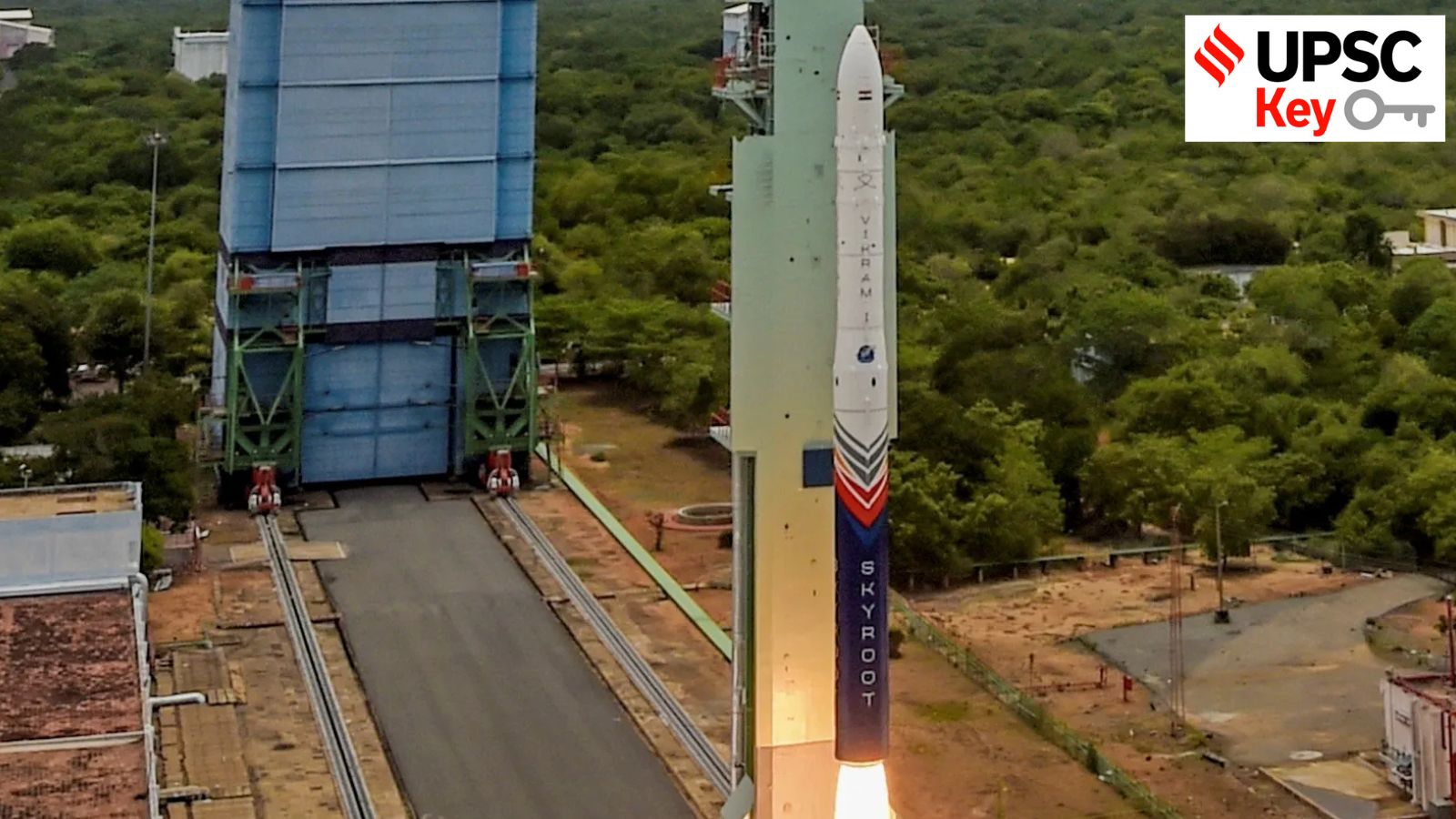

Preliminary Examination: Current events of national and international importance.
Main Examination: General Studies-III: Science and Technology, Awareness in the fields of IT, Space.
What’s the ongoing story: Ushering in a new era of India’s space programme, Vikram-1, a rocket named after the legendary space leader Vikram Sarabhai, on Saturday became the country’s first privately-built launch vehicle to achieve an orbit around the Earth, and successfully deploy a diverse set of technology demonstration satellites in space.
Key Points to Ponder:
— Know about the Vikram-1 launcher in detail.
— What is the significance of the Vikram-1 rocket?
— What was ‘Vikram-S’ (Mission Prarambh)?
— What is Low Earth orbit?
— What is the status of private sector participation in India’s space sector?
— What is IN-SPACe?
— How does the Indian space sector benefit from private-sector participation?
— What are the challenges related to the private sector participation in India’s space sector?
— What are the various launch vehicles of ISRO and what are their specifications?
— What are the various types of orbits in which spacecraft are usually placed?
Key Takeaways:
— Built by the Hyderabad-based company Skyroot Aerospace, Vikram-1 marks the beginning of private space flights in India, a development that has been actively enabled and supported by the Indian Space Research Organisation (ISRO) and the government. With this launch, India has become just the third country, after the United States and China, to have launching capabilities in the private sector.
— Saturday’s launch mission was named Aagaman, meaning ‘arrival’. The company said it signified the arrival of a new era in India’s space sector, an era in which “Indian innovation, engineering and enterprise come together to provide reliable access to orbit”.
— Skyroot had flown Vikram-S rocket, an earlier version of the Vikram-1, to sub-orbital space in 2022. Another private company, the Chennai-based Agnikul, has also carried out a sub-orbital flight of its Agniban rocket, the world’s first to be powered by a 3-D printed engine, in 2024.
— In sub-orbital flights, rockets usually fly alone, without any satellites, enter into space, and then fall off on to the Earth under the impact of gravity. They do not attain an orbit around the Earth, and are largely meant for technology demonstration.
— Vikram-1, on the other hand, has now become a full-fledged satellite launch vehicle, having deposited its payloads in the intended low-Earth orbits at an altitude of about 450 km.
— Vikram-1 is a multi-stage rocket, rising up to about seven storeys, and is powered by a propulsion system developed in-house, including 3-D printed engines and high-thrust solid fuel motors. It is designed to carry small satellites, weighing up to 350 kg, to low-Earth orbits.
— Vikram-1 is an innovative launch vehicle, with its body being made of a carbon composite instead of metal. Its engines are 3D printed, reducing the time and cost. It is a four stage vehicle — three solid propellant-fuelled stages that give the rocket the maximum power to escape Earth’s atmosphere, and the fourth liquid propellant-based engine that gives it the precision to insert its payloads in orbit.
— While the name of the rocket pays homage to the father of India’s space programme, Dr Vikram Sarabhai, the solid engines have been named ‘Kalam’ for the rocket man, former President Dr APJ Abdul Kalam, and the liquid engine ‘Raman’ for the physicist, Dr C V Raman.
Do You Know:
— In 2020, the government created IN-SPACe (Indian National Space Promotion and Authorisation Centre) and formulated the Indian Space Policy 2023 with the intent to facilitate greater participation of private industry in the space sector.
— It is a single-window, independent, nodal agency that functions as an autonomous agency in the Department of Space (DOS).
— It is a facilitator and also a regulator. It acts as an interface between ISRO and private parties, and assesses how best to utilise India’s space resources and increase space-based activities.
— Low Earth orbit, or LEO, is the zone immediately surrounding our planet. It is typically defined as the region between 160 km and 2,000 km above Earth’s surface. Satellites in LEO generally take between 90-120 minutes to circle the planet.
Other Important Articles Covering the same topic:
📍Knowledge Nugget | From Vikram-1 to Drishti: How India’s private space sector is taking off
📍India’s first private rocket Vikram-1 succeeds in maiden orbital launch
📍The race for low Earth orbit: What the launch of Vikram-1 means for India
UPSC Prelims Practice Question Covering similar theme:
(1) Consider the following statements:
1. Vikram 1 is India’s first private orbital rocket under ‘Mission Aagaman’.
2. Vikram 1 has an all-carbon composite structure with solid fuel boosters.
3. It has a 3D printed liquid engine.
4. It can carry up to 350kg till low Earth orbit.
Which one of the following conclusions based on the above statements is correct?
(a) There are four correct statements.
(b) There is only one correct statement, that is statement 2.
(c) There are two correct statements, that include statement 1.
(d) There is no correct statement.
Maharashtra panel to examine if STs who convert can still receive benefits
Syllabus:
Preliminary Examination: Current events of national importance, Indian Polity and Governance.
Mains Examination: General Studies-II: Indian Constitution, Government policies and interventions for development in various sectors.
What’s the ongoing story: The Maharashtra government has constituted a 27-member committee to examine whether Scheduled Tribe (ST) members who convert to another religion should continue to receive reservation and other government benefits, reopening a politically and constitutionally sensitive issue that has long been raised by RSS-affiliated organisations and sections of the BJP.
Key Points to Ponder:
— What is the constitutional basis for the identification and recognition of Scheduled Tribes in India?
— How does the Scheduled Tribe category differ from the Scheduled Caste category in terms of constitutional criteria and eligibility?
— How Articles 341 and 342 shape affirmative action policies for marginalised communities?
— What are the different kinds of reservation in India? What are the arguments for and against reservation?
— Examine whether Scheduled Tribe status should be linked to religion.
— Connect the dots between tribal identity, culture, and religion in India.
— What other initiatives can be taken by the government for the upliftment of the marginalised?
Key Takeaways:
— A Government Resolution (GR) issued by the state’s Tribal Development Department on July 16 said the committee, headed by Tribal Development Minister Ashok Uike, will examine the constitutional and legal position governing reservation and welfare benefits for STs after religious conversion, study the approach followed by the Centre and other states, and recommend a policy for Maharashtra.
— The GR, however, does not specify any deadline for the committee to submit its recommendations. Uike did not respond to phone calls or text messages.
— The issue is legally distinct from that of Scheduled Castes (SCs). While SC reservation is linked to religion under the Constitution (Scheduled Castes) Order, 1950, there is no such restriction for STs. Under Article 342 of the Constitution, STs continue to be recognised as STs, irrespective of the religion they profess.
Do You Know:
— “Delisting” refers to the demand that tribal people converting to another religion should not continue receiving benefits for STs.
Other Important Articles Covering the same topic:
📍Religion and the tribal identity: Why ‘delisting’ debate refuses to die down
Previous year UPSC Prelims Questions Covering similar theme:
(2) Consider the following statements: (UPSC CSE 2023)
Statement-I: The Supreme Court of India has held in some judgments that the reservation policies made under Article 16(4) of the Constitution of India would be limited by Article 335 for maintenance of efficiency of administration.
Statement-II: Article 335 of the Constitution of India defines the term ‘efficiency of administration’.
Which one of the following is correct in respect of the above statements?
(a) Both Statement-I and Statement-II are correct and Statement-II is the correct explanation for Statement-I
(b) Both Statement-I and Statement-II are correct and Statement-II is not the correct explanation for Statement-1
(c) Statement-I is correct but Statement-II is incorrect
(d) Statement-I is incorrect but Statement-II is correct
(3) Consider the following statements: (UPSC CSE, 2024)
1. It is the Governor of the State who recognizes and declares any community of that State as a Scheduled Tribe.
2. A community declared as a Scheduled Tribe in a State need not be so in another State.
Which of the statements given above is/are correct?
(a) 1 only
(b) 2 only
(c) Both 1 and 2
(d) Neither 1 nor 2
NATION
Stone Age to Sangam era, Tenkasi settlement thrived across millenia
Syllabus:
Preliminary Examination: Current events of national importance.
Mains Examination: General Studies-I: Indian Heritage and Culture, History.
What’s the ongoing story: On the banks of the Vaippar river in Tamil Nadu’s Tenkasi district, archaeologists are slowly uncovering the story of a settlement that appears to have survived — and evolved — for thousands of years.
Key Points to Ponder:
— Know about the Vaippar river.
— Read about the Sangam Age in detail.
— What is Sangam literature?
— What is the significance of excavations at Malayadipatti ?
— How do archaeological discoveries complement literary sources in reconstructing India’s ancient history?
— What do recent excavations in Tamil Nadu reveal about the Sangam Age?
— Read about the Keezhadi (or Keeladi) excavation and its findings.
Key Takeaways:
— At Malayadipatti near Karivalamvanthanallur, where excavations have been underway since April, each trench is adding another layer to a remarkably continuous sequence of human occupation.
— From tiny microlithic stone tools left behind by some of the region’s earliest inhabitants to expansive Sangam-era brick structures, iron-working evidence and craft-production debris, the site is emerging as one of southern Tamil Nadu’s most significant archaeological landscapes.
— Unlike northern Tamil Nadu, where archaeology has established a clearer transition from the Microlithic to the Neolithic and then the Iron Age, Karivalamvanthanallur appears to follow a different trajectory.
— Archaeologists say the evidence points to continuous occupation from the Microlithic period through the Iron Age and into the Early Historic and Historic periods, bypassing the Neolithic or Chalcolithic phases — a cultural sequence that mirrors discoveries at sites such as Mangudi, Sivagalai and Adichanallur.
— The excavation, being carried out by the Tamil Nadu State Department of Archaeology (TNSDA), has opened 18 trenches so far and forms part of the state’s broader archaeological programme that also includes Keeladi.
— The site’s importance was first recognised nearly a century ago after Roman coins were reported from the region. The then Tirunelveli Deputy Collector, L A Cammiade, surveyed the area, while the Madras Museum’s 1932-33 annual report documented glass beads and burial urns collected from local residents. Those early references have now acquired fresh significance as archaeologists uncover evidence suggesting the settlement was not merely inhabited over centuries, but also functioned as a manufacturing centre.
— The discoveries made so far point towards an organised industrial settlement. Archaeologists have recovered hematite used for iron extraction, iron implements, large quantities of glass beads, terracotta figurines, graffiti-marked pottery, hopscotch pieces, black-and-red ware and other ceramics associated with the Early Historic period.
— One of the excavation’s most significant finds is a large brick structure measuring about 8.7 metres by 4.2 metres, built with bricks measuring 40 x 20 x 7 centimetres. The structure, which includes descending steps, is believed to have served either as an underground granary or a rainwater harvesting tank.
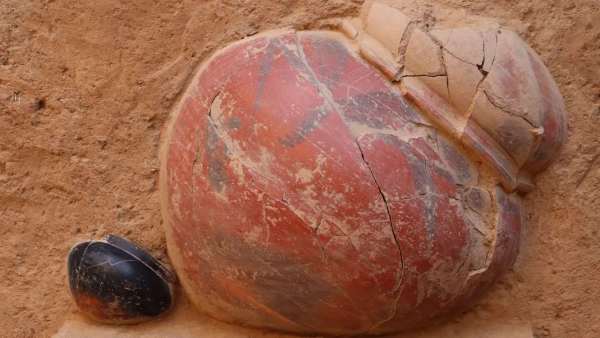 The excavation, being carried out by the Tamil Nadu State Department of Archaeology (TNSDA), has opened 18 trenches so far and forms part of the state’s broader archaeological programme that also includes Keeladi.
— Its design has prompted archaeologists to consider the possibility of sophisticated water management despite the settlement’s proximity to the Vaippar river. Soil analysis is expected to help determine its precise function, while carbon-dating samples have been sent to Beta Analytical Laboratory in Florida for scientific dating.
— The dimensions and style of the bricks resemble those found at Keeladi, Alagankulam and Poompuhar, suggesting that the structure belongs to the Early Historic or Sangam period.
— Another discovery has drawn attention because it appears to bridge archaeology and ancient Tamil literature. Archaeologists unearthed a red-slipped burial pot decorated with painted peacocks on its shoulder. Molar and premolar teeth recovered outside the vessel, along with a black-and-red ware pot placed beneath it, suggest it served as a burial urn.
— Sangam literature, particularly Akananuru, also refers to decorating memorial stones with peacock feathers, lending literary resonance to the archaeological evidence.
Do You Know:
— Recognised as the earliest literature from South India, Sangam refers to a group of texts written in old Tamil. The corpus includes eight anthologies of poems, 10 idylls, a work on grammar, and 18 minor works. Altogether, there are about 2,381 poems by 473 poets and 102 poems by anonymous authors.
— While scholars are divided about the precise dates of the Sangam texts, there is a general understanding that they were composed between the third century BCE and the third century CE.
— The Sangam poems are classified into two types: akam and puram. While akam poetry focuses on love, puram poems explore subjects like war, death, community, and kingdom.
Other Important Articles Covering the same topic:
📍The ‘rediscovery’ of Sangam literature and how it became a source of Tamil history and archaeology
📍Knowledge Nugget: How is Keeladi excavation relevant for UPSC Exam?
Previous year UPSC Mains Question Covering similar theme:
Though not very useful from the point of view of a connected political history of South India, the Sangam literature portrays the social and economic conditions of its time with remarkable vividness. Comment. (UPSC CSE 2013)
OPINION
No, no, no, it’s only football. But England-Argentina history begs to differ
Syllabus:
Preliminary Examination: Current events of international importance.
Mains Examination: General Studies-II: Bilateral, regional and global groupings and agreements, Effect of policies and politics of developed and developing countries.
What’s the ongoing story: Murari, Saptarshi Basak writes- ““The World Cup might not be ours, but the Falkland Islands definitely are,” was Downing Street’s response after Argentina’s football team unfurled a banner proclaiming “Las Malvinas son Argentinas” upon eliminating England to reach the final.”
Key Points to Ponder:
— Read about the Falkland Islands.
— What is the dispute related to the Falkland Islands?
— What was the Falklands War?
— What happened during the 1982 Falklands War?
— Read about the FIFA World Cup 2026.
— Map work: Locate Falkland Islands, Argentina, and England on map
Key Takeaways:
— “That the outgoing Keir Starmer government felt compelled to reaffirm British sovereignty over the archipelago off the coast of Argentina in the South Atlantic and that the prime minister himself has urged FIFA to investigate the players who displayed the banner are enough to illustrate how England versus Argentina has long been a proxy for unresolved questions of territory, nationalism, and historical memory.”
— “It wasn’t always like this. Football arrived in Argentina in the 19th century with British immigrants, and the Scottish schoolmaster Alexander Watson Hutton is widely regarded as the “Father of Argentine football”.”
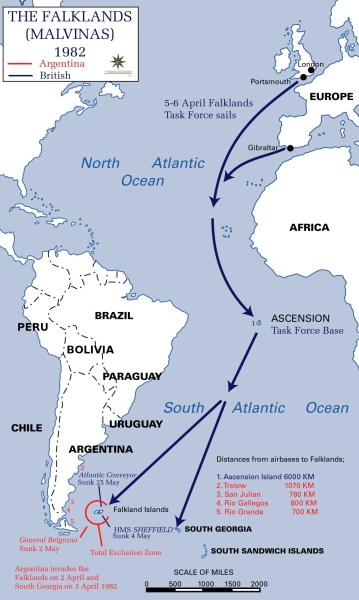 Distances from British airbases to the Falklands. (Image: Wikimedia Commons)
— “The Falkland Islands have been under continuous British administration since 1833, though the roots of the enmity stretch further back to the British invasions of Buenos Aires in the early 19th century. Argentina has long claimed that it inherited the islands’ sovereignty from Spain after independence.”
— “In 1982, military dictator Leopoldo Galtieri’s decision to invade the islands, to shore up domestic support amid economic turmoil and public anger over the junta’s human rights abuses, ended in a British victory under Margaret Thatcher, hastening the dictatorship’s collapse and Argentina’s return to democracy. But the “Malvinas” remained deeply embedded in Argentina’s national consciousness. Every football match against England thereafter was played under the shadow of a war neither side had left behind.”
Do You Know:
— The FIFA World Cup 2026 kicked off on June 11 with Mexico taking on South Africa at the Azteca Stadium in Mexico City. The 2026 FIFA World Cup is being co-hosted by the United States, Canada, and Mexico.
— The World Cup is the international soccer tournament that has been held every four years by FIFA since 1930. The last FIFA World Cup was held in Qatar in 2022.
— The 2026 FIFA World Cup features three official mascots to represent the three host nations: ‘Maple’ the Moose (Canada), ‘Zayu’ the Jaguar (Mexico), and ‘Clutch’ the Bald Eagle (United States).
Other Important Articles Covering the same topic:
📍Knowledge Nugget: How Argentina’s FIFA semifinal win brought Falkland Islands dispute into spotlight
UPSC Prelims Practice Question Covering similar theme:
(4) Consider the following statements with reference to the Falkland Islands dispute:
1. The Falkland Islands are located in the South Atlantic Ocean.
2. The 1982 Falklands War ended with Argentina regaining control of the islands.
Which of the statements given above is/are correct?
(a) 1 only
(b) 2 only
(c) Both 1 and 2
(d) Neither 1 nor 2
ECONOMY
India’s 3 inflations: Clues from prices on consumption, profits & China dependence
Syllabus:
Preliminary Examination: Economic and Social Development.
Mains Examination: General Studies-III: Indian Economy and issues relating to planning, mobilization, of resources, growth, development and employment.
What’s the ongoing story: This week, the government released three different measures of inflation – Consumer Price Index (CPI), Wholesale Price Index (WPI), and Producer Price Index (PPI) – for the month of June. The common theme across all three was that prices rose at a faster rate in June compared to May on the back of higher food inflation and elevated fuel prices, thanks to the weak rains and the West Asia war.
Key Points to Ponder:
— What is inflation? How is inflation measured in India?
— What is the difference between CPI, WPI and PPI?
— What is the difference between core and headline inflation?
— What are the factors that affect the inflation rate in India?
— What are the impacts of high inflation on the economy?
— What are the recent changes introduced in CPI and WPI?
Key Takeaways:
— CPI inflation, which is relevant for households, rose to 4.38% from 3.93% in May; WPI inflation, which measures the year-on-year change in wholesale prices, increased to 9.87% from 9.68%; and output PPI inflation edged up to 9.57% from 9.38%. But the price situation in the country is more complex than just an increase in inflation.
—The 4% inflation the Reserve Bank of India targets refers to headline CPI inflation. And while that crossed 4% in June for the first time in 17 months, core inflation was unchanged at 3.9%.
— Core inflation measures the year-on-year change in prices for items other than food and fuel, which can be volatile. Households also may not drastically change their consumption of food and fuel just because prices rose or fell – people can’t give up eating and necessary travel. This is why focussing on the non-food-non-fuel portion of the CPI can provide more useful information. Economists think core inflation suggests consumption is subdued.
— The most widely-used core inflation measure has risen only 20 basis points over the last six months from 3.7% in January. A narrower version of core inflation that also excludes gold and silver jewellery – precious metal prices have rapidly risen and fallen over the last 12 months or so – has also edged up to 2.5%. However, it was as high as 6% in early 2023.
— Also pulling down India’s non-food-non-fuel-non-precious metal inflation is falling prices of Chinese goods. With China’s Producer Price Index (PPI) inflation in negative territory from October 2022 to February 2026, India has been importing ‘deflation’ from China.
— The GST rate cuts and the subsequent price reductions of last year also explain why core inflation has been subdued over the better part of the last one year. However, this low base effect will vanish in a couple of months.
Do You Know:
— Inflation refers to the rate at which the general price level for goods and services increases over a period of time, causing a decrease in purchasing power of money or real income. There are different methods for measuring inflation such as Consumer Price Index, Wholesale Price Index (WPI), GDP deflator, and more, with each focusing on a specific aspect of price changes.
— Consumer Price Index (CPI) Inflation relates to consumer prices of all goods purchased by the consumer, which may be either domestically produced or imported.
— CPI inflation is the most important economic indicator in the country as it directly influences the level of interest rates set by the Reserve Bank of India (RBI). The central bank has a legal mandate to target a CPI inflation rate of 4% in the medium term within a tolerance band of 2-6%.
— Wholesale Price Index (WPI): While the CPI measures the price changes in the retail market (maximum retail pricesMRP, inclusive of taxes), the WPI measures the price changes in the wholesale market. Say, for example, the price of a commodity (such as onions) would vary depending on the fact that it is bought from the wholesale market or retail market.
— GDP deflator: The GDP deflator (also called implicit price deflator) is the ratio of the value of goods and services an economy produces in a particular year at current prices to that at prices prevailing during any other reference (base) year.
Other Important Articles Covering the same topic:
📍Knowledge Nugget: CPI vs WPI and Inflation basics for UPSC preparation
Previous year UPSC Prelims Question Covering similar theme:
(5) Consider the following statements: (UPSC CSE 2020)
1. The weightage of food in Consumer Price Index (CPI) is higher than that in Wholesale Price Index (WPI).
2. The WPI does not capture changes in the prices of services, which CPI does.
3. The Reserve Bank of India has now adopted WPI as its key measure of inflation and to decide on changing the key policy rates.
Which of the statements given above is/are correct?
(a) 1 and 2 only
(b) 2 only
(c) 3 only
(d) 1, 2 and 3
Data breach revives memories of 2019 cyber attack at Kudankulam
Syllabus:
Preliminary Examination: Current events of national importance.
Mains Examination: General Studies-III : Infrastructure: Energy, Challenges to internal security through communication networks.
What’s the ongoing story: A data breach has exposed information linked to the Kudankulam Nuclear Power Plant (KKNP), India’s flagship nuclear project located in Tamil Nadu’s Tirunelveli district.
Key Points to Ponder:
— Know about the Kudankulam Nuclear Power Plant (KKNP) and its significance.
— What is the dark web?
— What is ransomware?
— What are the cybersecurity concerns related to India’s critical and strategic infrastructure?
— How do high-security setups work?
— What are air-gapped networks?
—What steps should be taken to strengthen the cyber resilience of critical infrastructure?
Key Takeaways:
— For nearly a month, numerous documents purportedly linked to the plant — including engineering drawings, inspection records, minutes of meetings, technical reports and official correspondence — have been circulating on the dark web after it was leaked by ransomware group World Leaks.
— The Nuclear Power Corporation of India Ltd (NPCIL), which operates the plant, has downplayed the leak, maintaining that documents relate only to non-critical facilities outside the ‘reactor island’ and pose no risk to nuclear safety.
— Reactor island refers to the central, highly protected section of a nuclear power plant where all nuclear processes and critical safety operations take place.
— Yet, the breach has renewed cybersecurity concerns over India’s critical and strategic infrastructure, particularly at a time when the government has begun opening up the tightly regulated civil nuclear sector to private participation.
— The incident has also drawn particular attention because it is not the first time the Kudankulam plant has been linked to a cyber incident. In 2019, malware attributed to a North Korean hacking group was detected within the plant’s administrative network, highlighting the persistent cyber risks facing India’s strategic nuclear assets.
— The 2019 cyber incident was not confined to the KKNP. It also affected the Indian Space Research Organisation (ISRO). The breach became public on October 28, 2019, after some of the plant’s data showed up on virustotal.com, an online malware scanning service..
— Subsequent investigations by multiple cybersecurity agencies and experts attributed the intrusion to DTrack malware, which was linked to the North Korea-backed Lazarus Group, “an umbrella name that typically describes hacking activity which advances Pyongyang’s interests”.
— According to cybersecurity analysts, Dtrack belongs to the same family of malware that was linked to the 2016 cyberattack on an Indian private bank’s ATM network. It spread across the banking system and forced the replacement of an estimated 2.9-3.2 million compromised debit and credit cards.
— Most high-security setups operate on two “air-gapped”, or separate, networks. The first is a standalone control system that runs the core function — reactors in the case of a nuclear power plant. The other is an online network responsible for the rest of the functions.
— Air-gapped networks, however, are not considered foolproof. Such systems have been compromised in the past, including at the Davis–Besse Nuclear Power Station in Ohio in 2003, and in breaches involving classified US military networks in 2008.
Other Important Articles Covering the same topic:
📍 Kudankulam nuclear plant files on the dark web: Inside the alleged data leak
📍Kalpakkam fast breeder reactor attains criticality: why this is a ‘defining step’ in India’s 3-stage n-programme
ALSO IN NEWS
National Film Awards for Mammootty, Kartik, Yami
— The winners of the 72nd National Film Awards were announced in New Delhi on Saturday, with Article 370 emerging as the Best Feature Film. While Yami Gautam won the Best Actress award for her performance in Article 370, Kartik Aaryan (Chandu Champion) and Mammootty (Bramayugam) shared the Best Actor honour. Rajkumar Periasamy was named Best Director for Amaran. Kalki 2898 AD, Srikanth and Captain Miller were also among the big winners.

Centre defers domestic solar cell sourcing mandate till December 31
— One-and-a-half month after implementing mandatory domestic cell sourcing mandates for all domestic, commercial and industrial solar projects, the Ministry of New and Renewable Energy (MNRE) on Saturday exempted these projects from the mandatory cell sourcing requirement till December 31.
— The exemption comes after the government had on May 25 said that there would be “no blanket” relief for domestic cell sourcing mandates despite developers seeking an extension of the deadline.
— Cells are the building blocks of solar modules that convert sunlight into electricity. The manufacturing chain begins with polysilicon, which is processed into ingots. These ingots are sliced into wafers, which, in turn, are used to manufacture solar cells. These cells are subsequently assembled into modules, or panels.
— India has a large solar module manufacturing base, nearly 200 gigawatts (GW) per annum. But the manufacturing capacity of cells, the primary constituents of these modules, is far lower at around 30 GW. This means much of the module manufacturing capacity has been built upon imported cells.
— Even though the mandatory domestic cell sourcing mandate is aimed at reducing India’s dependence on imports and strengthening the domestic solar manufacturing ecosystem, it could disproportionately affect smaller solar module manufacturers which, unlike larger companies, may not manufacture their own cells.
— The mandate also threatened to hit the country’s flagship solar rooftop program, PM Surya Ghar: Muft Bijli Yojana by pushing up domestic solar cell prices and limiting the availability of rooftop solar panels.
Mount Olympus, home of ancient Greek gods, nominated for UNESCO World Heritage List
— Snow-capped for much of the year, Mount Olympus, the mythological home of ancient Greece’s 12 Olympian gods, has captured the imagination through the millennia. Rising to 2,918 metres from a base practically at sea level, the ancient Greeks believed the throne of Zeus, king of the gods, stood on the highest of its craggy, often mist-shrouded peaks.
— Now, modern-day Greeks hope their tallest mountain will be inducted into UNESCO’s World Heritage List as a mixed cultural and natural site. The nomination will be discussed when the World Heritage Committee meets in Busan, South Korea, from Sunday through July 29.
India amends tax treaty with Sri Lanka to plug avoidance
— India has amended its tax treaty with Sri Lanka to tighten loopholes in double taxation avoidance and to curb revenue leakage by preventing treaty abuse. The intention for amending the pact has been to eliminate double taxation without creating opportunities for non-taxation or reduced taxation through tax evasion or avoidance through treaty-shopping arrangements.
— The amended protocol between the two countries was brought into force on June 19 this year and has now been notified by the Ministry of Finance.The provisions of the amended protocol will apply in India on income derived beginning April 1, 2027.
PRELIMS ANSWER KEY
1. (a) 2. (c) 3. (b) 4. (a) 5. (a)
Subscribe to our UPSC newsletter. Stay updated with the latest UPSC articles by joining our Telegram channel – Indian Express UPSC Hub, and follow us on Instagram and X.
🚨 Click Here to read the UPSC Essentials magazine for July 2026. Share your views and suggestions in the comment box or at manas.srivastava@indianexpress.com🚨