Prateek Tanmay

Preliminary Examination: Current events of national and international importance
Mains Examination: General Studies-II: Bilateral, regional and global groupings and agreements involving India and/or affecting India’s interests
What’s the ongoing story: In a move that is expected to impact a large number of US-bound Indians, the Donald Trump administration on Thursday moved to tighten the visa duration for foreign students, journalists and cultural exchange visitors.
Key Points to Ponder:
— What is the issue related to US-visas?
— What are F-1 visas?
— What are the areas of cooperation between India and the US?
— What are the reasons that the US is tightening its regime on Visas?
— What are the different types of visas offered by the US?
— How does the change in visas impact US-bound Indians?
— What is the issue of immigration in the US?
Key Takeaways:
— According to a US government notice, the new final rule from the Department of Homeland Security (DHS) creates a fixed time period for F visas for international students, J visas that allow visitors on cultural exchange programmes to work in the US, and I visas for members of the media. Currently, these visas are available for the duration of the programme or employment in the US.
— Under the new regulations, the student and exchange visa periods would be no longer than four years. The visa for journalists — which currently can last years — would be for up to 240 days or, in the case of Chinese nationals, 90 days. The visa holders could apply for extensions, it said.
— The regulations also prohibit graduate students from changing their “educational objectives” at any point, or from transferring to another school without authorisation. They halve the amount of time students have to leave the US after completing their degree or training, from 60 to 30 days.
— Among Indian students, the US is a favoured destination for higher education. As of January 2025, there were about 300,000 Indian students in the US, mostly in graduate (Masters) programmes in STEM (Science, Technology, Engineering and Mathematics) fields.
— The significant increase in the volume of such visitors “poses a challenge to DHS’s ability to monitor and oversee these non-immigrants while they are in the United States,” it said. DHS said it has many examples of students and exchange visitors staying for decades on their visas.
Do You Know:
— While the DHS visa rules will not stop the upcoming fall intake, the rules do create significant administrative challenges and uncertainty for new students. The final rule takes effect on September 15, by which time Fall admissions and visa processes are generally complete.
— The policy change also moves oversight from university staff back to federal authorities and subjects applicants to biometric vetting, background checks, and fraud screenings, the DHS said. It further institutes strict limitations on academic changes.
— Experts point out that there is still a lack of clarity, and processes will become clearer once the rules become applicable in mid-September. However, they say that in their new form, the rules may complicate things for people who are already in the US.
Other Important Articles Covering the same topic:
📍With a $100k price tag on H-1B visas, is it the end of Indians’ American dream?
📍How US move to shrink visa duration will hurt students already in the country
Previous year UPSC Mains Question Covering similar theme:
Indian diaspora has a decisive role to play in the politics and economy of America and European Countries.’ Comment with examples (UPSC CSE 2020)
POLITICS
Hydrogen Train rolls out today; leak detectors, auto shutdown, real-time monitoring on track
Syllabus:
Preliminary Examination: Current events of national and international importance
Mains Examination: General Studies-III: Achievements of Indians in science & technology; indigenization of technology and developing new technology
What’s the ongoing story: India’s first hydrogen-powered train, to be flagged off by Prime Minister Narendra Modi from Haryana’s Jind railway station on Friday, has multiple layers of safety features that can detect gas leak, heat, and smoke, and an automatic shut-off system that will cut off the hydrogen supply, without waiting for manual reaction, in case anything unusual is found.
Key Points to Ponder:
— What are hydrogen-powered trains?
— What are its pros and cons?
— Know about the characteristics of hydrogen as a fuel
— What is the National Hydrogen Mission?
— What is the significance of decarbonisation of the railways sector?
— What are the efforts taken by the government to reduce carbon emissions from railways?
— What is the significance of Railways in India?
— What is a Proton Exchange Membrane (PEM) fuel cell?
Key Takeaways:
— With the launch of the 10-coach train, which will operate between Jind and Sonipat section of Northern Railway, India will join a select group of nations that has adopted the clean technology.
— Unlike electric trains that draw power from overhead wires, the Hydrogen Fuel Cell Trainset generates electricity on board through a Proton Exchange Membrane (PEM) fuel cell.
— Hydrogen stored in cylinders reacts with oxygen from the atmosphere to produce electricity for the traction motors, with water vapour and heat as the only direct by-products.
— Given hydrogen’s highly flammable nature, the train is equipped with multiple layers of safety systems. The loco pilot’s cabin has been designed to keep the person safe, with a special mode that allows the train to be moved to safety in an emergency and a screen that shows the loco pilot the real health of the whole system at all times.
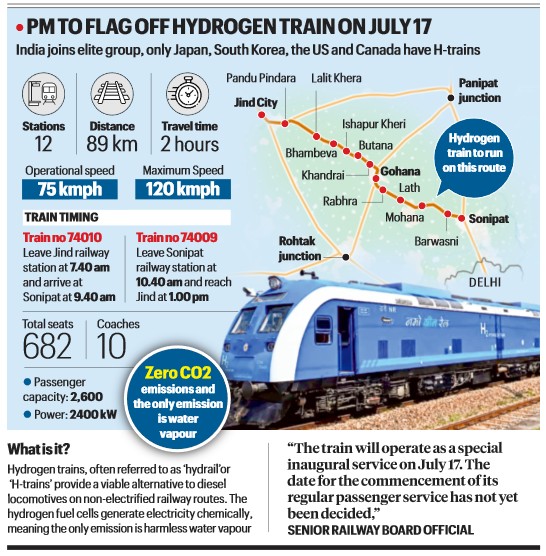 The hydrogen train’s route.
— The dedicated hydrogen storage, compression and dispensing facility established at Jind too has similar safety features, including leak and flame detectors, automatic shutdown systems, fire alarms and water spray arrangements.
— Globally, hydrogen-powered rail transport remains at an early stage. Germany was the first country to introduce commercial hydrogen passenger trains, while France, Italy, China and Japan have either pilot projects or limited deployments, largely on short regional routes with two to four coaches.
— The Indian Railways is also exploring the deployment of hydrogen technology on heritage railways, including the Kalka-Shimla route, by leveraging the experience gained through the Jind-Sonipat hydrogen train project, it said.
Do You Know:
— Decarbonisation of the railways is a significant step towards attaining the net-zero goal by 2070. Indian Railways under “Hydrogen for Heritage” envisages deploying 35 hydrogen-powered trains on heritage and hill routes across the country.
— The National Green Hydrogen Mission was approved by the Union Cabinet in 2023, recognising the role of Green Hydrogen in India’s ambitions of energy independence by 2047 and Net Zero by 2070.
— The mission aims to build capacity to produce Green Hydrogen at least 5 MMT (Million Metric Tonne) per annum by 2030, with potential to reach 10 MMT per annum with growth of export markets.
| Types of Hydrogen | |
| Grey Hydrogen | It constitutes the bulk of India’s production. It is mainly produced through steam methane reforming (SMR), in which natural gas (methane) is used as the feedstock. The process relies on fossil fuels and releases carbon dioxide into the atmosphere |
| Blue Hydrogen | Production of hydrogen from coal/natural gas combined with Carbon Capture and Storage (CCS). CCS is a way to catch carbon and trap it beneath the earth. It is different from carbon dioxide removal (CDR) — where carbon is sucked out of the atmosphere. The byproducts, like carbon monoxide and carbon dioxide, are captured and stored. |
| Green Hydrogen | In this, hydrogen is produced from water electrolysis—splitting water into hydrogen and oxygen—by using renewable energy-powered electrolysers. It is considered a virtually emission-free pathway for hydrogen production. |
Other Important Articles Covering the same topic:
📍India’s first hydrogen train: How does hydrogen fuel cell technology work?
Previous year UPSC Prelims Question Covering similar theme:
(1) Which of the following statements with regard to Green Hydrogen is/are correct? (UPSC CSE 2026)
1. It is decarbonized hydrogen obtained from natural gas reforming combined with carbon capture and storage (CCS).
2. It is produced using electrolysis of water with electricity generated by renewable energy.
3. The National Green Hydrogen Mission of India aims for an abatement of nearly 50 MMT of annual greenhouse gas emissions by 2030.
Select the answer using the code given below:
(a) 1 only
(b) 2 and 3 only
(c) 2 only
(d) 1, 2 and 3
Previous year UPSC Mains Question Covering similar theme:
Why is Public Private Partnership (PPP) required in infrastructural projects? Examine the role of PPP model in the redevelopment of Railway Stations in India. (UPSC CSE 2022)
THE IDEAS PAGE
DIS/AGREE
Syllabus:
Preliminary Examination: Current events of national and international importance
Mains Examination: General Studies-II: Issues relating to development and management of Social Sector/Services relating to Health, Education, Human Resources.
What’s the ongoing story: Private equity in health and education is to be welcomed. Several lakh crores are being invested by foreign and Indian PEs, especially into hospitals, diagnostics and home healthcare services, and to a comparatively lesser degree, into education.
Key Points to Ponder:
— What is the status of the Education and Health sector in India?
— What are the advantages and disadvantages of allowing private investments in these sectors?
— Why is there a need for private investment in Health and Education?
— Educator John Gardner challenged policymakers and entrepreneurs to design education systems that are equal and excellent. What are the challenges in doing this?
Key Takeaways:
Remember who real stakeholders are
— Shailaja Chandra writes: Care continues to be delivered by smaller, fragmented facilities. But the infusion of equity into corporate hospitals marks two things: India has the capacity to provide quality care in health, and the country has a huge market, both Indian and international, which will assure wholesome returns.
— For over three decades, policy has encouraged private investment in hospitals and allied sectors. Public hospitals have not been able to meet rising demand.
— Private equity funds carry a fiduciary duty to deliver attractive returns to their investors within a defined investment horizon. PEs have no mandate to protect patients.
— Private equity funds carry a fiduciary duty to deliver attractive returns to their investors within a defined investment horizon. PEs have no mandate to protect patients. Their focus is almost exclusively on financial performance.
— However, the government has the responsibility to ensure that returns are achieved not merely through cost-cutting or expansion, but through efficiency and quality. Unlike other industries such as banking, telecom, electricity, and civil aviation, healthcare has no independent regulator with statutory powers, appellate processes, reporting obligations, penalties, or mechanisms for public accountability.
— Other countries, too, allow private equity investment in the hospital sector, but they regulate outcomes. England’s Care Quality Commission inspects both National Health Service hospitals and private hospitals. Its reports are public.
— The challenge before the government is not to discourage investment but to ensure that patients and students remain at the centre of the health and education systems. Institutions already collect outcome data. Government now needs the resolve to direct that it be made public.
More education entrepreneurs needed
Manish Sabharwal writes: India hasn’t created mass prosperity alongside its magnificent creation of mass democracy because of an uneasy relationship with entrepreneurship in general.
— Supply: Princeton Professor Avinash Dixit’s suggestion that life is second-best at best implies a pragmatic acceptance that the most expensive school is no school.
— Only half of our kids are left in government schools; if anything constitutes the infrastructure of opportunity and should be free in a country, it is K-12 education. Yet, the private sector now teaches 120+ million students: Millions of India’s poor parents pay something to avoid something free.
— Biodiversity: Goodhart’s Law holds that when a metric becomes a goal, it ceases to be useful. The state’s failure to fix government schools stems from confusing school buildings with building schools.
— Cracking this complexity requires inspiration from Hayek’s discovery principle: Unlike infrastructure, educational quality cannot be mandated; it must be discovered through competition, experimentation, and replication.
— Entrepreneurs making many independent and diverse tries with differing goals, strategies, and resources will not solve our education problems but will surely catalyse the innovation that could.
— Meritocracy: India’s education regulations prescribe land size, building norms, and legal structures. These make setting up a school or university capital-intensive, given rising building costs and mispriced land so early in our development (a new Bengaluru or Mumbai school with a reasonable commute will pay more per acre for land than in Chicago).
— This creates an adverse selection among education entrepreneurs — most are politicians or land sharks — because success requires upfront capital and lifelong regulatory skills.
— Excellence: AI is bringing weaker students to the median while making strong students stronger. The second is accelerating; the power law of 80 per cent of results coming from 20 per cent of the people in technology, innovation, research, and science is shifting to 90/10.
— Countries that aspire to lead the world will need to complement mass education programmes (that count students) with gifted-student programmes (that weigh them).
— Honesty: My unscientific survey suggests that 75 per cent of capacity in K-12, engineering, business, and undergraduate education over the last three decades is legally, but not spiritually, non-profit.
— Educator John Gardner challenged policymakers and entrepreneurs to design education systems that are equal and excellent. The difficulty of this trade-off is dismissed as a lack of idealism by thinkers who don’t do and a lack of pragmatism by doers who don’t think.
— Historian Thucydides warned us that any army with a big gap between its thinkers and doers will have its fighting done by fools and its thinking done by cowards. The same doer-thinker disease that hurts Indian education has a simple medicine: Idealism without illusions.
Other Important Articles Covering the same topic:
📍Yogendra Yadav writes: Question isn’t whether we should study Indian Knowledge Systems, but why and how
Previous year UPSC Mains Question Covering similar theme:
National Education Policy 2020 is in conformity with the Sustainable Development Goals-4 (2030). It intended to restructure and re-orient the education system in India. Critically examine the statement. (UPSC CSE 2020)
EXPLAINED
Nolan’s vision and India’s screens
Syllabus:
Preliminary Examination: Current events of national and international importance
Mains Examination: General Studies-III: Science and Technology- developments and their applications and effects in everyday life
What’s the ongoing story: ‘The Odyssey’s’ release today marks a landmark technical achievement in the world of film—it is the first full length feature movie shot entirely on an IMAX camera.
Key Points to Ponder:
— What is ‘Keighley Camera’?
— What do you understand from 15 perforation/70mm film reel?
— How does the camera work?
— What’s an IMAX camera?
— Who is the author of The Odyssey?
— What is the theme of the epic The Odyssey?
Key Takeaways:
— Nolan has advocated that his films be watched on an IMAX screen that projects the analog 15 perforation/70mm film reel developed from the original colour negative (OCN).
— While IMAX cameras capture better image resolution and details than others, they are both expensive and inconvenient to regularly handle due to their size and deafening internal motors. To bypass this, Nolan and the IMAX team created a new camera titled the ‘Keighley Camera’. This camera is housed inside a novel carbon-fibre casing termed ‘The Blimp,’ reducing the sound of the motors by 30-50%.
— India, however, will only screen digital versions of the film.
— The 15 perforation/70mm film reel refers to the physical reel where the strip’s width is 70mm with 15 perforations or sprocket holes punched alongside its edge. These holes advance the film frames during projection. This technique yields an image resolution equivalent to 18K and a towering 1.43:1 aspect ratio.
— Once the film is captured on celluloid, the post-production process is what sets apart the analog print of ‘The Odyssey’ from other versions. ‘The Odyssey’ employed an analog-only post production pipeline with limited digital corrections for VFX heavy scenes.
— The Indian IMAX landscape is currently populated by three tiers of digital projection: dual 2K Xenon systems, single-lens 4K Commercial Laser (CoLa) and the 4K XT Laser.
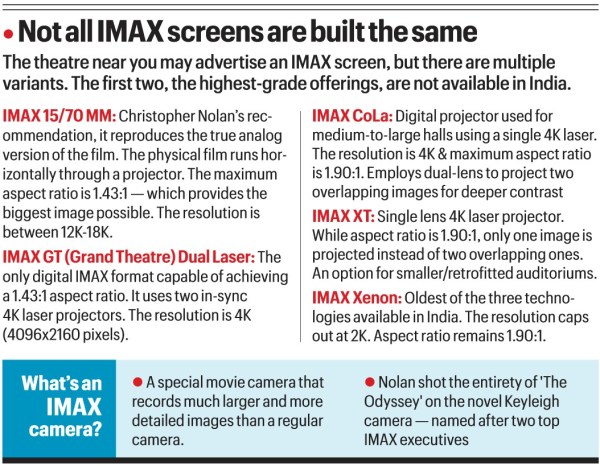 Different IMAX technologies
— Both IMAX CoLa and XT systems are restricted by their architecture and digital systems to a maximum aspect ratio of 1.90:1. The CoLa projector is utilised for medium-to-large auditoriums and is typically paired with IMAX’s 12 channel audio system. The IMAX XT system is a newer and cost-effective solution deployed in retrofitted multiplex screens (typically under 50 feet wide).
— The only digital system capable of achieving a 1.43:1 aspect ratio is the IMAX Grand Theatre (GT) Dual Laser which uses two synchronized 4K laser projectors. As of 2026, no commercial cinema in India operates an IMAX GT Dual Laser system.
— When The Odyssey—shot to fill a towering 1.43:1 canvas—is projected onto India’s 1.90:1 CoLa or XT screens, the image is expanded horizontally to fit the screen width, but the top and bottom of the frame are permanently truncated.
— This does provide an advantage —Indian exhibitors do not receive a 300-kg metal platter containing sensitive film inside; they receive an encrypted, digital hard-drive that greatly democratises the distribution of the film.
From the Explained page: Before watching The Odyssey, a primer on the epic
— Christopher Nolan’s adaptation of The Odyssey arrives in cinemas on July 17, introducing one of the oldest surviving works of Western literature to a new generation of viewers.
— Despite its enduring influence, many readers and filmgoers know The Odyssey more by reputation than by its story. Written nearly 3,000 years ago, it is a story of homecoming after war, set in a world populated by gods, monsters and mortals.
— One of the foundational works of Western literature, The Odyssey is one of two epic poems traditionally attributed to the Greek poet Homer, and generally dated to the eighth century BCE.
— Both the Iliad and The Odyssey have sparked debate about their authorship, triggering what is known as the Homeric Question. Scholars continue to debate whether Homer was a historical individual, a name attached to an oral poetic tradition, or some combination of both.
— The Iliad and The Odyssey are companion epics set within the same mythic tradition. While the Iliad recounts a brief episode during the Trojan War, The Odyssey follows Odysseus’ decade-long journey home after the war has ended. It is often cited as one of literature’s earliest and most influential “hero’s journeys”.
— Wilson notes that the story being recounted in this poem is “small and ordinary”, that of “a man” who is “not ‘the’ man, but one of many men — albeit a man of extraordinary cognitive, psychological and military power”.
— She also notes that, contrary to the reader’s expectation of what we conventionally understand as an “epic” narrative, The Odyssey recounts “the story of a man whose grand adventure is simply to go back to his own home, where he tries to turn everything back to the way it was before he went away. For this hero, mere survival is the most amazing feat of all.”
Do You Know:
— Nearly three thousand years after it was first composed, The Odyssey continues to inspire readers as the questions it asks remain deeply relevant. Every generation has found something different in the poem.
— For the ancient Greeks, it reflected the uncertainties of travel and seafaring. Later readers saw a tale of endurance and self-discovery. Today, it is often read as a meditation on displacement, exile, and the lasting consequences of conflict.
— Its themes resonate in a world marked by migration and war. Millions of people have been forced from their homes by conflict, persecution or economic hardship. Odysseus’s struggle to return speaks not only to refugees and exiles, but also to those who discover that coming home is itself a difficult journey.
— He returns to a son he scarcely knows, a household in disorder and a kingdom transformed by his absence. The epic recognises that journeys change both the traveller and the destination.
— Wilson has described The Odyssey as “the story of a man trying to get home.” The description is deceptively simple. Beneath the adventures lies a meditation on family, memory, resilience and belonging. The poem asks enduring questions: What do we owe to those we leave behind? How do we rebuild our lives after conflict? And what does it mean to belong somewhere again?
— Perhaps that is why artists continue to return to Homer’s epic. Every adaptation reflects the concerns of its own age, whether as an adventure, a war story, a family drama or a tale of self-discovery.
Other Important Articles Covering the same topic:
📍Why The Odyssey has endured for nearly 3,000 years
NATION
Drones reduce time and cost of TB diagnosis: Study
Syllabus:
Preliminary Examination: Current events of national and international importance
Mains Examination: General Studies-III: Issues relating to development and management of Social Sector/Services relating to Health, Education, Human Resources
What’s the ongoing story: Drones can be very effective in reducing the time and cost of tuberculosis (TB) diagnosis, according to a study conducted by the Indian Council of Medical Research (ICMR) in Telangana.
Key Points to Ponder:
— What is TB?
— What is the status of TB in India?
— What are the efforts taken by the government to eradicate TB from India?
— What is the role of AI in the health sector? Cite some examples.
— What is out-of-pocket expenditure?
— What are the challenges on the path eliminating TB?
— Read about India’s National Tuberculosis Elimination Programme (NTEP).
— What are the socioeconomic implications of high TB incidence in India?
Key Takeaways:
— In areas where drones were used to carry patient samples to centres with molecular diagnostics, the average time to receive a TB diagnosis reduced from 16.6 days to 6.9 days. Importantly, the cost for this diagnosis went down from Rs 9,451 to just Rs 91, according to the study.
— This comes at a time when the government is looking towards various innovations, including several AI tools, to catch up with the global deadline of eliminating TB by 2030. India missed the deadline it set for itself for eliminating TB by 2025.
— A hub-and-spoke drone network was established between 60 sub-centres, 11 primary health centres and four TB units in Telangana — Alair, Bhongir, Ramannapet, and Choutuppal — to test samples. The aim was to see whether it can actually improve the efficiency of TB diagnosis in remote and rural areas.
— Before the i-Drone initiative, patients would have to travel anywhere between 10 and 30 km by road with often limited transport facilities to get themselves tested. Now, they can go to their nearest sub-centre or primary health centre — which does not have the molecular diagnostic tests but can collect samples — and give their sputum samples that are transported using drones.
— Two types of drones were used for the initiative — an 11.5 kg drone that could carry a 2-kg payload and a 24-kg drone that could carry an 8 kg payload. Detailed flight routes were pre-programmed, keeping in mind the terrain, population density, and no-fly zones. Safe take-off and landing sites were also created at these health centres and TB units.
— Other than the reduced time and out-of-pocket expenditure, the study found that the proportion of persons receiving their diagnosis within a day or two also went up.
Do You Know:
— TB is caused by an organism called mycobacterium tuberculosis, which mainly affects the lungs, but can also impact other parts of the body. TB spreads through the air when an infected individual coughs, sneezes, or speaks.
— Once diagnosed, the treatment depends on whether it is drug-resistant or simple tuberculosis. According to experts, when recovering from TB, it is critical to consume a well-balanced and nutritious diet to help strengthen the immune system.
Other Important Articles Covering the same topic:
📍Knowledge Nugget: Everything you need to know about WHO’s Global TB Report 2025 and beyond
Previous year UPSC Prelims Question Covering similar theme:
(2) Which of the following diseases can be transmitted from one person to another through tattooing? (UPSC CSE 2013)
1. Chikungunya
2. Hepatitis B
3. HIV-AIDS
Select the correct answer using the codes given below:
(a) 1 only
(b) 2 and 3 only
(c) 1 and 3 only
(d) 1, 2 and 3
ECONOMY
RBI introduces SNFA category, bars banks from selling assets back to defaulters
Syllabus:
Preliminary Examination: Current events of national and international importance
Mains Examination: General Studies-III: Indian Economy and issues relating to planning, mobilisation of resources, growth, development and employment.
What’s the ongoing story: The Reserve Bank of India (RBI) has introduced the concept of specified non-financial assets (SNFAs) in the event of loan defaults and mandated that disposal of such assets should primarily be through public auctions under SARFAESI Act principles and prohibited resale to the original borrower or related parties.
Key Points to Ponder:
— What is SARFAESI Act?
— Why was it introduced?
— What are non-performing assets (NPA)?
— How do banks settle with the defaulters?
— How are NPAs declared?
— What are the different classification of NPAs?
Key Takeaways:
— SNFAs refer to immovable properties that banks acquire when borrowers fail to repay loans. Such assets include residential buildings, commercial properties, industrial land or other real estate accepted by banks in settlement of outstanding debt.
— The RBI has issued the Third Amendment Directions, 2026 under its Commercial Banks-Resolution of Stressed Assets Directions, 2025. The new regulations establish a comprehensive framework for how banks should acquire, value, manage and dispose of non-financial assets obtained from defaulting borrowers.
— According to the new directions, banks may acquire an SNFA only after a borrower’s loan has been officially classified as a non-performing asset (NPA). The acquisition must involve either full or partial settlement of the bank’s outstanding exposure.
— In cases where only part of the loan is settled through the transfer of property, the remaining debt will continue to be treated under restructuring norms, ensuring that banks maintain appropriate provisioning and risk management standards.
— The amendment also requires every commercial bank to formulate a detailed internal policy governing the acquisition and disposal of SNFAs. The policy must specify eligibility criteria, approval procedures, recovery efforts to be attempted before acquiring property, limits on such assets relative to total bank assets and a clear timeline for disposal.
— Under the revised norms, banks are prohibited from selling repossessed properties back to the original borrower or any related parties, even if the property later ceases to be classified as an SNFA.
— This measure is expected to prevent misuse of the recovery process and improve transparency. Banks had encountered several cases in the past where defaulters claimed return of the property seized by banks.
— The RBI has also clarified accounting and disclosure requirements. SNFAs will no longer be counted as part of gross NPAs, net NPAs or stressed assets. Instead, they will appear separately in bank balance sheets under the category “non-banking assets acquired in satisfaction of claims.”
Do You Know:
— Securitisation and Reconstruction of Financial Assets and Enforcement of Security Interest (Sarfaesi) Act of 2002 was brought in to guard financial institutions against loan defaulters. To recover their bad debts, the banks under this law can take control of securities pledged against the loan, manage or sell them to recover dues without court intervention. The law is applicable throughout the country and covers all assets, movable or immovable, promised as security to the lender.
— The Act comes into play if a borrower defaults on his or her payments for more than six months. The lender then can send a notice to the borrower to clear the dues within 60 days. In case that doesn’t happen, the financial institution has the right to take possession of the secured assets and sell, transfer or manage them.
Other Important Articles Covering the same topic:
📍Explained: What is the Sarfaesi Act, invoked against telecom provider GTL?
Previous year UPSC Prelims Question Covering similar theme:
(3) With reference to the evergreening of loans, consider the following statements:
1. Banks adopt the evergreening of loans to avoid classifying a loan as a non-performing asset (NPA).
2. It is a process whereby a lender tries to revive a loan that is on the verge of default or in default by extending more loans to the same borrower.
3. The process of evergreening of loans is a temporary fix for a bank.
How many of the statements given above are correct?
(a) Only one
(b) Only two
(c) All three
(d) None
ALSO IN NEWS
Skyroot to launch Vikram-1 orbital rocket tomorrow
Indian space-tech startup Skyroot Aerospace will attempt the first orbital launch of its indigenously developed rocket, Vikram-1, on Saturday, July 18, at 11.30 am, from the country’s premier spaceport at the Satish Dhawan Space Centre in Sriharikota. The mission, named ‘Aagaman’, meaning ‘arrival’, marks a milestone for India’s private space sector: the nation’s first-ever attempt to place a payload into orbit using a completely privately developed launch vehicle.
Vaishno Devi ‘silver’ row: how the shrine stores, guards offerings
A court in Jammu is hearing a plea claiming possible adulteration and misappropriation of silver worth around Rs 550 crore donated by devotees at the Shri Mata Vaishno Devi Shrine.
The controversy arose from reports that only around 5-6% of the approximately 20 tonnes of the shrine’s accumulated silver offerings was found to be actual silver. The complainant sought an investigation into whether devotees had been sold fake silver articles, or whether genuine silver offerings had been diluted and pilfered after their receipt.
PRELIMS ANSWER KEY
1. (b) 2. (b) 3. (c)
Subscribe to our UPSC newsletter. Stay updated with the latest UPSC articles by joining our Telegram channel – IndianExpress UPSC Hub, and follow us on Instagram and X.
🚨 Click Here to read the UPSC Essentials magazine for July 2026. Share your views and suggestions in the comment box or at manas.srivastava@indianexpress.com🚨