Prateek Tanmay
India officially recorded more than 99% of its estimated births and deaths in 2024, according to the latest official data released earlier this month. This marks a significant increase in coverage in around a decade.
Data on births, deaths and stillbirths are recorded under a continuous and compulsory mechanism known as the Civil Registration System (CRS). It serves as a foundational source of India’s population data — how many people are being born, how many are dying, where these events are occurring, and so on — for the accurate estimation of mortality, fertility and sex ratio at birth.

India nearing universal registration signals movement towards building a system in which every birth and death can be counted, certified, and ultimately used to inform public policy.
What has the path to universal registration been like?
The CRS has been legally operational since 1970, though the coverage and completeness of reporting were historically poor. The system operates under the Registration of Births and Deaths Act, 1969, which was amended in 2023. Births and deaths are ordinarily required to be reported within 21 days. In hospitals, the medical officer in charge or an authorised official is responsible for reporting such events. For events at home, responsibility generally lies with the head of the household or another prescribed informant.
Until 2000, India registered only 56% of births and 48% of deaths. By 2014, this figure rose to around 86.6% and 72.5%, respectively.
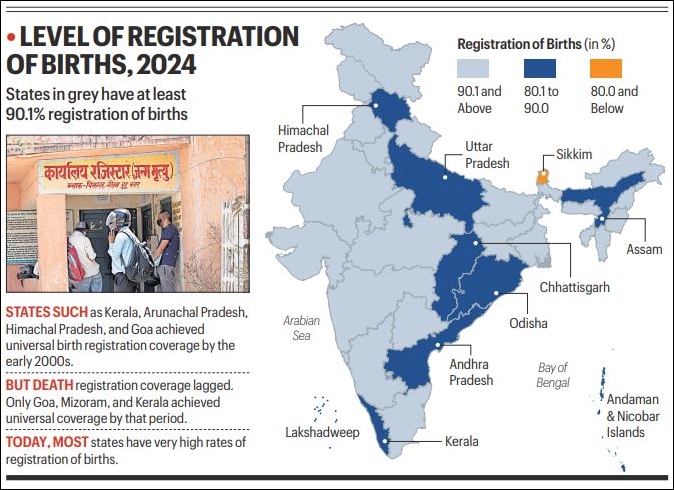
Registration coverage also varied considerably, both by rural-urban location and across states.
The latest CRS report, from the Office of the Registrar General and Census Commissioner of India under the Home Ministry, shows coverage approaching 100%. In 2024, birth registration reached 99.1% and death registration reached 99.4%. Death registration has historically lagged behind birth registration, but it has since caught up rapidly. This marks a major shift for a country that historically had incomplete civil registration and relied heavily on surveys to estimate fertility and mortality.
The improvement is also visible across states. In 2024, 18 states and Union Territories achieved 100% birth registration, while 21 states and UTs achieved 100% death registration.
Why does the data matter?
A complete CRS is one of the most important sources of vital statistics. It is a crucial input for administrative use, assessing the impact of health and social policies, and understanding trends in fertility, mortality, and population change.
Timely registration of births and deaths can provide real-time information on demographic changes and population health. For example, during a health crisis like the Covid-19 pandemic, timely reporting of deaths was crucial for identifying high-risk areas and controlling the spread of the disease. CRS is also important for understanding seasonal mortality changes, driven by high temperatures and pollution.
Because of the CRS’s historically poor coverage, India has traditionally depended heavily on the Census, the Sample Registration System (SRS), and household surveys for estimates. But the Census is conducted only once every 10 years, and sample surveys do not provide reliable annual estimates at the district level.
A complete CRS can support local planning under decentralised governance, since district and sub-district level data are far more useful for programme design than national or state-level estimates alone. Registrations also enable individuals to prove their identity from a legal standpoint.
What explains the shift in data?
The rapid rise in registration is likely due to a combination of factors.
For births, the increase in institutional deliveries in hospitals or health facilities, incentivised by post-delivery benefits, is an important driver — making the event more likely to be reported and registered. Birth certificates are also now necessary for school admission, identity documents, welfare benefits and other official purposes, strongly incentivising registration.
Similarly, death registration may have increased because more people are accessing formal healthcare, including through expanded health insurance and public health schemes. The expansion of schemes, particularly the PM-JAY, has increased coverage among poorer and vulnerable households. Families also require death certificates for pensions, insurance, inheritance, property transfer, bank accounts and other administrative processes.
Digitisation may have also played a role. The Registration of Births and Deaths (Amendment) Act, 2023, marked an important step by the Government of India towards making civil registration more complete, timely, and accessible.
By making the birth certificate an essential document for education and enrolment for Aadhaar and voter ID, the amendment gives families a strong incentive to register every birth. However, much will depend on effective implementation, digital access, and consistent monitoring.
The state-level variations can be traced to differences in socioeconomic development, public awareness, institutional delivery, health-system access and administrative capacity. States are responsible for the registration machinery.
What gaps remain?
First, regional disparities remain a major concern.
Second, timely registration is a challenge. Many births and deaths are not registered within the prescribed 21-day period.
The most important gap concerns infant death registration. The report shows that 84.2% of registered infant deaths occurred in urban areas, compared with only 15.8% in rural areas. Since a large share of population still lives in rural areas, where early-age mortality is higher, this pattern may indicate under-registration of infant deaths.
Then there is the quality of information. Registering a death is not the same as recording a medically certified cause of death. Many deaths may still lack reliable medical certification, limiting the usefulness of CRS for disease and mortality analysis.
Finally, the completeness of death registration is itself estimated using SRS figures. However, previous studies have shown that the SRS undercounts both births and deaths, which may lead to an overestimation of CRS coverage.
Building on the progress thus far, the next stage of improvement must focus not only on coverage but also its quality — including timely registration, accurate records, and responsible use of digital data.
India could further consider a system for recording internal migration, which would strengthen administrative planning.