Prateek Tanmay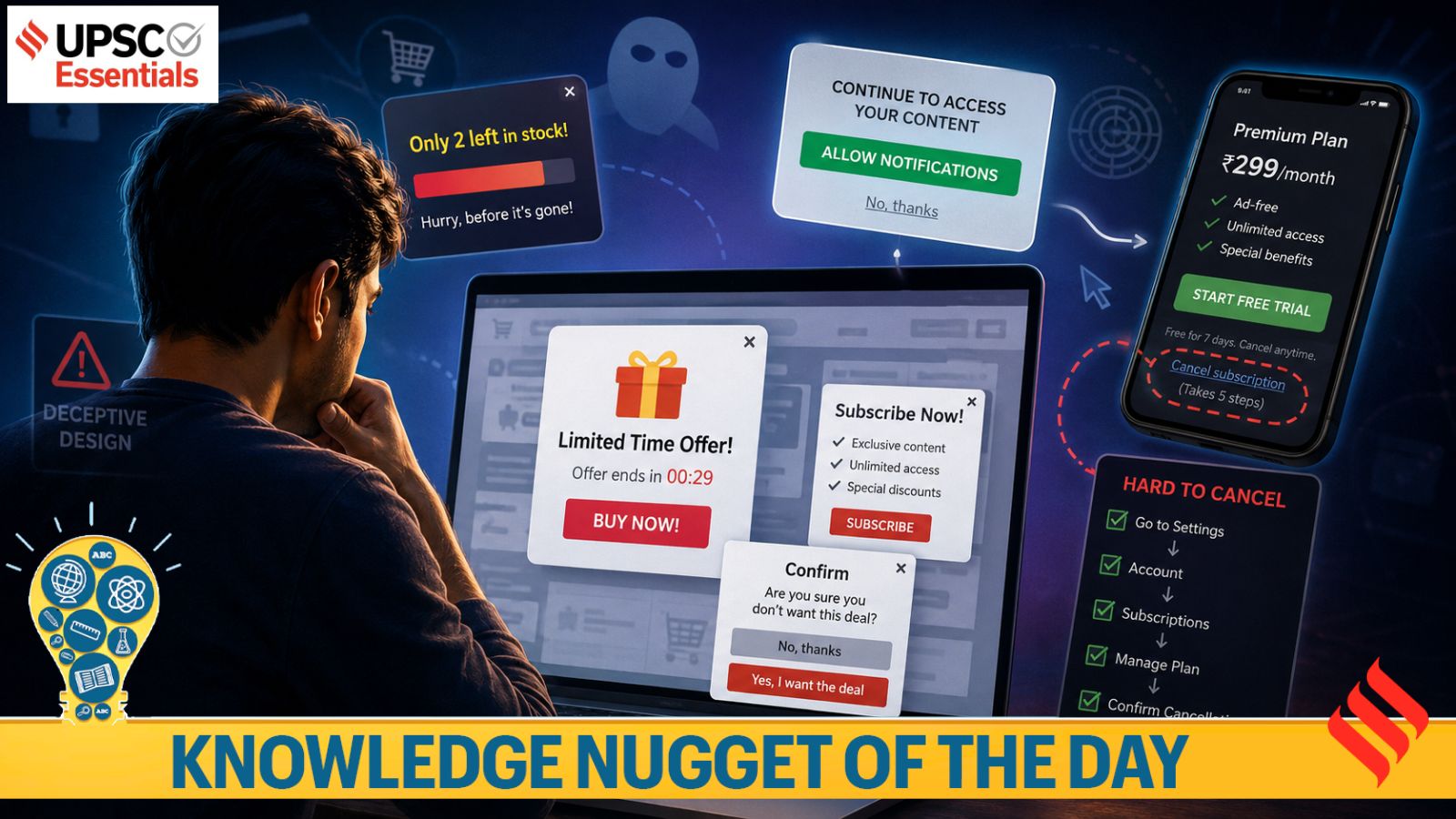
Take a look at the essential events, concepts, terms, quotes, or phenomena every day and brush up your knowledge. Here’s your UPSC Current Affairs knowledge nugget for today on dark patterns.
Despite years of regulatory scrutiny, dark patterns deployed by online platforms continue to mislead Indian customers and prevent them from making right choices. However, a new study has a bold proposal: Ensure all listed companies and those planning to list in India do not use dark patterns in their digital consumer journey and transactions.
In this context, let’s understand what ‘dark patterns’ are and, recently, what step the Insurance Regulatory and Development Authority of India (IRDAI) has taken to curb dark patterns.
Key Takeaways:
1. According to the study published by LocalCircles, over 95 per cent of publicly-listed companies involved in online consumer transactions are riddled with various dark patterns. These dark patterns are deployed during the online selection, transaction, and returns or refund journey of consumers.
2. “Dark patterns”, also known as deceptive patterns, refer to practices and deliberate mechanisms hidden in websites intended to manipulate users into sharing data or making choices they otherwise won’t usually make by pressurising or misleading them.
3. Some examples of dark patterns include forcing users to provide personal information to view product offerings on websites, deliberately making it difficult for users to cancel subscriptions, and spam calling to push products.
Let’s understand the ‘dark pattern’ through an example: Think of that annoying advertisement that keeps popping up on your screen, and you can’t find the cross mark ‘X’ to make it go away because the mark is too small to notice (or to click/tap). Worse, when you try to click/tap on the tiny ‘X’, you sometimes end up tapping the ad instead.
Story continues below this ad
4. The deceptive tactics primarily rely on manipulative interface designs through subscription renewals, forced cancellation processes, inaccurate pricing displays, consent mechanisms, personalised recommendations, gamified engagement, and behavioural nudges that influence consumer decisions.
5. The term dark patterns was coined by Harry Brignull, a London-based user experience (UX) designer, in 2010.
|
Central Consumer Protection Authority (CCPA) CCPA is being constituted under Section 10(1) of The Consumer Protection Act, 2019. The Act replaced the Consumer Protection Act, 1986, and seeks to widen its scope in addressing consumer concerns. It has come into force w.e.f 24th July 2020. It aims to protect the rights of the consumer by cracking down on unfair trade practices, and false and misleading advertisements that are detrimental to the interests of the public and consumers. |
Dark Patterns specified by CCPA
6. Notably, on December 1, 2023, the Central Consumer Protection Authority (CCPA) issued guidelines for the “prevention and regulation” of dark patterns. It has specified 13 dark patterns.
(i) False urgency: Creates a sense of urgency or scarcity to pressure consumers into making a purchase or taking an action. It includes showing false popularity of a product or service to manipulate user decisions or stating that quantities of a particular product or service are more limited than they actually are.
Story continues below this ad
(ii) Basket sneaking: Dark patterns are used to add additional products or services to the shopping cart without the user’s consent.
(iii) Confirm shaming: Uses guilt to make consumers adhere; criticises or attacks consumers for not conforming to a particular belief or viewpoint.
(iv) Forced action: Pushes consumers into taking an action they may not want to take, such as signing up for a service in order to access content.
(v) Nagging: User is disrupted and annoyed by repeated and persistent interactions, in the form of requests, information, options, or interruptions, to effectuate a transaction and make some commercial gains, unless specifically permitted by the user.
Story continues below this ad
(vi) Subscription traps: Easy to sign up for a service but difficult to quit or cancel; option is hidden or requires multiple steps; forcing a user to provide payment details or authorization for auto debits for availing a free subscription; or making the instructions related to cancellation of subscription ambiguous, latent, confusing, cumbersome.
(vii) Bait & switch: Advertising a certain product/ service but delivering another, often of lower quality;
(viii) Rogue Malwares: Using a ransomware or scareware to mislead or trick user into believing there is a virus on their computer and aims to convince them to pay for a fake malware removal tool that actually installs malware on their computer.
(ix) Disguised ads: Designed to look like content, such as news articles or user-generated content.
Story continues below this ad
(x) Interface interference: Manipulate the user interface in a way that highlights certain specific information and obscures other obscures other relevant information relative to the other information; to misdirect a user from taking an action as desired.
CCPA’s 13 Dark Patterns Explained
BACKGROUND
Deceptive design, real manipulation
Dark patterns are deliberate mechanisms hidden in websites and apps designed to manipulate users into sharing data or making choices they otherwise wouldn’t. The term was coined by London-based UX designer Harry Brignull in 2010.
95%+
Listed companies using dark patterns: LocalCircles study
13
Dark patterns specified by CCPA
2010
Year the term was coined
⚠
False urgency
Creates false scarcity or popularity to pressure a purchase, e.g. overstating how limited stock is.
◆
Basket sneaking
Adds extra products or services to the cart without the user’s consent.
●
Confirm shaming
Uses guilt or criticism to pressure users who don’t conform to a suggested choice.
→
Forced action
Pushes users into an unwanted action, like signing up for a service to access content.
★
Nagging
Repeated, persistent interruptions and requests aimed at pushing a commercial transaction.
⏱
Subscription traps
Easy to sign up, hard to cancel — hidden cancel options or forced auto-debit authorisation.
⚖
Bait & switch
Advertises one product or service but delivers another, often of lower quality.
⚠
Rogue malwares
Fake virus/scareware alerts trick users into paying for a “removal tool” that installs malware instead.
◆
Disguised ads
Ads designed to look like genuine content, such as news articles or user-generated posts.
●
Interface interference
Highlights certain information while obscuring other relevant details to misdirect user choice.
→
Drip pricing
Hides price elements upfront, revealing them only late in checkout or after purchase confirmation.
★
Trick question
Uses confusing wording or double negatives to misdirect users from their intended action.
⏱
SaaS billing
Exploits recurring subscription loops in software-as-a-service models to collect payments surreptitiously.
THE REGULATOR
CCPA’s mandate
The Central Consumer Protection Authority was constituted under Section 10(1) of the Consumer Protection Act, 2019, in force since July 24, 2020. It cracks down on unfair trade practices and misleading advertisements harming consumers. On December 1, 2023, it issued guidelines specifying the 13 dark patterns above.
SECTOR WATCH
IRDAI’s insurance crackdown
IRDAI is tightening rules around dark patterns in digital insurance marketplaces to boost consumer trust. It has partnered with the Institute of Public Auditors of India to monitor the industry over 9 months, following an April directive asking insurers to self-assess and report on dark patterns.
Sources: The Indian Express · LocalCircles study · CCPA Guidelines, Dec 1, 2023
(xi) Drip pricing: A ‘dark pattern’ practice whereby elements of prices are not revealed upfront or are revealed surreptitiously within the user experience, or revealing the price post-confirmation of purchase, or a product or service is advertised as free without appropriate disclosure of the fact that the continuation of use requires in-app purchase.
(xii) Trick Question: Deliberate use of confusing or vague language like confusing wording, double negatives, or other similar tricks, in order to misguide or misdirect a user from taking the desired action or leading the consumer to take a specific response or action.
(xiii) Saas billing: Generating and collecting payments from consumers on a recurring basis in a software as a service (SaaS) business model by exploiting positive acquisition loops in recurring subscriptions to get money from users as surreptitiously as possible.
Story continues below this ad
BEYOND THE NUGGET: IRDAI’s step to curb dark patterns
1. To curb dark patterns in insurance, IRDAI is now seemingly tightening regulations surrounding “dark patterns” across many digital insurance marketplaces in order to boost consumer trust.
2. The regulator has partnered with the statutory body Institute of Public Auditors of India to monitor dark patterns across the industry over a period of 9 months. This comes after the regulator in April had directed insurers to conduct a self-assessment on dark patterns and submit observations.
Post Read Question
Consider the following statements:
1. Dark pattern is a deceptive attempt made by e-commerce platforms to make users do things that they otherwise wouldn’t.
2. ‘Saas billing’ is identified as a dark pattern by the Central Consumer Protection Authority (CCPA).
Story continues below this ad
3. In the ‘Bait and Switch’ dark pattern, elements of prices are not revealed upfront or are revealed post-confirmation of purchase.
How many of the above statements are correct?
(a) Only one
(b) Only two
(c) All three
(d) None
Answer key
(b)
(Sources: Why IRDAI has brought in a statutory body to curb dark patterns in insurance, New study finds 95% of India’s public companies use dark patterns, calls for SEBI crackdown, Center notifies guidelines against ‘dark patterns’ that mislead buyers)
🚨 Click Here to read the UPSC Essentials magazine for June 2026. Share your views and suggestions in the comment box or at manas.srivastava@indianexpress.com🚨
Subscribe to our UPSC newsletter. Stay updated with the latest UPSC articles by joining our Telegram channel – Indian Express UPSC Hub, and follow us on Instagram and X