Prateek Tanmay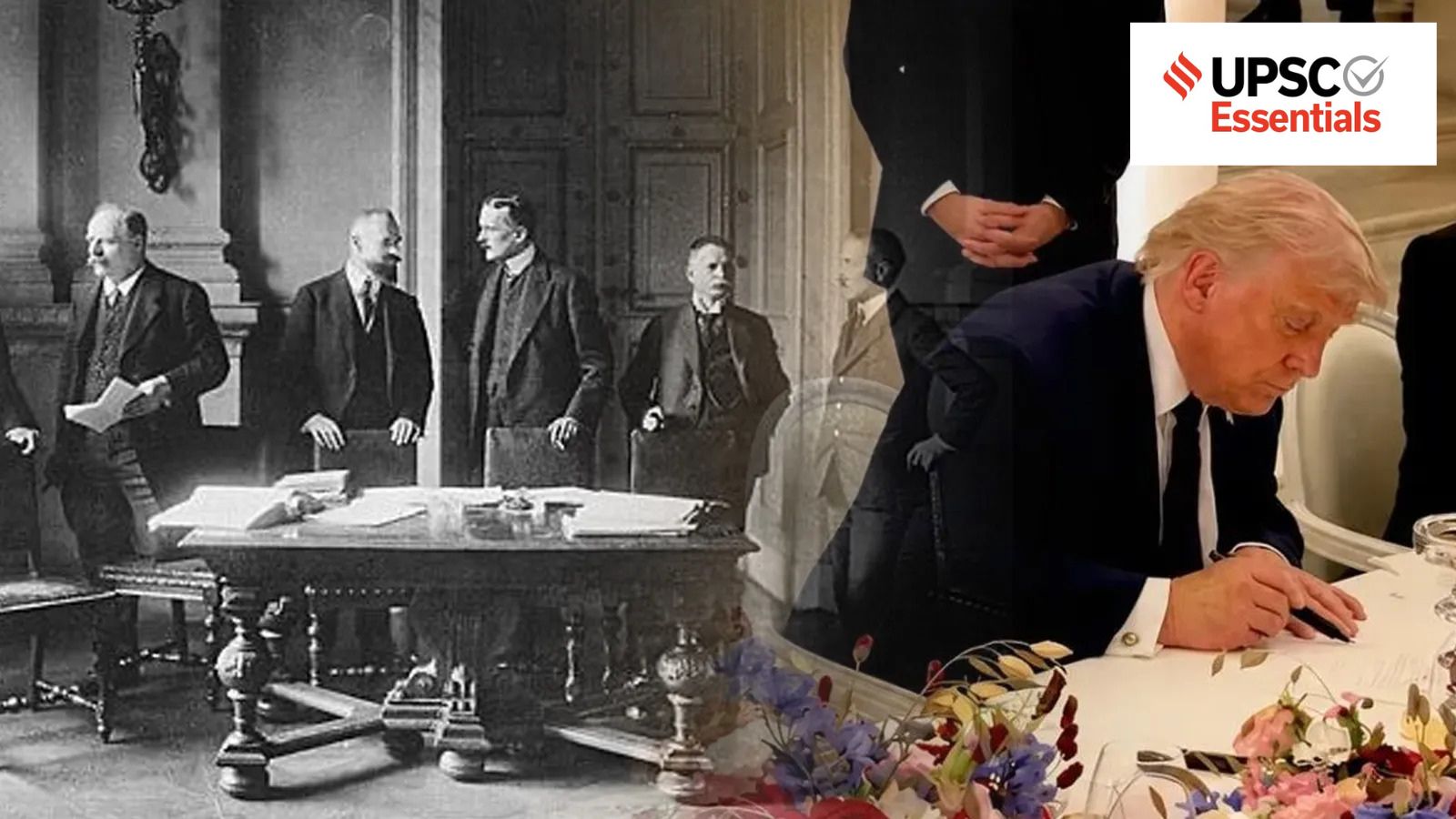
Although it remains unclear whether the attack and counterattack between the US and Iran represent a new phase of escalation, it amounts to the collapse of the ceasefire announced three weeks ago.
US President Donald Trump signed the Memorandum of Understanding (MoU) with Iran to end the war in the Palace of Versailles near Paris. The choice of the venue brought back memories of the Treaty of Versailles signed in 1919 that formally ended WWI.
The British historian Eric Hobsbawm, in his magisterial account of the twentieth century, The Age of Extremes: 1914-1991 (1994), notes that the Treaty of Versailles is something of a misnomer, as it is made to stand in for a series of treaties that were signed in Parisian suburban parks and palaces to conclude WWI.
Technically, the Treaty of Versailles brought an end to war with Germany. The other series of treaties that were signed at Sèvres, a commune in the southwestern suburbs of Paris, are:
* Treaty of Saint Germain with Austria (1919)
* Treaty of Neuilly with Bulgaria (1919)
* Treaty of Trianon with Hungary (1920)
* Treaty of Sèvres with Turkey (1920)
The terms that the Treaty of Versailles imposed on Germany were humiliating, especially the war reparations that it had to pay to Britain and France. It thereby had to wholly accept the guilt of the First World War that had ravaged Europe.
How WWI changed the world
The First World War changed the world, as Britain no longer remained the dominant power that it was throughout the 19th century. Slowly and steadily, a rising and industrialising Germany, even as a latecomer, had begun to challenge Britain. France, for its part, was always fearful of the inexorable rise of Germany, which had a larger population.
By 1913, the US had become the world’s largest economy, producing over one-third of the world’s industrial output, just below the combined output of Britain, France, and Germany. In line with the growing stature of the US as an ascendant power, the most important statesman who dominated the proceedings at the Treaty of Versailles was the American President Woodrow Wilson. Alongside him, the other statesmen of note were the British Prime Minister David Lloyd George and the French President Georges Clemenceau.
Story continues below this ad
The Soviet Union, which had just emerged with the Bolshevik Revolution of November 1917, was not represented. However, its shadow presence could be felt as the map of Europe was redrawn to take in the realities that the First World War had created. The changes that the Treaty of Versailles oversaw tried to create a protective layer of territory around the Soviet Union so that countries in Europe would be protected from the pull of Bolshevism.
This redrawing of the map included countries like Finland in the north; the Baltic Republics of Latvia, Lithuania and Estonia; the emergence of Poland; and the creation of Yugoslavia and Czechoslovakia. These states acted as a kind of territorial buffer between Germany and the Soviet Union.
The Versailles settlement and its consequences
The Treaty of Versailles was a failure. It was rejected by the US Senate in November 1919 when it came up for ratification. It was also a treaty that could not ensure peace after the First World War for even two decades, as by 1939 the Second World War had begun. The German resentment that was created as a result of the war reparations became a major cause for the rise of Nazism.
One of the most prescient observers present at the Treaty of Versailles as a delegate was the British economist John Maynard Keynes, who gave voice to his concerns about the faults of the Treaty in his book, The Economic Consequences of the Peace (1919). In addition to the humiliation of the war reparations, there was no clarity in terms of how these payments were to be made and the French, British, and Americans understood these terms according to their convenience.
Story continues below this ad
The other aspects of the treaty that need consideration are the territorial and military conditions imposed upon Germany. The territory of Alsace-Lorraine was handed back to the French, and the Rhineland that abuts the border with France was demilitarised. The old territory of Eastern Prussia was handed to Poland.
Conditions were set on the size of the German military and navy. Colonial territories of Germany were divided between France and Britain and, to some extent, Japan. These were now called mandates in keeping with the changing political trends of the times when the word ‘colony’ had started feeling outdated.
Wilson’s idealism and the redrawing of Europe
Given the very important presence of US President Woodrow Wilson, the Treaty of Versailles reflected his idealistic vision. This Wilsonian idealistic vision looked at the European political situation with the disadvantage of the distance that lay between Europe and the US, which, of course, is the considerable expanse of the Atlantic Ocean. Wilson’s idealism was to come clashing against the messy political realities of Europe and can be understood as another significant reason for the failure of the treaty.
Wilson’s political vision oversaw the redrawing of the European map along the lines of neat and well-demarcated nation-states. The European political reality was far more unmanageable. The end of the First World War and the Treaty of Versailles witnessed and abetted the collapse of three major empires: the Austro-Hungarian Empire, which was centred very much in Europe, and the Russian and Ottoman Empires, which may not have been centred on the continent, but whose territorial expanse implicated many areas firmly within Europe.
Story continues below this ad
The sharply demarcated borders of nation-states went along the lines of the dominant ethnic group. This meant significant populations within nation-states became marooned, as minorities as they were now disconnected from the nation-state that reflected the dominance of their ethnic affiliation. For instance, minority German ethnic groups found themselves stranded in countries like Poland, Austria, and Czechoslovakia. In Czechoslovakia, the cause of the Sudeten Germans was taken up by Hitler, and his military actions in the country were one of the major political developments that triggered the Second World War.
Wilson’s Fourteen Points and international peace
The attempt to impose a simplistic principle of national self-determination along the lines of ethnic homogeneity on an ethnically diverse Europe was one aspect of Woodrow Wilson’s Fourteen Points drawn up in January 1918. The Empires that existed before the end of the First World War were able to encapsulate this ethnic diversity that now jarred against the nation-states that emerged from the rubble of those same collapsed empires.
Another aspect of Wilson’s Fourteen Points was the association of nations that was envisaged and was behind the creation of the League of Nations. This organisation was the predecessor of the United Nations, which was created in October 1945 after the Second World War. The short-lived existence of the League of Nations created from the Treaty of Versailles could be held up as another instance of the many failures of the treaty. The US itself never became a member.
Drawing from Wilson’s Fourteen Points, the Treaty of Versailles tried to create the basis for international peace by ending the system of secret negotiations that European powers had entered earlier to settle territorial disputes between and amongst themselves. An emphasis was thus placed on open negotiations rather than secret ones between sovereign nation-states.
Story continues below this ad
The end of the old world order
The Treaty of Versailles and the end of the First World War brought the curtains down on an old world order that declining powers like Britain and France simply wanted to go back to but could not. That old world order was characterised by four things, wrote Karl Polanyi in his significant book, The Great Transformation (1944). These were:
The balance of power.
The presence of the international gold standard to settle trade between states.
The self-regulating market.
The liberal state.
Out of these, Wilson especially felt that the balance of power was part of an old world order that needed to be left behind. Versailles did bring the curtains down on an old world order but could not ring in a new one. It took the economic turbulence of the inter war years (1919-1939) and the end of the Second World War for that to happen.
Lessons from Versailles
The Treaty of Versailles provides ample lessons from history about peacemaking in the aftermath of war, especially for our war-ravaged times. The victorious Allied powers, the US, Britain and France seemed to be working at cross-purposes in terms of how they should manage Germany: subjugation or conciliation.
Story continues below this ad
The Americans wanted to conciliate Germany into a liberal international capitalist order. The French seemed to want subjugation so that Germany would cease to be a threat. The British wavered between an initial desire for subjugation and a later more conciliatory stance. Initially, British PM David Lloyd George even suggested he would squeeze the Germans so hard ‘until the pips squeaked’.
The one lesson that emerges is that no nation or people in defeat should be subjected to humiliation and made to feel an unwarranted guilt, as the Germans were made to feel through the Treaty of Versailles. The Germans perhaps developed a guilt complex that they cannot seem to overcome.
Post read questions
1. What were the main objectives of the Treaty of Versailles? Why did it fail to establish a lasting peace in Europe?
2. Critically examine the military, territorial, and economic provisions imposed on Germany under the Treaty of Versailles. How did it shape Germany’s post-war politics?
Story continues below this ad
3. Discuss the significance of the creation of new nation-states after the First World War. Did they contribute to peace or instability?
4. Discuss the reasons why the United States rejected the Treaty of Versailles. What impact did this decision have on international politics?
5. The failure of the Treaty of Versailles lay less in its severity than in its inability to reconcile idealism with geopolitical realities. Discuss.
(Amir Ali is an Assistant Professor at the Centre for Political Studies, Jawaharlal Nehru University, New Delhi.)
Story continues below this ad
Share your thoughts and ideas on UPSC Special articles with ashiya.parveen@indianexpress.com.
Click Here to read the UPSC Essentials magazine for June 2026. Subscribe to our UPSC newsletter and stay updated with the news cues from the past week.
Stay updated with the latest UPSC articles by joining our Telegram channel – IndianExpress UPSC Hub, and follow us on Instagram and X.