Prateek Tanmay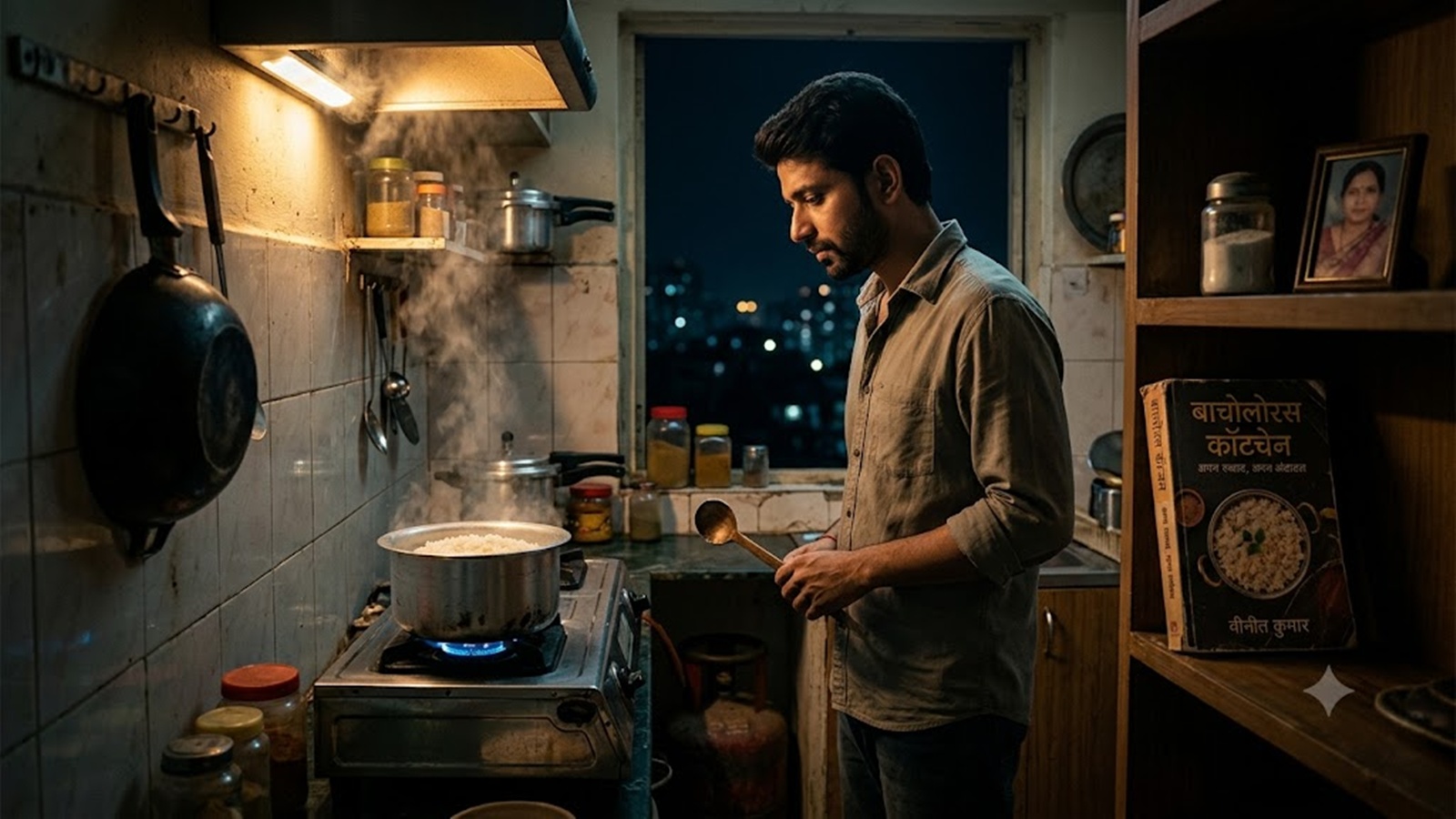
Vineet Kumar’s Bachelors Kitchen: Apna Swaad, Apna Andaaz looks, on the cover, like a bachelor’s account of learning to cook in rented rooms. Read a few pages in, though, and it turns out to be a treatise on memory and the loneliness that hits while standing next to a stove while rice cooks in a dented aluminium pot.
I read most of it on a flight from Bengaluru to Banaras. The seat cover in front of me had “Literature Only” stitched on it, which struck me as an odd thing for an airline to print, almost like a stray line from a novel rather than a marketing tagline. Vineet Kumar’s book was next to me. Outside it was dark, a plane full of people going home to different places, and I had, in my hands, a book that seemed to know exactly what it feels like to be away from home for too long.
The kitchen, in most Indian households, has been a woman’s domain. A man cooking is either an emergency or a joke. “The boy doesn’t even know how to cook rice” sounds like an ordinary jibe, but it carries an entire social arrangement behind it. Vineet Kumar’s book doesn’t argue with that line, but at the end of the day it does manage to deliver the point that the kitchen is not a gendered domain.
Rather than recipes, the book is a record of unlearning. It is about a young man who leaves home, moves into the anonymity of city life, rents rooms that carry traces of whoever lived there before him. Slowly he works out that the kitchen is not just where he feeds himself, but it is also a place where he gets to rebuild a sense of who he is, away from everything familiar.
The kitchen as private politics
Writing about food and migration is not new. Madhur Jaffrey’s An Invitation to Indian Cooking, Chitra Banerjee Divakaruni’s The Mistress of Spices, Anthony Bourdain’s Kitchen Confidential, Pushpesh Pant’s India: The Cookbook, and Tarana Husain Khan’s Degh to Dastarkhwan all tie what is on the plate to something larger.
Then there’s the more public tradition of Tarla Dalal, Sanjeev Kapoor, and Ranveer Brar, where cooking is performance, built around family and guests and an audience. Bachelors Kitchen has nothing to do with that world, after all it is a solitary tenant’s kitchen with few utensils, little money, and plenty of memory. Nobody’s watching. It is just a man and his plate, and cooking works more like talking to yourself than putting on a show.
Story continues below this ad
Where most food writing is about people eating together, Vineet Kumar is writing about eating alone. The cooking happens inside him first, long before it lands on a plate, and doing it properly starts to feel like a refusal to let himself be neglected.
At one point the book stops on a line a lot of people have probably said to a bachelor at some point: What does it matter for someone living alone? He can eat anything and sleep.
And then it asks why should that be true. Why cannot loneliness have some beauty in it? Why is bothering to plate your own food excessive? Why does remembering your mother’s recipes feel like something to hide, in a culture so invested in men not caring about such things?
From there the questions go somewhere bigger. Cooking for yourself means running into the work women have quietly done for generations without anyone noticing. Rice doesn’t cook itself and the lentils don’t season themselves. Every single meal takes time and attention that somebody, somewhere, was always putting in.
Story continues below this ad
There’s something close to an ethics lesson buried in that.
Manorama: Mother and the social meaning of memory
The book’s emotional weight sits with the author’s mother, Manorama. He does not call her “Maa” in these pages, he uses her name. It reads strange at first, and then gradually it just feels honest. She stops being a symbol and turns back into a person.
What is really cooking here is not the food, it is memory, held in oil and mustard seeds. The smell of lentils carries a whole family history with it.
Reading this, I thought of other books that do not let memory and family stay separate: Arundhati Roy’s Mother Mary Comes to Me, Vyomesh Shukla’s Garjianta, and Jey Sushil’s Dukh Ki Duniya Bhitar Hai. All of them work through the same uncertain ground of relationships and what gets passed down. Bachelors Kitchen fits right in among them.
Story continues below this ad
Food carries its own history under the surface. Every familiar taste has affection and labour and loss buried inside it somewhere.
And there’s a point worth naming here. Domestic labour shouldn’t stay invisible, and using a mother’s actual name is one way of giving her an identity outside of the role she was assigned.
Chapters as areas of experience
The chapter titles are names for feelings. “Manorama Rasoi” holds the warmth of memory, “Ladka Bhaat Banana Nahin Janta” (The Boy Does Not Know How to Cook Rice) pushes back at gendered assumptions. “Dekhne Ka TV To Takta Rehta Hai Kadhai” (The Wok Keeps Staring at the Television) is about being alone in a city, “Aao Singles, Ab Facebook Par Khana Banate Hain” (Come Singles, Let Us Cook on Facebook) is about finding company online, and “Hostel Ki Plate, Politics Batiyati Hain” (Hostel Plates Talk Politics) turns eating into a site of argument and student politics.
Read together, the chapters trace a whole generation that moved from small towns into cities, dragging inherited recipes along like letters folded into their luggage. You probably would not look at a frying pan quite the same way after reading it. One does realise that learning to cook rice was never just a skill. It was always about staying human while living by yourself.
Story continues below this ad
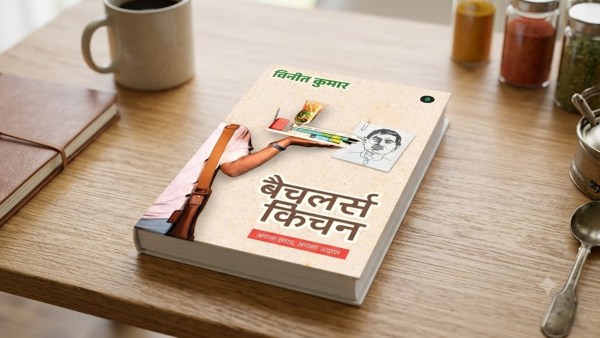 Bachelors Kitchen: Apna Swaad, Apna Andaaz by Vineet Kumar. (Generated using AI)
Bachelors Kitchen: Apna Swaad, Apna Andaaz by Vineet Kumar
Unbound Script
Rs 299/-
(Ashutosh Kumar Thakur writes on society, technology, environment, literature and the arts, reflecting on the shared histories and cultures of South Asia.)