Prateek Tanmay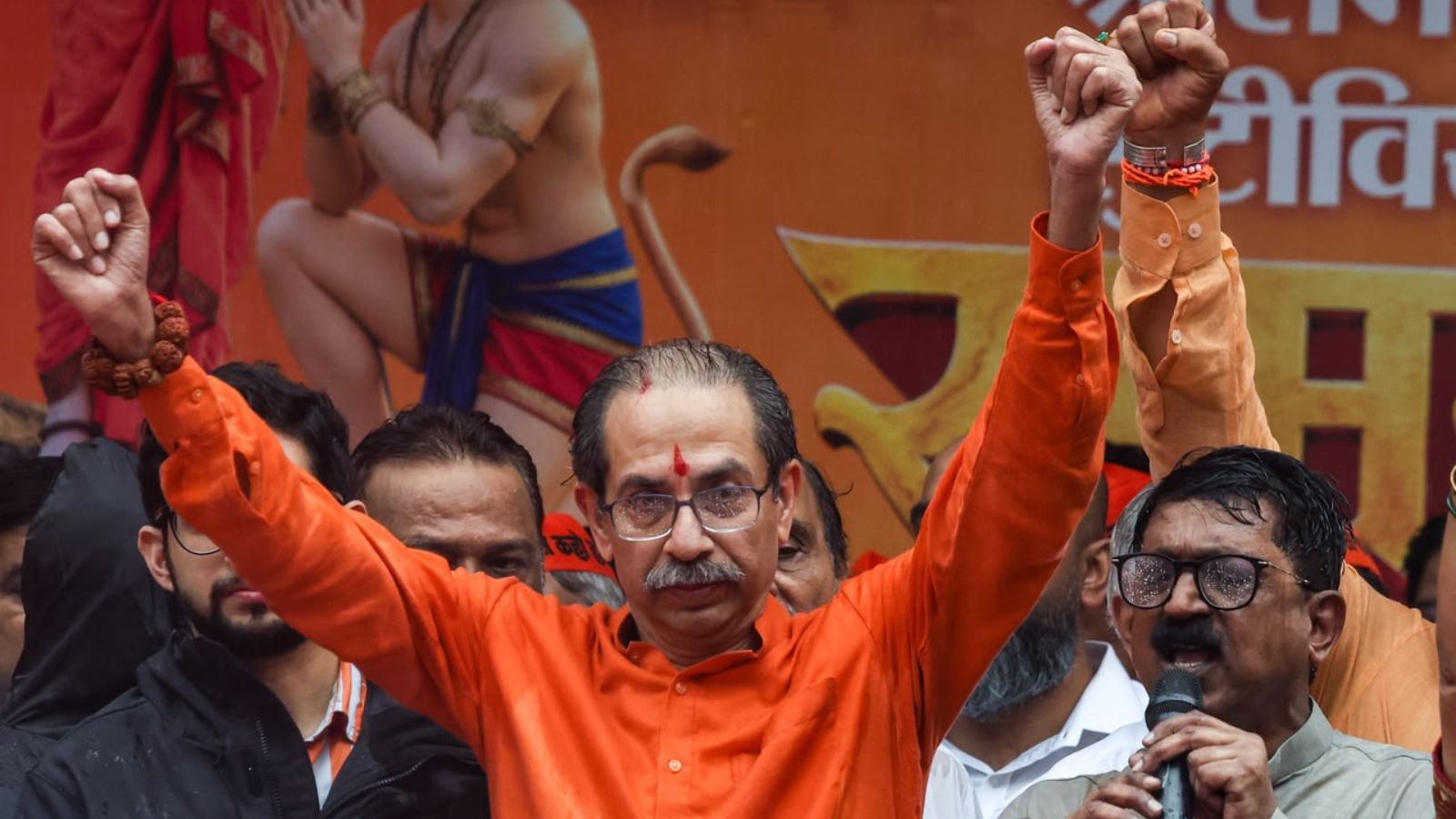
For much of his politics after 2019, which marked his break with the BJP, Shiv Sena (UBT) chief Uddhav Thackeray rarely placed Hindutva at the centre of his campaign. On Sunday, that changed.
Standing outside Dadar’s Hanuman temple, Uddhav launched the Shiv Sena (UBT)’s Rama Raksha Andolan, invoked the Ram Janmabhoomi movement, recalled Bal Thackeray’s role in it, and accused those handling donations at the Ayodhya Ram temple of betraying devotees’ faith.

The immediate trigger was the alleged irregularities in the handling of donations at the Ram temple. Politically, however, the campaign appeared to signal something larger.
Less than two weeks after six of his nine Lok Sabha MPs crossed over to the Eknath Shinde-led Shiv Sena, and days after senior Mumbai leader Sachin Ahir switched sides, Uddhav has sought to shift the political chatter away from defections and back to ideology.
After the MPs’ rebellion, Uddhav toured their constituencies to reassure party workers. Sunday’s programme was the party’s first major statewide political campaign since those setbacks.
Following a maha aarti and the chanting of the Ramaraksha Stotra, Hanuman Chalisa and Maruti Stotra, Uddhav devoted most of his speech to Ayodhya and the Ram Janmabhoomi movement rather than the recent defections.
“We Hindus are innocent, but we are not fools. If somebody exploits our faith and loots a temple, ab Hindu maaf nahi karega (now Hindus will not forgive),” he said.
Recalling the Ram Janmabhoomi movement, Uddhav said Shiv Sainiks had participated in shila pujan, Rath Yatra and kar seva, and that many had shed blood and sacrificed their lives. Without naming the BJP, he questioned what had changed after Narendra Modi became Prime Minister.
“Twelve years ago, we believed ‘ab Hindu maar nahi khayega (now, the Hindu will not be beaten)’. Instead, they are being looted,” he said.
Throughout his speech, Uddhav carefully distinguished Lord Ram from those managing the temple trust. “We are questioning those handling devotees’ donations, not Lord Ram,” he said, arguing that devotees had a right to know how their contributions had been handled.
He also unveiled a new slogan: “Japava hridayat Ram, mukhaat Jai Shri Ram (keep Ram in your heart and Jai Shri Ram on your lips).”
‘Not a political line’
Within the Sena (UBT), leaders insist the campaign does not represent a change in the party’s politics.
“It is not about changing our politics. Balasaheb never treated Hindutva as an election issue. It was the party’s ideology. We are reminding people of the Shiv Sena’s role in the Ram Janmabhoomi movement,” a senior Sena (UBT) leader said.
Another leader said the party had deliberately framed the issue around devotees’ faith rather than the temple itself. “The issue is not Ram. The issue is whether devotees’ faith has been betrayed.”
Party leaders also said the campaign helped shift attention from recent defections to ideology, while avoiding any criticism of Lord Ram or the temple itself. “If there are allegations of irregularities in donations, those responsible should answer,” a functionary said.
Shiv Sena and Ayodhya
For the Shiv Sena, the Ram Janmabhoomi movement marked a turning point. Founded in 1966 on the plank of Marathi identity and the “sons of the soil” movement, the party broadened its politics in the late 1980s as Bal Thackeray increasingly embraced Hindutva.
His slogan, “Garv se kaho hum Hindu hain (say proudly that we are Hindu),” came to define that phase. The Ram Janmabhoomi movement expanded the Sena’s appeal beyond Mumbai and helped the BJP-Shiv Sena alliance emerge as a major political force in Maharashtra, culminating in the formation of its first government in 1995 under Manohar Joshi.
For Bal Thackeray, the movement also elevated his political profile beyond Maharashtra and cemented his image among supporters as the “Hindu hridaysamrat”.
One episode from that period continues to occupy a special place in the Sena’s political memory. After the demolition of the Babri Masjid on December 6, 1992, when several BJP leaders publicly distanced themselves from the demolition, Bal Thackeray said that if Shiv Sainiks had demolished the structure, he was proud of them. For Sena workers, that statement came to symbolise his willingness to publicly own a movement that many others hesitated to claim.
Post-split significance
That history has acquired fresh political significance after the 2022 split in the Shiv Sena.
The Shinde-led Sena now has the party’s official name, the “bow and arrow” symbol and the support of a majority of legislators. The Sena (UBT), however, argues that Bal Thackeray’s political and ideological legacy remains with Uddhav.
Sources in the party say that after losing the legal battle over the Shiv Sena’s name and symbol, the next contest is inevitably over Bal Thackeray’s legacy.
“The organisation, the legislators and the symbol have gone with the Shinde faction. What remains open is the question of political inheritance. Sunday’s campaign was as much about that as it was about Ayodhya,” a source said.
For the Sena (UBT), the controversy offers an opportunity to put the BJP on the defensive over an issue central to its politics. The BJP, however, sees the campaign as an attempt by Uddhav to reclaim the political space he vacated after breaking ties with it in 2019.
Speaking in Chandrapur, Chief Minister Devendra Fadnavis took a swipe at Uddhav.
“I am happy that Uddhav has remembered Lord Ram. He had forgotten Ram and that is why he reached this situation. If he follows the path of Lord Ram, it will be good for him. He should recite the Ramaraksha Stotra every day,” he said.
Whether Uddhav’s strategy succeeds remains uncertain. Unlike the late 1980s and early 1990s, when Bal Thackeray built the Sena’s Hindutva politics around the Ram Janmabhoomi movement, Uddhav today leads a party that is part of the INDIA bloc alongside the Congress and NCP (SP).
The challenge for the Sena (UBT) is two-fold: convincing traditional Hindutva voters that Bal Thackeray’s ideological legacy remains with Uddhav, while ensuring that its renewed emphasis on Hindutva does not unsettle its allies.