Prateek Tanmay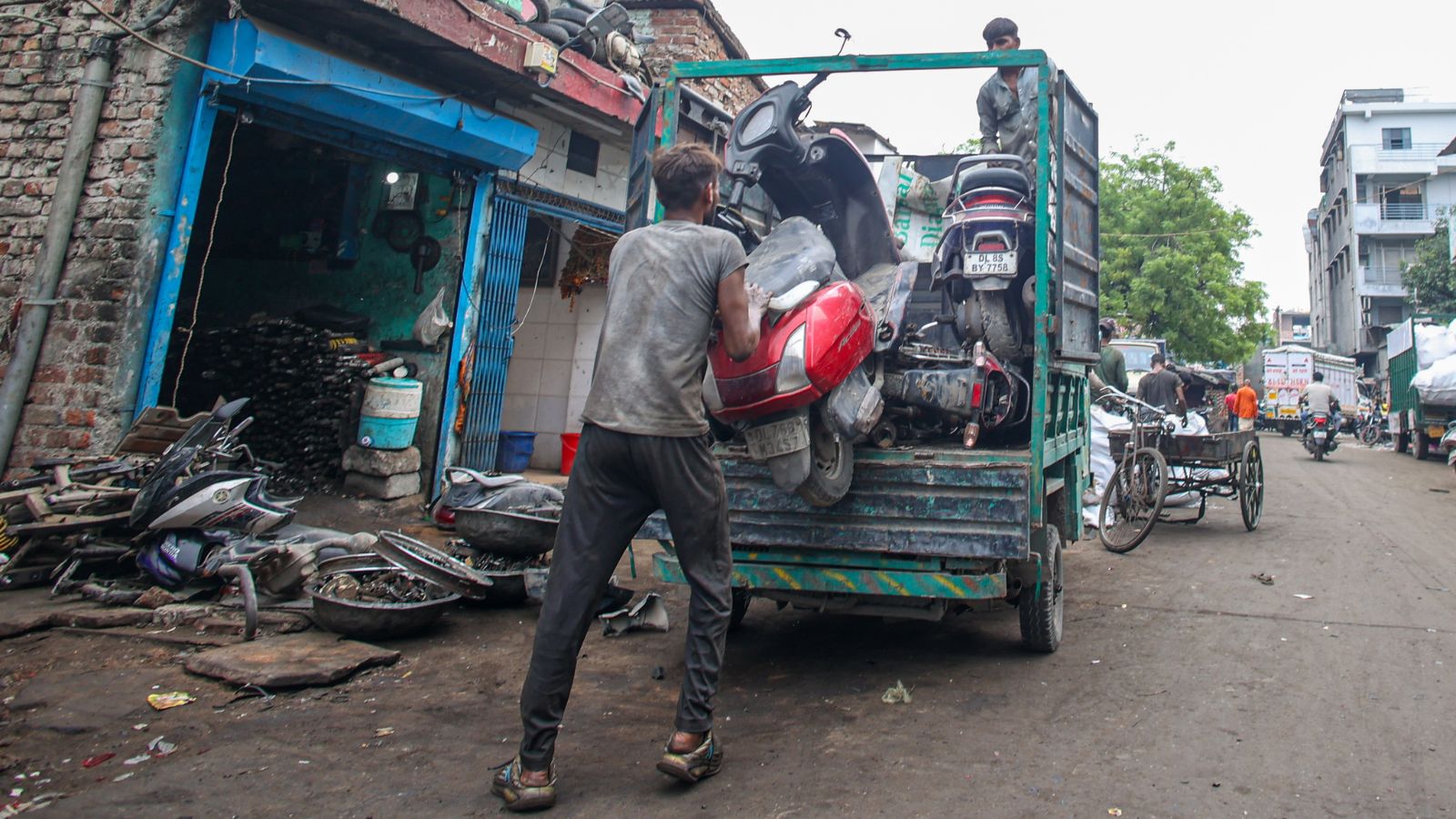
Sanjay Kumar has no idea of the number of scooters and motorcycles his thick, grease-stained fingers have checked, fixed, and got going again – definitely hundreds, possibly thousands. This is the only thing that Sanjay knows; this is what he has been doing since the time he was a child – for 40 of his 52 years.
The Delhi government’s mandate in favour of a full transition to battery electric two-wheelers is intended to address the problem of air pollution in the capital. For Sanjay, the phasing out of petrol bikes is a question of his survival.
“Yeh (petrol bikes) bandh ho jayenge, saare electric ho jayenge,” he says, adjusting his worn black cap and glasses. “Dheere dheere aa hi rahe hain market mein (EVs)… Jab yeh (petrol) gaadiyan aane bandh ho jayenge, toh hum bilkul bekar ho jayenge.” (These bikes will no longer be allowed, there will be only EVs… They have been entering the market anyway; after petrol vehicles stop, there will be nothing left for me to do.)
Beside Sanjay, 23-year-old Abhishek is bent over the skeleton of a scooter. It is Friday morning, and a large part of the road in Karol Bagh’s bustling two-wheeler repair hub has turned into a workshop. The clanking of metal and revving engines are part of the sounds of traffic that flows by haltingly.
Besides the workers, mechanics, and their apprentices, others who earn their livelihoods in this teeming market include the owners and workers of wholesale dealerships of two-wheeler spare parts and accessories, vehicle modification workshops, and dozens of shops selling helmets.
Inside a shop selling motorcycle engine oil, grease, and metal and plastic spare parts, the dealer begins his conversation with a customer with a key question: “BS 6 or 4?” The Bharat Stage – BS – emissions standard is fundamental to the regulatory framework for tailpipe emissions in petrol and diesel vehicles. The question is asked and answered countless times in the market that exists for internal combustion engines.
Over the next few years, this market must either adapt or watch itself wither away. Its current trades, skills, workers, and language have very limited relevance for electric two-wheelers. Everyone in the market agrees that upskilling is the only way forward. The alternative scenario is bleak: “rozi roti band ho jayegi – we will have no livelihood left”.
Story continues below this ad
After spending more than half his life repairing petrol-powered two-wheelers, 40-year-old Balkar trained earlier this year at an automotive company in Wazirpur, learning how to assemble and repair electric two-wheelers. He returned to Karol Bagh after the company let him go, but he believes he can learn to repair an EV within six months.
There aren’t many like Balkar, though. “There is nobody to help us learn. Right now, if an electric scooter comes in, we can only do limited work on the body and brake pads. The major repairs are handled by company service centres,” says Abhishek.
Some like Tariq are sceptical the transition would be permanent. “What we have been seeing on the ground is that EVs have no longevity. The battery does not last for longer than five years,” he says.
Research suggests current lithium‑ion batteries typically last between five and eight years, depending on chemistry, charging cycles and climate. A 2025 review in MDPI Batteries noted that temperature extremes and depth of discharge were the biggest drivers of degradation.
Story continues below this ad
A Stanford study from the same year found that real‑world stop‑and‑go driving patterns can sometimes extend battery life compared to lab simulations. Consumers can replace a degraded battery, but the cost – often Rs 45,000 to more than Rs 1 lakh for mainstream scooters – remains a significant barrier, BloombergNEF’s 2025 EV outlook noted.
46-year-old Denny Kakkar, who started an engine oil dealership five years ago, says he is already reconsidering his business. “Now that the policy has come through, we will have to shift towards electric vehicles. There is no option,” he says.
Unlike the shift from petrol to CNG or ethanol blends, where most engine components remained similar, electric vehicles have far fewer mechanical parts, Kakkar says – which means less demand for lubricants and spares.
“There are only a few major components – the battery, motor, and electronics. This will affect many workers and businesses linked to conventional vehicles,” he says.
Story continues below this ad
Kakkar also does not trust the technology. “I am not very comfortable allowing my wife, mother or sons to drive an electric bike because of safety concerns,” he says. “In a petrol engine, the fuel-air mixture is regulated by the fuel injection system. That balance keeps combustion stable and prevents sudden failure or fire. With electric scooters, there’s no fuel tank or mixture safeguard.. It all depends on the battery. If the battery overheats or isn’t managed properly, it can catch fire,” he says.
About 13 km away in West Delhi’s Mayapuri, the streets are lined with the remains of vehicles that have reached the end of the road.
Burnt frames, dismantled scooters, engine casings, suspension forks and wheel rims rise like mountains as workers strip vehicles apart, separating components that can be repaired, resold, or recycled. The air carries the acrid smell of burnt oil and hot metal, as trucks arrive with fresh loads of two-wheeler skeletons.
“We do get electric vehicle parts as well, but these are mainly batteries and are of no use to us. Generally, such bikes come in a very bad shape,” says Ankur, who has been a scrap dealer here for a decade.
Story continues below this ad
Sitting in his scrapping facility in the next lane, Vijay Dhingra points to his scooter parked outside. “I bought this back in 2016 for Rs 66,000. Even after a decade of use, it could easily fetch Rs 30,000-35,000 today. There isn’t an electric bike in the market that offers you this kind of longevity or resale value. If you take a battery-powered vehicle 200 km away and it breaks down, you’re stranded. You’d have to tow it all the way back to the service centre because no local mechanic can touch it,” he says.
Electric two-wheelers gained popularity in Delhi between 2008 and 2012 due to a state subsidy scheme. “Sheila Dikshit was Chief Minister then… I bought one, but it barely lasted a year, and I sold it as scrap for Rs 2,000. You can’t even buy a bicycle for that price,” Dhingra says.
Daleep, a customer, says he will stay with petrol – he will buy one before the deadline runs out on March 31, 2028, and ride it for as long as he can.
The scepticism of Dhingra and Daleep is rooted in the fact that Delhi currently has no established support network if an electric vehicle breaks down. For the average commuter, the immediate, out‑of‑pocket expenses of towing an EV to a company workshop remains a deterrent. “Company le jao… sab yahi kahenge. Because if the battery fails and you are stranded, no roadside mechanic can help you,” says Daleep.