Prateek Tanmay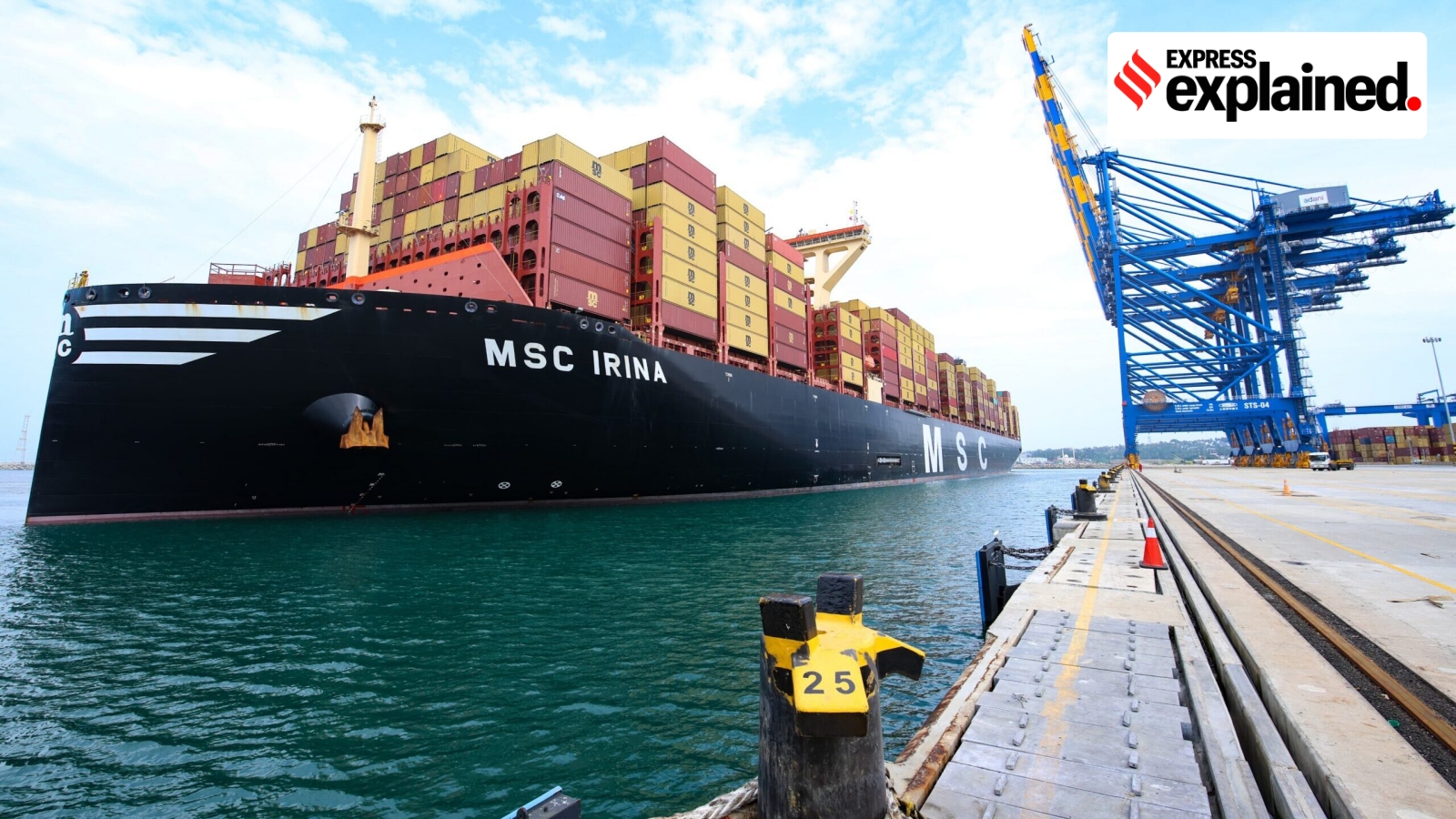
Adani Ports and SEZ (APSEZ) Ltd is moving to sell 49% of its stake in Kerala’s Vizhinjam port to Switzerland-based container shipping behemoth MSC Group for around $1.4 billion (more than Rs 13,000 crore).
The state government, however, has said that it was kept in the dark about the development. According to the Congress-led government — as well as the Opposition CPI(M) — the concession agreement with Adani mandates the state’s approval for such a deal.
A state panel is now examining the proposal. Here’s a look at what the agreement between the Kerala government and Adani Ports says and why the deal has created a controversy in Kerala.
First, what is the Vizhinjam project?
Vizhinjam is India’s first deep-water container transshipment port and is expected to handle domestic and regional cargo at a lower cost rather than routing it through Sri Lanka, according to its website.
The project is being developed as a public-private partnership between the Kerala government and Adani Vizhinjam Port Pvt Ltd (AVPPL) — the port’s operating company and concessionaire — under the Design, Build, Finance, Operate and Transfer (DBFOT) model.
The Kerala government, then led by the Congress, signed the concession agreement with AVPPL on August 17, 2015. After several delays, the first phase of the port was commissioned in December 2024, with the next stage slated for December 2028. The annual handling capacity in the first phase was one million TEUs (twenty-foot equivalent units), which is expected to increase to three million in the next phase.
The Kerala government invested Rs 5,595 crore in the first phase of the project while the Adani group put in Rs 2,454 crore. The Centre had provided a viability gap fund of Rs 817 crore. The DBFOT is for 40 years with provisions to extend the period for another 20 years.
Story continues below this ad
What did Adani Ports do?
On June 30, APSEZ disclosed to market regulator SEBI that it had entered into a share purchase and subscription agreement with Mundi Ltd on the previous day (June 29).
Mundi Ltd is a subsidiary of Terminal Investment Ltd (TiL) which, in turn, is the terminal operating arm of the MSC.
Under the deal, the MSC subsidiary was to acquire the 49% stake in AVPPL for $1.397 billion (around Rs 13,000 crore). This would be the largest foreign private investment in domestic port infrastructure if it goes through.
Story continues below this ad
The disclosure to SEBI has not set any deadline for the share transfer but said the transaction is subject to customary approvals, including regulatory ones.
Why did Kerala government object to the Adani deal?
The Kerala government has stated that Adani’s decision to sell the 49% stake constitutes a change in ownership under the agreement’s terms and, thus, requires government permission.
On Thursday, Chief Minister V D Satheesan communicated the state’s displeasure to Adani Ports and SEZ Ltd. His office said in a statement that the state envisaged the port as a competitive global container transhipment hub, one where all stakeholders would get a level playing field. The government fears that the deal will lead to a monopoly in shipping and container traffic for MSC, which is the world’s biggest container shipping company.
The agreement says the concessionaire should manage and operate the port on a “common-user” basis, which means providing non-discriminatory access to all vessels, vehicles, shipping lines, shippers, receivers, forwarders and other users.
Story continues below this ad
TiL has a joint venture with APSEZ in Mundra port in Gujarat since 2016. In 2023, TiL had acquired 49% equity in Adani Ports Ennore Container terminal. The Ennore deal, however, has not led to the monopoly of the investor in port operations. The port policy in India makes it mandatory that terminal concessionaires operate under the “common-user” terminal model.
What is the Adani group’s stand on Vizhinjam project?
AVPPL issued a communication to the state’s ports department about the deal on July 1, a day after it disclosed the matter to SEBI. AVPPL is of the view that it was mandatory to inform the SEBI before approaching the state government seeking its consent.
According to the concession agreement, Adani must retain 51% share in the port during the construction period and the first year of commercial operations. Beyond the first year, it has to maintain a minimum share of 26%.
Story continues below this ad
According to the Adani group, the Vizhinjam port is now in its second year of operations, allowing it to dilute up to 74% of its stake.
What does the agreement between Kerala and Adani say?
The agreement doesn’t prohibit a stake sale, as laid out above. But it does say that Adani shall not undertake or permit any change in ownership, except with the prior approval of the authority — that is, the government.
The agreement also defines what a “change in ownership” is. It says that transfer of equity in aggregate of 25% or more of the total equity of the concessionaire, “shall constitute a change in ownership requiring prior approval of the authority from national security and public interest perspective”. But the agreement does not define the contours of public interest.
The decision of the authority will be conclusive and binding on the concessionaire.
How disputes have to be solved
Story continues below this ad
According to the 2025 agreement, any dispute, difference or controversy between the parties should be settled amicably in accordance with the conciliation process. There is also a provision for arbitration, which shall be held in accordance with the Rules of Arbitration of the International Centre for Alternative Dispute Resolution, New Delhi.