Prateek Tanmay
Cristiano Ronaldo waits at the edge of the D. The Croatian goalkeeper stands still on the goal line at the other end. This is a wild-west face-off of the footballing kind. Here one shoots, the other saves. Between them sits the ball.
The next few seconds will decide the fate of the world’s most famous footballer. Ronaldo’s Portugal trails by a goal in this World Cup knockout tie’s 67th minute, and for Ronaldo the clock could be running out for good. Should he kick right of the goalkeeper, or left? Pause the frame and check the statistics for the answer.

In his seminal book on football shootouts, Pressure: Lessons from the psychology of the penalty shootout, Norwegian researcher Geir Jordet gives the numbers. Going right, the chance of scoring is 70.7 percent; going left, virtually the same at 71.2 percent.
Counterintuitively, going straight down is actually the best option, with the chances of scoring climbing to 77.9 percent. The logic: most goalkeepers second-guess. With the ball rocketing towards them at pace, there’s no time to react after the kick, so they must pre-decide, pick a side. Straight down is the easiest way to beat both keeper and odds.
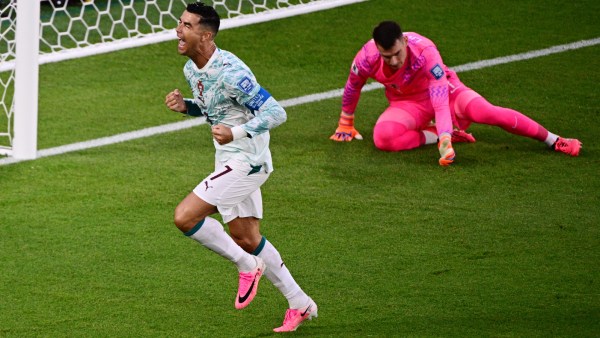 Ronaldo paused before taking his penalty against Croatia but ended up converting it. (AP)
But goalkeepers have researchers too. What if they stand still? Then the straight kicks land in their laps. The save instantly turns the penalty-taker into a villain: a choker, a counterfeit Panenka.
Ronaldo took the biggest gamble of his life. He starts, then suddenly stops in his stride. The Croatian keeper dives to his right. Ronaldo’s pause has done its job: he goes straight. Goal. 1-1. He, and Portugal, live to tell the tale.
ALSO READ | That Summer of ’86 when Maradona, Socrates changed our sleepy town forever
CR7 came close to joining football’s hall of shame of unsuccessful penalty-takers, the cursed fraternity of men like Baggio, forced to relive their worst day every time they step outside. For some, even that wouldn’t help.
***
Which raises the real puzzle: why do the best players in the world, men who can thread a pass through four defenders, sometimes come apart with nothing between them and the goal but a set of gloves twelve yards away?
“Why didn’t you just whack it in?” This was Gareth Southgate’s mother Barbara after her son missed that crucial penalty against Germany in the 1996 Euro semi-finals. A loving parent, but a natural reaction, and one echoed in living rooms across England that night. Barbara’s line would go on record, the familiar cry fans let out when a player fails to do what seems deceptively simple.
Days earlier, even Messi triggered this frustration when he hit the goalpost from the spot against Austria. Even Buenos Aires would have thrown up its hands watching their greatest player fail at football’s supposedly easiest task.
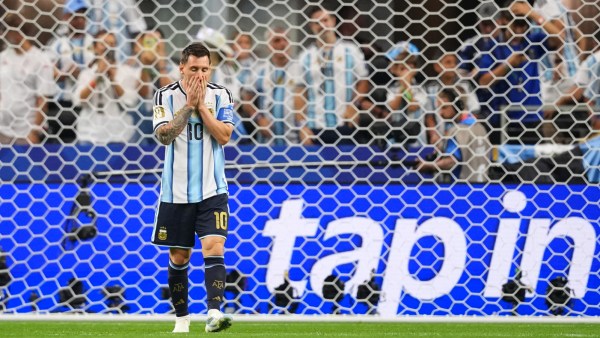 Messi missed a penalty against Austria. (AP)
Over the years, research scientists, neuroscientists, economists and pundits have all tried to crack this battle of nerves within a team game. What makes it fascinating is how little has actually been cracked. Every angle has been examined, but no one has solved the penalty. It remains the suspense drama that makes football’s narrative richer, the ultimate test of coolness. A strange geometrical puzzle where nothing can work but anything can be handy. Even Mrs Southgate’s wise-with-hindsight instruction: “Why didn’t you just whack it in?”
***
Hungary’s captain and Liverpool’s main man Dominik Szoboszlai truly believes in Mrs Southgate’s “whack it in” approach. Son of a failed footballer and reformed gambling addict, Szoboszlai spent nearly five hours playing football every day since the age of six, logging his 10,000 hours before adulthood, with his father as coach and taskmaster. Besides being a skilful footballer, he became an expert penalty-taker: pick a spot, kick low and hard, make the goalkeeper redundant.
ALSO READ | In Messi’s second goal & Sachin’s googly to Moin, an insight into genius minds
One story from his RB Leipzig days: facing PSG in a Champions League game where a goal would deny PSG a point. As Szoboszlai walked in to take it, Neymar tried playing mind games. He’d picked the wrong guy. “You going to score?” Neymar asked. “Yes.” “Are you sure?” Szoboszlai, calm and matter-of-fact: “Yes. I never miss.” He was right. Donnarumma dived right; the kick went past him anyway, same direction, no contest.
How could Szoboszlai be so sure of himself? Training and temperament, perhaps, but this slam-bang approach comes with no guarantee. Jordet’s book is full of cases where it didn’t hold: England’s Chris Waddle in 1990, too hasty on his run-up; Steven Gerrard in 2006, describing the wait before his turn as an unbearable countdown in his own head. Jordet’s diagnosis is the same in both: dread, urgency, a desire to end the wait and stop the pain.
So is the stuttered approach better? Not always. Nothing is etched in stone when it comes to spot kicks.
***
Marcus Rashford, another Englishman with penalty trauma, has his own stutter-penalty story. In his book, he writes about his miss in the Euro 2020 final against Italy, the game where he and the other players who failed to score, mostly Black footballers, were trolled brutally enough to question their future in the game. “Normally I don’t get nervous when playing football,” he wrote. “But that day, something was off, the brain wasn’t telling me ‘just try your best’ like it normally did.” Instead: “You have to be perfect.” So he tried something different: a stuttering run-up, a pause on the way to the ball. It wasn’t the instruction his feet were used to receiving.
Even the smartest penalty-takers, Messi, Harry Kane, have fluffed chances after their own stutter. Which brings us back to where we started: why do the most skilful footballers in the world keep failing to beat a six-foot goalkeeper guarding an eight-foot-high, twenty-four-foot-wide target?
Football’s greatest thinker, the late Johan Cruyff, put it quite simply. “They look so simple, that’s why they’re difficult.” So next time someone who can’t toss a crumpled paper into the bin says “Why didn’t you just whack it in?”, tell them to shut up.