Prateek Tanmay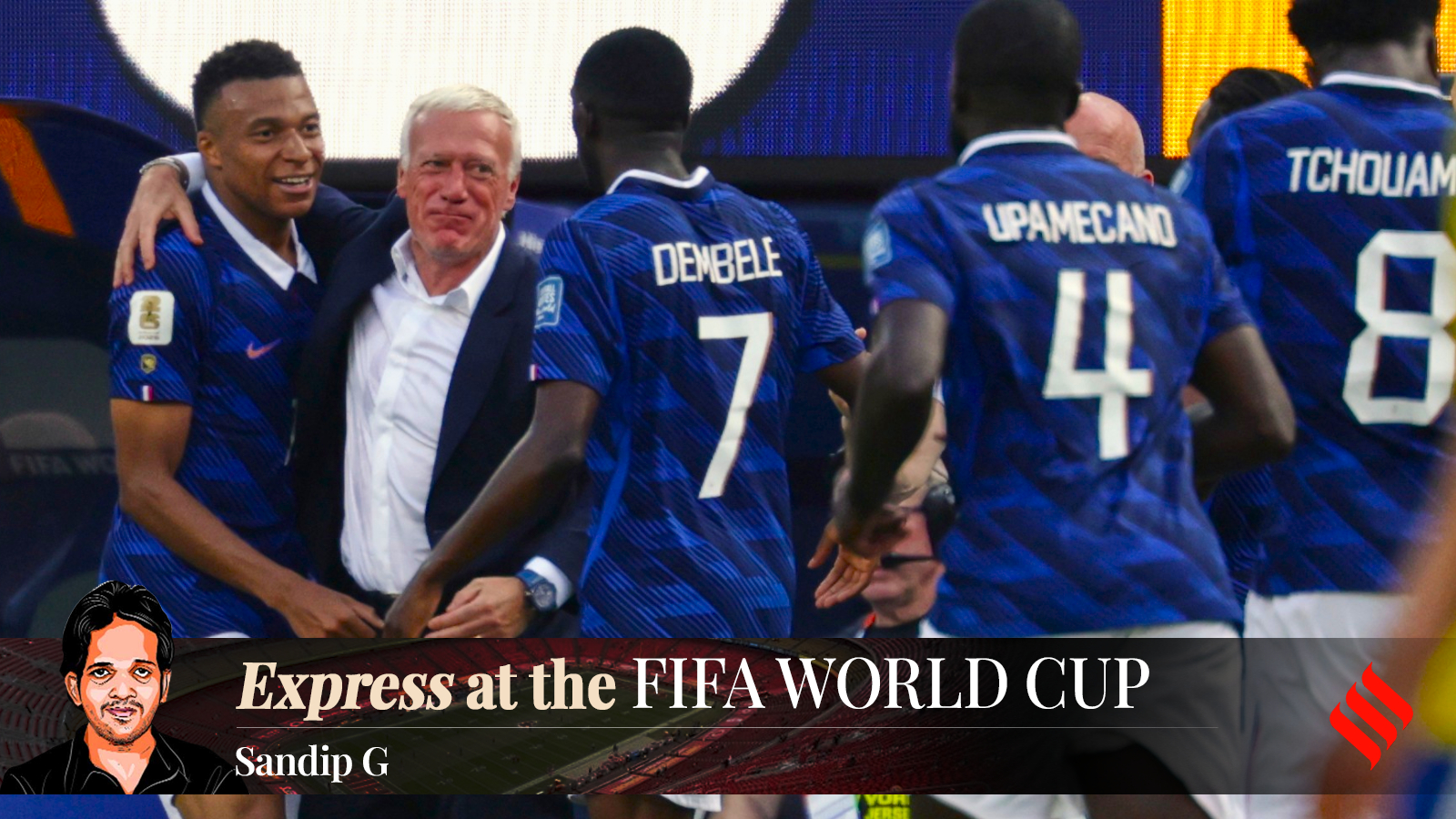
A blue cloth with flowers embroidered on its side greeted France manager Didier Deschamps, returning from his mother’s death, into the Metlife Arena. The message was simple but touching: “Didier, we are with you.” The emcee stopped the hip-hop song blasting from the loudspeakers. The players performed their warm-up drills without the usual frolics, but with an unusual sombreness. After the national anthem was rendered, the French fans chorused: “C’est vous, Didi!” You are the man.
The understated French manager would be the man of the evening, although Kylian Mbappe nailed two goals of artful precision, Bradley Barcola exhibited his velvet feet with a goal cut from silk, and his flying Les Bleu eviscerated Sweden’s iron-willed defence (3-0). The signs are sinister and fatalistic for teams destined to stumble into them, shepherded by a manager that walks without aura or vanity.

The arena was so emotionally charged that Deschamps eventually broke down. He shed a tear when he staggered to the tunnel. The face of calm creaked, touched by a moment that showed how much the players loved him. Mbappe, putting France ahead, turned back and ran towards his manager, yelling and pointing his index finger towards, “ C’est pour vous.” It is for you. Sweating profusely in New Jersey, he tightly hugged Deschamps, in black suits. Deschamps whispered a thanks in his ears and clung onto him. The French players joined them, and embraced their manager. He turned back, and the cameras soaked his eyes that had turned red.
The French talisman considers him as a father figure, an unwavering pillar of support during his lean days. He handed him the leap of faith debut in the tournament against Argentina in 2018; he spent months consoling him after the heartbreak of Qatar in 2022 and the European Championship in between; he defended him when rumours of rift swirled in the dressing room. “Kylian—whether you like him or not—the youngsters love him. You have the image of a selfish, individualistic guy, and of course a striker must also be selfish, but I can assure you that in the French national team, he acts like a captain,” he defended him last year. Most of all, no manager has harnessed his gifts as much as Deschamps has.
Mbappe loves him back too. “He is my comfort zone. He brings a lot of calm into the dressing, never loses his cool, and gives us the liberty to play in our way. It’s a misconception that he is a defensive coach,” he said during the Nations League on February.
Rather, he is no longer one. Deschamps has pragmatic traits, a spillage of virtues from his days as a grim defensive midfielder. The condescending nickname still lingers: the water carrier. But a number from the 1998 World Cup is often forgotten. That no one made as many touches as Deschamps in the entire tournament. He was the team’s backbone, if Zinedine Zidane was its brain. He never won his dues as a player; as a manager it’s time he should. He is a World Cup winner (as player and coach), a finalist in another World Cup and European Championship. Yet, he goes uncelebrated. Maybe, it is the way he wants to, existing in the shadows.
Even his 2026 batch, the most attractive French iteration of this century is viewed as a happenstance of dizzying attacking talents rather than the manager harnessing the individual potential to an awesome collection of artistes. He has found a way to combine both Mbappe and Dembele, despite the pundits’ cynicism, he has let Michael Olisse blossom into his team’s creative thrust;’ he has enabled Desire Doue and Bradley Barcola flourish; he has configured a defensive pack that combines the old-school virtues of toughness and tenacity as much as the new-age principles of ball carrying and attacking output.
Story continues below this ad
The results are bewildering. France has shipped in only two goals and coughed up 10. All against adversaries inclined to defend in numbers. His group has the keys to unlock any defences. For 30 minutes, Sweden did all they could to block them. Four-men defence became five, five became six, then they dug a trench. Yet, France harassed them in a variety of ways. First with long rangers, then with clever runs through the channels, then with fast transitions, with Olise and Barcola switching roles. It was simply maddening for the Swedes. Twice the post denied them. One was an jaw-dropping overhead kick by Olise. The other was Mbappe’s low curler with a millimetre more whip than he would have desired for.
Goals were but a certainty. So those came. Mbappe’s first strike was like a lucid sonnet, every line precise and rhyming. Olise and Dembele exchanged a one-two, from a short corner. Dembele preened to his right, and dropped the ball to the left. Mbappe travelled diagonally and picked the ball. He dropped the shoulder, feigned a step-over and viciously veered to the right, wedged through two Swedish shirts, the first layer of firewall, before threading his raspy shot through the narrow alley between the second line of defence. Almost invisibly, unpretentiously, he cut the stoic Swedish defence to ribbons. His second strike was more like a stab with a Nepali knife, one touch to pull out the weapon and the next to twist. Barcola, who started the game instead of Doue for his diligence in running behind the three forwards, scored a delicious goal. He controlled the ball flying away from him with the outside of his right boot and whipped the ball home. Olise was the silent conductor, stamping his intuitive passing in each of the three goals France scored.
The evening ended with the usual frolics. Mbappe and Co engaging with the crowd, dancing on the ground and blowing kisses towards the fans. They patiently waited for Deschamps to return after his media commitments, so that they could tell him once more that they are with him in his grief. The evening his troops strung a nerveless exhibition of attacking, artistic football, Deschamps was the man.