Prateek Tanmay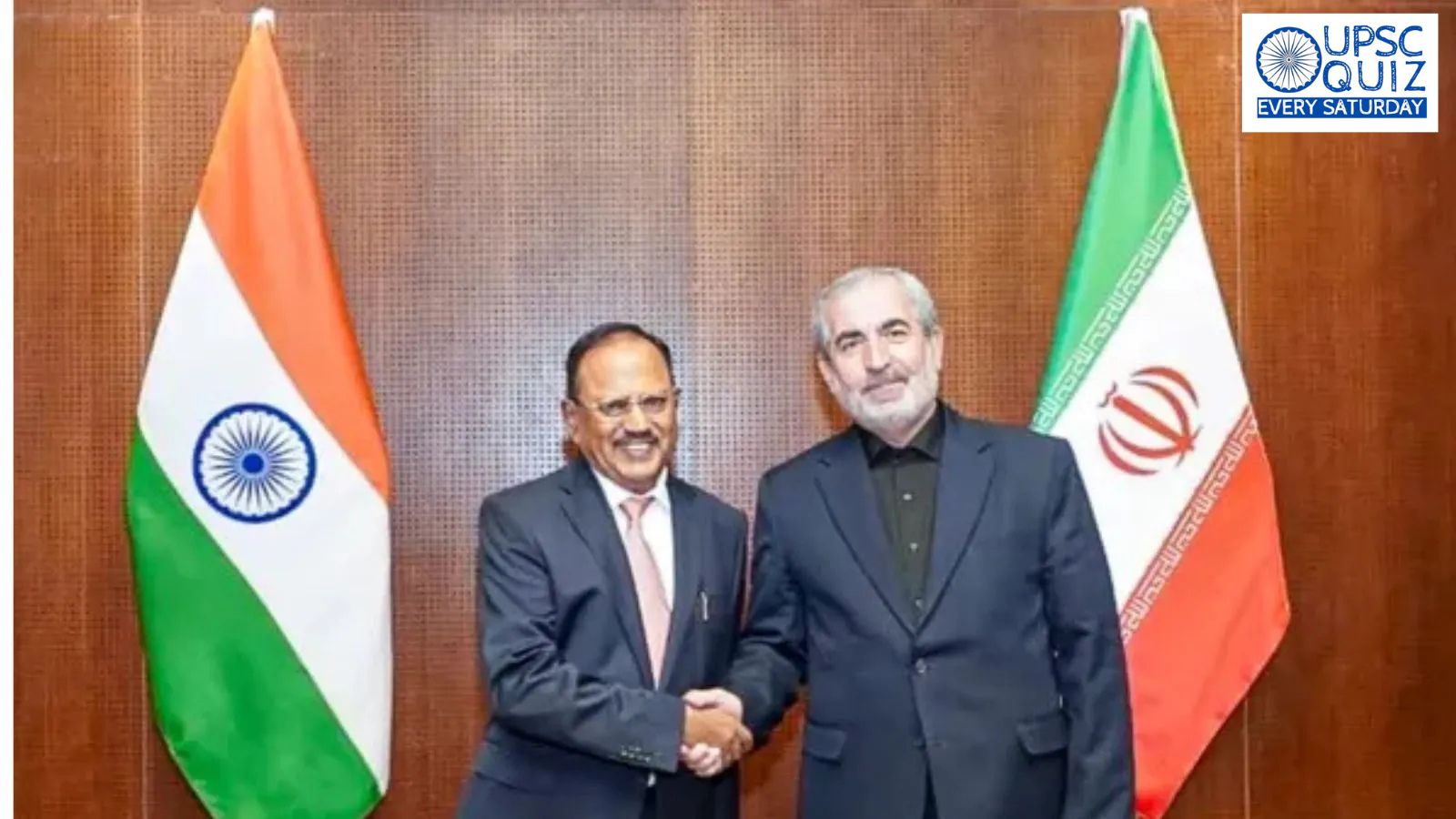
As UPSC CSE Prelims 2027 is still ahead, building a strong foundation alongside regular current affairs preparation is essential. UPSC Weekly Quiz is a current affairs–based quiz on relevant topics from the past week, curated for aspirants of competitive examinations. Attempt the weekly quiz every Saturday and review the detailed answers with explanations to strengthen conceptual clarity and exam readiness.
🚨 Click Here to read the UPSC Essentials magazine for June 2026. Share your views and suggestions in the comment box or at manas.srivastava@indianexpress.com🚨
1. FDCs contain two or more active ingredients in a single formulation.
2. All fixed-dose combinations approved for sale in India are considered rational and therapeutically superior to single-drug formulations.
3. FDCs do not require separate regulatory approval if each individual drug component has already been approved.
How many of the statements given above are correct?
(a) Only one
(b) Only two
(c) All three
(d) None
Why this question for UPSC Prelims 2027?
The question is relevant because fixed-dose combinations (FDCs) have been in the news due to concerns over irrational drug combinations, regulatory oversight, and recent actions by drug authorities to review and prohibit unsafe formulations. The topic integrates science and technology, health policy, and governance, making FDCs a potential area for conceptual and current affairs-based Prelims questions.
Explanation
Story continues below this ad
— The government has banned 16 fixed-dose combination (FDC) drugs, including certain antibiotic combinations and a range of dermatological products containing aloe vera and other herbal ingredients, because their amplified benefits lack scientific justification.
— Fixed-dose combinations contain two or more active ingredients in a single formulation and are commonly prescribed for conditions ranging from infections to pain and skin ailments. While some combinations are evidence-based and improve patient outcomes, others are considered “irrational” because there is little or no scientific evidence that the ingredients work better together than when used separately. Hence, statement 1 is correct.
— A fixed-dose combination is considered irrational when the ingredients do not have a scientifically established rationale for being combined in a single product. For a combination to be considered rational, each component should contribute meaningfully to the intended therapeutic effect, have compatible pharmacological properties and demonstrate additional clinical benefit compared to using the individual medicines separately.
— Not every FDC is deemed rational or therapeutically superior. Concerns have been raised in India over the approval and marketing of various irrational FDCs, prompting the government and courts to issue periodic bans and regulatory reviews. Hence, statement 2 is not correct.
Story continues below this ad
— An FDC is considered a novel medicine under the regulatory system and, in most cases, requires independent approval from the drug regulator, even if the individual components have already been approved separately. Hence, statement not 3 is correct.
Therefore, option (a) is the correct answer.
QUESTION 2
Consider the following pairs:
1. Atlantic Charter – A joint statement of Allied war aims and principles for a post-war peaceful international order.
2. Moscow Declaration – It marked the first firm Soviet commitment to establish a general international organisation to maintain peace and security.
Which of the pairs given above is/are correctly matched?
(a) 1 only
(b) 2 only
(c) Both 1 and 2
(d) Neither 1 nor 2
Why this question for UPSC Prelims 2027?
Story continues below this ad
Understanding milestones such as the Atlantic Charter and the Moscow Declaration helps in tracing the development of the United Nations and the collective security framework, making them potential areas for conceptual and current affairs-linked Prelims questions.
Explanation
— On June 26, 1945, at the Veterans’ War Memorial Building in San Francisco, delegates from 50 nations signed the Charter of the United Nations (UN), a document of 111 articles spread across 19 chapters, agreed upon over two months of negotiation. The conference, formally called the United Nations Conference on International Organisation, convened on April 25, while the war against Japan was still raging. Germany surrendered midway through, on May 8.
— The charter was unanimously adopted by a standing ovation on June 25 and formally signed the next day. The Charter signed that day had four core purposes as laid out in Article 1: maintaining international peace and security, developing friendly relations among nations, achieving international cooperation on economic, social, cultural, and humanitarian problems, and serving as a center for harmonising the actions of nations toward these ends.
— The Charter did not emerge from nowhere. Its intellectual lineage ran through a number of wartime summits and declarations. The idea of the United Nations began to be articulated in August 1941, when Roosevelt and Churchill signed the Atlantic Charter, a joint statement of Allied war aims and principles for a post-war peaceful international order. Hence, pair 1 is correct.
Story continues below this ad
— In October 1943, the Moscow Conference, where the foreign ministers of the US, UK, USSR, and China met and issued the Moscow Declaration, marked the first firm Soviet commitment to establish a general international organisation to maintain peace and security. Hence, pair 2 is correct.
— The United Nations formally came into existence on October 24, 1945, now observed as United Nations Day, when the five permanent members and a majority of the other signatories ratified the Charter.
Therefore, option (c) is the correct answer.
QUESTION 3
Consider the following statements:
1. This area is part of the Eastern Dharwar Craton, a piece of the Earth’s crust formed 3.6-2.5 billion years ago.
2. The region is known for gold mineralisation.
3. The site was renowned during Emperor Ashoka’s period (268-232 BCE), with Ashokan inscriptions found near Erragudi.
The above mentioned statements refer to:
(a) Jonnagiri, Andhra Pradesh
(b) Hutti, Karnataka
(c) Jaduguda, Jharkhand
(d) Malanjkhand, Madhya Pradesh
Why this question for UPSC Prelims 2027?
Story continues below this ad
UPSC can ask interdisciplinary questions that connect geography, geology, mineral resources, and ancient Indian history, particularly through location-based current affairs. The linkage of the Eastern Dharwar Craton, gold mineralisation, and Ashokan inscriptions at Erragudi makes this region a strong current affairs-cum-static knowledge question in UPSC Prelims.
Explanation
— Andhra Pradesh Chief Minister N Chandrababu Naidu inaugurated India’s largest private-sector gold mining project at Jonnagiri in Kurnool district earlier this week.
— Geomysore Services India Pvt Ltd and Deccan Gold Mines, the companies behind the project, are investing Rs 405 crore in mining, extraction, processing, and marketing of gold bars from Jonnagiri itself.
— Jonnagiri has been known as a site of gold exploration since ancient times. It was once known as Swarnagiri and was renowned during Emperor Ashoka’s period (268-232 BCE), with Ashokan inscriptions found near Erragudi.
Story continues below this ad
— The wider Rayalaseema region has also been known as the land of precious stones and minerals. During the reign of Sri Krishnadevaraya (1509-29), gems and precious stones were traded in abundance.
— The Jonnagiri area is part of the Eastern Dharwar Craton, a piece of the Earth’s crust formed 3.6-2.5 billion years ago. The region is known for gold mineralisation, or when various geological processes result in the transformation of gold into extractable ore deposits.
Therefore, option (a) is the correct answer.
QUESTION 4
With reference to the passport, consider the following statements:
1. The Indian passport is a legal document that confers citizenship.
Story continues below this ad
2. The Indian passport establishes that the holder is travelling under Indian nationality and that the Government of India has verified the person’s credentials before issuing it.
Which of the statements given above is/are correct?
(a) 1 only
(b) 2 only
(c) Both 1 and 2
(d) Neither 1 nor 2
Why this question for UPSC Prelims 2027?
The question is relevant because issues related to passports, citizenship, nationality, and identity documents have frequently appeared in public discourse, judicial proceedings, and administrative reforms.
Explanation
— The Ministry of External Affairs’ (MEA) recent note that an Indian passport is primarily a “travel document” and not conclusive proof of citizenship has prompted broader questions about nationality and identity. Hence, statement 1 is not correct.
— A passport is the primary document that allows Indians to travel internationally. According to former Indian diplomat Veena Sikri, “The Ministry of Home Affairs (MHA) alone has the authority to grant and determine citizenship. The Ministry of External Affairs cannot make that determination because citizenship falls outside its jurisdiction.”
— A passport serves as a travel document and a document of nationality for international travel, but it is not, in itself, a legal document that confers citizenship.
— When an Indian traveller presents a passport at a foreign immigration counter, the document is accepted because it has been issued by the Government of India. The passport establishes that the holder is travelling under Indian nationality and that the Government of India has verified the person’s credentials before issuing it. Hence, statement 2 is correct.
Therefore, option (b) is the correct answer.
QUESTION 5
Consider the following statements about the Upper Layer NBFC (NBFC-UL):
1. Under RBI rules, an NBFC-UL is required to list on a stock exchange within three years of being notified and comply with stricter governance and disclosure norms.
2. The NBFCs with assets of Rs 1 lakh crore or more will be classified as NBFC-UL.
Which of the statements given above is/are correct?
(a) 1 only
(b) 2 only
(c) Both 1 and 2
(d) Neither 1 nor 2
Why this question for UPSC Prelims 2027?
The question is relevant because the Reserve Bank of India recently revised the criteria for identifying the Upper Layer NBFC (NBFC-UL) under its Scale-Based Regulation framework, bringing the topic into current affairs.
Explanation
— The Reserve Bank of India (RBI) came out with revised guidelines earlier this week stating the requirement to qualify as Upper Layer non-banking finance companies (NBFC-UL) without giving clarity whether Tata Sons, the holding company of $180 billion Tata group, will have to go public with an IPO or not.
— The RBI’s final list of NBFC-UL – which is expected soon — and the qualifying assets are potentially very significant for Tata Sons as they could remove the main regulatory trigger that has kept alive the possibility of a mandatory IPO.
— In 2024, the RBI classified Tata Sons as an Upper Layer NBFC (NBFC-UL) under its Scale-Based Regulation framework because of its size and systemic importance. Under RBI rules, an NBFC-UL is required to list on a stock exchange within three years of being notified and comply with stricter governance and disclosure norms. Hence, statement 1 is correct.
— That classification effectively put Tata Sons on the path toward a public listing since September 2025, unless the RBI changed the rules or granted relief. Tata Trusts holds 66% stake in Tata Sons.
— Earlier this week, the RBI replaced the previous methodology to determine NBFC-UL with a simple criterion that only NBFCs with assets of Rs 1 lakh crore or more will be classified as NBFC-UL. While this is a major policy shift, it’s not clear whether Tata Sons will qualify as an NBFC-UL. Hence, statement 2 is correct.
— The key question is: does Tata Sons still have NBFC assets of Rs 1 lakh crore or more? In recent years, Tata Sons has repaid the debt, reduced its NBFC activities and increasingly functioned as a holding company rather than a lender. If Tata Sons is no longer classified as NBFC-UL, the RBI requirement to list as an Upper Layer NBFC would become irrelevant and the biggest regulatory reason for a mandatory IPO effectively goes.
Therefore, option (c) is the correct answer.
QUESTION 6
With reference to the Asian stock markets, consider the following pairs:
1. Kospi index – Japan
2. Nikkei 225 index – South Korea
3. Taiex index – Taiwan
How many of the pairs given above are correctly matched?
(a) Only one pair
(b) Only two pairs
(c) All three pairs
(d) None of the above pairs
Why this question for UPSC Prelims 2027?
The question is relevant because Asian stock markets have been in the news due to global trade tensions, tariff measures, geopolitical developments, and their impact on international financial markets.
Explanation
— Asian stock markets tanked as much as 6% on Friday (June 26) as Apple’s move to jack up prices of some of its product lines by as much as 20%, and the South Korean government’s proposal to tax unrealised gains on equities, weighed on sentiment for AI and chip-related stocks.
— South Korea’s Kospi index ended 5.8% lower on Friday, briefly triggering the 8% lower circuit midway into the session, leading to a halt in trading for the second time this week after having lost 10% on Tuesday. For the week, the index ended around 7% lower. Hence, pair 1 is not correct.
— Japan’s Nikkei 225 index lost 4.2%, with major constituent Softbank tanking 12.5%. Meanwhile, Taiwan’s Taiex index fell 3.6% on Friday. Both Japan’s and Taiwan’s stock markets are heavily dominated by chipmaking companies. Hence, pair 2 is not correct and pair 3 is correct.
— Samsung and SK Hynix, a semiconductor company, make up over 50% weight on the Kospi, while the chipmaking giant TSMC constitutes around 40% weight on the Taiex.
Therefore, option (a) is the correct answer.
QUESTION 7
Who can be the beneficiaries of the Mission for Integrated Development of Horticulture (MIDH)?
1. Self-help groups
2. Farmer producer organisations
3. State agriculture universities and R&D organisations
4. Agricultural produce marketing committees
Select the correct answer using the codes given below:
(a) 1 and 2 only
(b) 2 and 4 only
(c) 1 and 3 only
(d) 1, 2, 3 and 4
Why this question for UPSC Prelims 2027?
The question is relevant because the Mission for Integrated Development of Horticulture is a major centrally sponsored scheme aimed at promoting horticulture, farmer collectives, and agricultural infrastructure. UPSC can ask questions on the objectives, beneficiaries, and institutional framework of important government schemes.
Explanation
— Bhagirath Choudhary, the Minister of State in the Union Ministry of Agriculture and Farmers’ Welfare, was among the beneficiaries in Rajasthan of a scheme under his own ministry to promote commercial farming, records investigated by The Indian Express show.
— The scheme to promote “commercial farming” — on a large scale for profit — of select vegetables and flowers comes under Mission for Integrated Development of Horticulture (MIDH), which was launched in 2014-15 and is administered by the National Horticulture Board (NHB), an autonomous organisation under the administrative control of Choudhary’s Ministry.
— ‘Development of Commercial Horticulture through Production and Post-Harvest Management of Horticulture Crops’ is a sub-scheme under National Horticulture Board’s Mission for Integrated Development of Horticulture (MIDH).
— Its purpose is to promote commercial farming (for profit) of horticultural crops on a large scale. The crops under the scheme are three types of vegetables: capsicum, cucumber and tomato; and eight varieties of flowers: anthurium, orchid, rose, lilium, chrysanthemum, carnation, gypsophila and gerbera.
— Upto 50 per cent of the project cost, capped at Rs 1 crore per family, is available as subsidy under the scheme.
— Beneficiaries: Individuals, self-help groups, associations or groups of growers, trusts, cooperative societies, companies, farmer producer organisations, cooperative marketing federations, agricultural produce marketing committees, marketing boards, municipal corporations, agro-industries corporations, state agriculture universities and R&D organisations.
Therefore, option (d) is the correct answer.
To read more: Minister got subsidy, under own ministry’s scheme: How projects are cleared – Explained
QUESTION 8
Recently, human skeletal remains were excavated from the Harappan site in Haryana. During excavations conducted by ASI in the 2025-26 field season, archaeologists uncovered eight burials. The site is:
(a) Banawali
(b) Kunal
(c) Rakhigarhi
(d) Kalibangan
Why this question for UPSC Prelims 2027?
UPSC frequently asks questions on the locations, characteristics, and recent discoveries related to the Indus Valley Civilisation and other archaeological sites.
Explanation
— Human skeletal remains excavated from the Harappan site of Rakhigarhi in Haryana have been formally handed over by the Archaeological Survey of India (ASI) to the Anthropological Survey of India (AnSI), a national research institute under the Union Ministry of Culture, for scientific investigation.
— In a Press Information Bureau (PIB) release Monday (June 22), the Ministry said that archaeologists uncovered eight burials at the site’s Mound No. 7 during excavations conducted by ASI in the 2025-26 field season. Field season refers to the primary period during the year when archaeologists conduct active fieldwork, such as excavations and surveys.
— Three complete human skeletons, along with skeletal fragments recovered from other burials, have now been transferred to AnSI’s ancient human skeletal repository and laboratory in Kolkata, the PIB note said. The remaining skeletal materials obtained at these sites are also expected to be transferred in the coming days.
— Material remains are a crucial source in reconstructing information about the Harappan Civilisation, since its script remains undeciphered. Human remains have been increasingly studied using approaches from palaeoanthropological research (interdisciplinary study of human evolution), molecular biology, and DNA studies. These techniques have enabled researchers to investigate what ancient people may have looked like and to trace patterns of ancestry and migration.
Therefore, option (c) is the correct answer.
QUESTION 9
With reference to the cultivation of bajra (pearl millet), consider the following statements:
1. It is preferred during a deficient monsoon.
2. Compared to crops such as cotton and wheat, bajra generally requires fewer irrigations during its crop cycle.
3. Bajra cultivation is generally unsuitable for crop rotations, as its long growing duration delays the sowing of rabi crops.
4. Besides grain production, bajra also provides substantial quantities of dry fodder, making it valuable for livestock-rearing households.
Which one of the following conclusions based on the above statements is correct?
(a) There are four correct statements.
(b) There are two correct statements, that is statement 2.
(c) There are three correct statements.
(d) There is no correct statement.
Why this question for UPSC Prelims 2027?
UPSC frequently asks questions on the agronomic characteristics, water requirements, cropping patterns, and economic importance of major crops and millets.
Explanation
Bajra or pearl millet
— This crop is suited for kharif (monsoon). It matures in 85-90 days, giving us time to plant mustard (in October) or wheat (in November) during the rabi (winter-spring) season.
— Bajra is a robust, drought-resistant, short-duration crop that thrives in insufficient monsoon conditions. Hence, statement 1 is correct.
— Because of its low water requirement and strong drought tolerance, bajra requires far less irrigation than crops like cotton and wheat. Bajra’s short growing season makes it ideal for crop rotations and enables timely sowing of rabi crops. Hence, statement 2 is correct and statement 3 is not correct.
— In addition to grain production, bajra produces a lot of dry fodder (stover), which is useful for livestock-rearing families. Hence, statement 4 is correct.
Therefore, option (c) is the correct answer.
QUESTION 10
The theme of the 16th BRICS National Security Advisers’ Meeting, hosted by India in 2026, was:
(a) Reforming global financial institutions
(b) Non-traditional security challenges confronting the world today
(c) Climate change and sustainable development
(d) Maritime security in the Indo-Pacific
Why this question for UPSC Prelims 2027?
The question is important because BRICS has emerged as a major platform shaping global governance, security cooperation, and the Global South agenda, making its developments relevant for UPSC Prelims. The focus on non-traditional security challenges reflects a contemporary area of international relations, including cybersecurity, terrorism, AI, energy, and supply chain security.
Explanation
— National Security Advisor (NSA) Ajit Doval said that India welcomes the memorandum of understanding (MoU) between the United States and Iran with “cautious optimism” and is hopeful it will help energy security.
— Speaking at the 16th BRICS NSAs’ meeting in New Delhi, Doval said, “India welcomes the MoU reached between the US and Iran. We have got cautious optimism, and we hope that it will work. It will help energy security. The opening of the Strait of Hormuz is a very welcome development.”
— Doval described the BRICS as a “very special coalition”, adding that its member and partner economies have “a very special role to play in the world”.
— Underscoring the evolving role of BRICS in global governance, Doval said that it was originally conceived to provide a platform for emerging economies to foster economic cooperation and strengthen the voice of the Global South.
— The discussions are expected to include a review of the outcomes of the recently held BRICS Joint Working Groups on Counter-Terrorism and on Security in the Use of Information and Communication Technologies. The grouping brings together 11 emerging economies, including Brazil, China, Egypt, Ethiopia, India, Indonesia, Iran, Russia, Saudi Arabia, South Africa and the UAE.
— According to the Ministry of External Affairs (MEA), NSAs and heads of delegation from BRICS member countries will exchange views on the theme ‘Non-traditional security challenges confronting the world today’.
Therefore, option (b) is the correct answer.
Previous Weekly Quiz
UPSC Weekly Current Affairs Quiz (June 14 – June 20)
UPSC Weekly Current Affairs Quiz (June 07 – June 13)
UPSC Weekly Current Affairs Quiz (May 31 – June 06)
UPSC Weekly Current Affairs Quiz (May 24 – May 30)
UPSC Weekly Current Affairs Quiz (May 17 – May 23)
UPSC Weekly Current Affairs Quiz (May 10 – May 16)
UPSC Weekly Current Affairs Quiz (May 03 – May 09)
Subscribe to our UPSC newsletter and stay updated with the news cues from the past week.
Stay updated with the latest UPSC articles by joining our Telegram channel – IndianExpress UPSC Hub, and follow us on Instagram and X.