Prateek Tanmay

From Sunday, India will resume tourist visas for Bangladesh nationals: Trivedi
Syllabus:
Preliminary Examination: Current events of national and international importance.
Main Examination: General Studies II: India and its neighbourhood- relations.
What’s the ongoing story: Moving to improve bilateral relations, India on Thursday announced the resumption of tourist visas for Bangladeshi nationals after a nearly two-year suspension.
Key Points to Ponder:
• India and Bangladesh Bilateral Relations-Know in Detail
• India and Bangladesh Bilateral Relations after August 2024-how things changed drastically?
• What are the areas of cooperation between India and Bangladesh?
• What are the issues and challenges between India and Bangladesh?
• How can India and Bangladesh strengthen their relations?
• What is the significance of Bangladesh for India?
• How external influences is shaping domestic policies in Bangladesh?
Key Takeaways:
• Delhi suspended tourist visas for Bangladeshi nationals in August 2024 following political unrest and the ouster of the Sheikh Hasina-led government. Trivedi announced that tourist visa applications will resume on June 28, at five visa centres, including the one in Dhaka. This was his first announcement after presenting his credentials to the President of Bangladesh, Mohammed Shahabuddin, Thursday afternoon, signalling that he has been tasked with repairing ties between the two countries.
• Last month, The Indian Express reported that India and Bangladesh were planning to resume visa services soon. As both countries sought to normalise their relationship after a period of significant turmoil, the full-scale resumption of visa services was agreed upon by both sides as an important first step.
• Bangladesh resumed issuing visas to Indian citizens across all categories following the swearing-in of the Tarique Rahman government in February this year. During Bangladesh Foreign Minister Khalilur Rahman’s visit to India in April, the normalisation of visa processes was one of the key topics discussed by Dhaka.
• All Bangladesh visa centres in India, including the High Commission in New Delhi and the consular divisions in Kolkata, Agartala, Mumbai and Chennai, have been operational since February 20. In response, Dhaka requested that Delhi promptly reciprocate on the visa issue.
• The five IVACs in Bangladesh came under attack in August 2024, and Indian personnel working at development projects were threatened. Due to security threats and the attacks on the High Commission premises, the High Commission of India was forced to scale down visa operations in Bangladesh.
Do You Know:
• The Centre has granted Dinesh Trivedi a status equivalent to that of a Union Cabinet Minister. An order issued by the Ministry of Home Affairs (MHA) said Trivedi “has been assigned the equivalent status of Union Cabinet Minister in the Table of Precedence (ToP) as a measure personal to him, without amending the Table of Precedence.”
“The position in the Table of Precedence is for ceremonial functions only,” it said.
Trivedi has succeeded Pranay Kumar Verma, who was the Indian High Commissioner to Bangladesh for four years until May this year. The Ministry of External Affairs announced Trivedi’s appointment to Dhaka on April 27.
• According to figures provided by the Bangladesh High Commission to The Indian Express, over 13,000 visas have been issued to Indian citizens in the first two months since the resumption of operations around February 20. These include various categories: business, tourism, medical and for those travelling across the border to meet family members.
• Bangladesh has been India’s top source of foreign tourist arrivals, often accounting for over 20% of total arrivals. A significant portion of these visits is for medical treatment, business, and visiting friends/family, with West Bengal being a primary destination. In 2023, around 21.2 lakh visitors from Bangladesh came to India, according to official statistics, while the number dropped marginally to 17.5 lakh in 2024. However, Bangladeshi tourist arrivals to India dropped sharply to 4.7 lakh in 2025 (a 73% decrease), largely due to political tensions and visa restrictions.
• Once visa processes on both sides are normalised, Delhi and Dhaka would look at other points of convergence including economic ties and energy connectivity. Recently, India transported diesel to Bangladesh to alleviate energy shortages in the wake of the West Asian crisis.
Other Important Articles Covering the same topic:
📍How Sheikh Hasina’s ouster may impact India-Bangladesh trade ties
Previous year UPSC Prelims Question Covering similar theme:
1) Consider the following statements about river bridges connecting India with neighbouring countries: (UPSC CSE, 2026)
1. ‘Maitri Setu’, built over Feni river, connects Ramgarh in India with Sabroom in Bangladesh.
2. Jhulaghat suspension bridge connects India with Myanmar.
3. Mechi bridge and its approaches connect Panitanki Bypass in India with Kakarvitta in Nepal.
Which of the statements given above is/are correct?
(a) 1 and 2
(b) 2 and 3
(c) 1 only
(d) 3 only
Previous year UPSC Main Question Covering similar theme:
📍Analyze internal security threats and transborder crimes along Myanmar, Bangladesh and Pakistan borders including Line of Control (LoC). Also discuss the role played by various security forces in this regard. (UPSC, 2018)
Thousands feared killed as twin quakes rock Venezuela, many trapped under rubble
Syllabus:
Preliminary Examination: Indian and World Geography-Physical, Social, Economic Geography of India and the World.
Mains Examination: General Studies I: Important Geophysical phenomena such as earthquakes, Tsunami, Volcanic activity, cyclone etc., geographical features and their location-changes in critical geographical features (including water-bodies and ice-caps) and in flora and fauna and the effects of such changes.
What’s the ongoing story: Venezuela is grappling with its deadliest earthquake disaster in decades after twin powerful earthquakes struck within seconds of each other, flattening buildings around Caracas, killing at least 164 people and leaving hundreds trapped beneath rubble.
Key Points to Ponder:
• Map Work-Venezuela and capital Caracas
• What is seismic doublet?
• What you know about the two earthquakes in Venezuela so far?
• What caused the earthquakes?
• Is Venezuela vulnerable to earthquakes?
• Why were the earthquakes so destructive?
• What is Earthquake?
• Do shallow earthquakes cause greater damage?
• Why earthquakes remain unpredictable?
• What exactly causes earthquakes?
• What is focus or seismic focus of Earthquake?
• What is epicentre of Earthquake?
• The intensity of earthquake is highest in the epicentre and decreases as one moves away-True or False?
• Earthquakes take place in the lithosphere-True or False?
• What is seismic waves or earthquake waves?
• What is Body waves and Surface waves?
• Know in detail-Primary waves (p-waves), Secondary waves (s-waves), L-waves and Rayleigh waves
• Map Work-Mark Circum-Pacific Belt
• Earthquake zones in World-Know in detail
Key Takeaways:
• A quake of magnitude 7.2 hit around 160 km (100 miles) west of Caracas, followed by an even stronger quake less than a minute later, the largest to hit the country in more than a century, news agency Reuters reported, citing the US Geological Survey.
• Delcy Rodríguez, acting President of the country, declared a state of emergency, and warned that the toll was expected to rise intensely once rescuers reached La Guaira, which is the hardest-hit state situated near the capital, which she described as the “disaster zone,” AP reported.
• The rescue team worked throughout the night, pulling survivors from rubble. International aid offers filled in from the United States, Latin America, Europe, and beyond, with thousands yet unaccounted for.
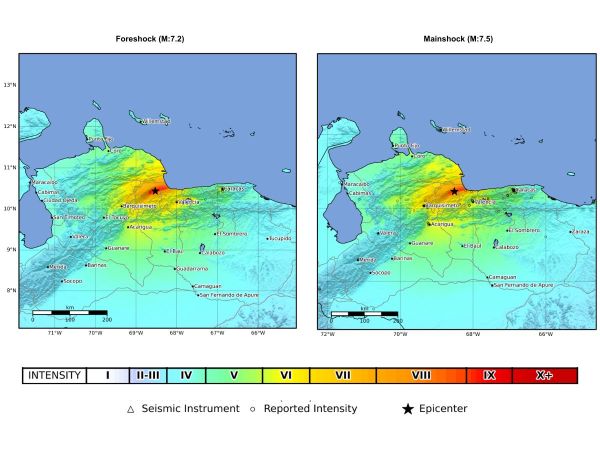 The magnitude 7.5 mainshock (right) produced stronger and more widespread ground shaking than the magnitude 7.2 foreshock (left). (USGS)
Do You Know:
• According to AP, the first earthquake, measured initially, had struck at a magnitude of 7.1. It was later revised to 7.2 by the USGS, struck in west of Morón, Venezuela’s Caribbean coast, around 168 km (104 miles) from Caracas, at a depth of 22 km. After less than a minute, an even greater quake of 7.5 magnitude with a depth of 10 km struck about 16 km southwest of Morón.
• The USGS stated that the pairing of this scale is unusual and difficult to model. Paul Earle, a seismologist, said that it is hard to unravel the effects “when the earthquakes are this close together” in time. The tremors were felt as far away as Brazil’s Amazon region, roughly 1,700 km from Caracas, prompting building evacuations in cities like Manaus, Belém, and Macapá, as well as in parts of Colombia. A tsunami warning was issued but swiftly cancelled once the danger had passed.
• President Rodríguez confirmed a minimum of 164 deaths and more than 900 were injured during a broadcast address and cautioned that the figures excluded La Guaira state, which is home to Caracas’s main airport, where “dozens of buildings have collapsed” and rescue operations were underway.
• Venezuela sits in one of the most seismically active regions in northern South America, along the boundary between the Caribbean and South American tectonic plates. These two plates can slide horizontally past each other along faults, in a phenomenon called a strike-slip fault causing earthquakes.
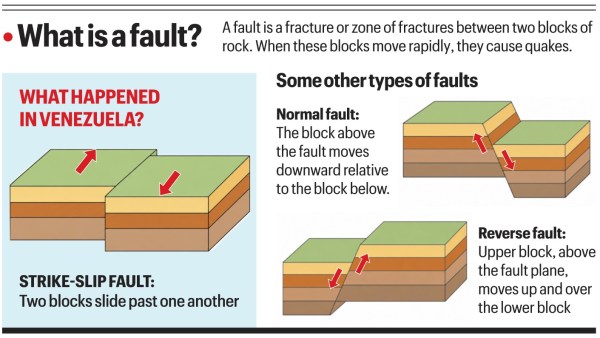 Different kinds of faults
• Venezuela sits where the Caribbean and South American tectonic plates meet, but it lies away from the Pacific “Ring of Fire” — the belt the USGS says is responsible for 90% of the world’s earthquakes. That makes powerful quakes here far rarer than along the Pacific coast in Mexico or Chile.
• The planet’s crust is broken into tectonic plates that grind past, pull away from, or push into one another. Venezuela straddles the seam between two of them — most of the time it moves slowly, but a sudden slip can release enormous energy as an earthquake.
• The mainshock occurred at a relatively shallow depth of about 10 km. This meant that the shockwaves reached the surface with high intensity. Worsening the situation was the fact that this was a doublet, distinct from routine aftershocks.
• “Doublets or twin earthquakes are slightly different from aftershocks that are routine after any major earthquake. Aftershocks are largely a result of disturbances or ruptures caused by the main earthquake. Some stress is already present, and it is then amplified by the main earthquake, resulting in another quake. Aftershocks are usually one or more magnitude smaller than the main earthquake, although these are not very tight definitions, and have to be assessed on a case-by-case basis,” Vineet Gehlot, director of Dehradun-based Wadia Institute of Himalayan Geology, told The Indian Express.
“Doublets are two independent events happening within a very short span of time, a few seconds or a few minutes, or maybe a couple of hours. They are roughly of the same magnitude and happen in close proximity to each other,” he said.
• Earthquake doublets can also be especially destructive because they prolong the strong ground shaking. A 2016 study in Nature Geoscience, analysing Pakistan’s 1997 Harnai earthquake, found that a second major shock, which struck 19 seconds after the first, doubled both the duration of ground shaking and the area affected by the strongest shaking.
Other Important Articles Covering the same topic:
📍Behind Venezuela’s quake devastation: Rare ‘seismic doublet’, vulnerable location
Previous year UPSC Prelims Question Covering similar theme:
2) Consider the following statements: (UPSC CSE, 2023)
1. In a seismograph, P waves are recorded earlier than S waves.
2. In P waves, the individual particles vibrate to and fro in the direction of wave propagation whereas in S waves, the particles vibrate up and down at right angles to the direction of wave propagation.
Which of the statements given above is/are correct?
(a) 1 only
(b) 2 only
(c) Both 1 and 2
(d) Neither 1 nor 2
Saving lives on road: SC told states to put in 5 key measures, hardly any state did
Syllabus:
Preliminary Examination: Economic and Social Development-Sustainable Development, Poverty, Inclusion, Demographics, Social Sector Initiatives, etc.
Mains Examination: General Studies III: Infrastructure: Energy, Ports, Roads, Airports, Railways etc.
What’s the ongoing story: INDIA’S DISMAL road safety record of 1.77 lakh fatalities a year has a revealing backstory. Not a single state has a complete trauma care architecture the Supreme Court sought for saving lives, according to data submitted to it by 34 states and Union Territories over the last nine months.
Key Points to Ponder:
• Road Accidents in India-Know Broad Profile of Road Accidents 2024 vis-a-vis 2025.
• Why Road Safety is must in India?
• What position does India have in terms of Road safety?
• What are the Initiatives Related to Road Safety?
• What is ‘Golden Hour’ in road safety mechanism?
• What actions are being taken by the Supreme Court of India in the matter of Road Safety?
• What are the Initiatives Related to Road Safety at national as well at international level?
• What is ‘Brasilia Declaration on Road Safety’?
• Know in detail about Motor Vehicles Amendment Act.
• What is the Significance of Road Safety in India?
• What is the advanced technique in traffic management?
Key Takeaways:
• A common emergency phone number, GPS-equipped ambulances, a Good Samaritan law, a trauma registry and a rescue protocol — these are the five most important measures of the total nine the Supreme Court had asked states to put in place in its May 26 order. These five measures form a crucial framework to prepare for the “Golden Hour” — the first 60 minutes after an accident critical to saving lives.
• The top court’s order came in a petition filed by SaveLIFE Foundation, a Delhi-based road safety organisation, which had recommended a uniform trauma care system across states.
• A comprehensive reading of the 1,200 pages of court submissions shows that of the eight states — Uttar Pradesh, Tamil Nadu, Maharashtra, Madhya Pradesh, Karnataka, Rajasthan, Bihar and Andhra Pradesh — that account for two out of every three accident deaths in the country, seven are yet to merge all their emergency numbers into 112; one state Karnataka did not provide information.
• The phone number 112 was launched by the Union Home Ministry in 2019 as a Nationwide Emergency Response System that would subsume all emergency numbers for police, fire, medical, ambulance, highways, women, etc. With so many numbers for different emergencies, NERS was conceived to do away with the confusion about which number to call.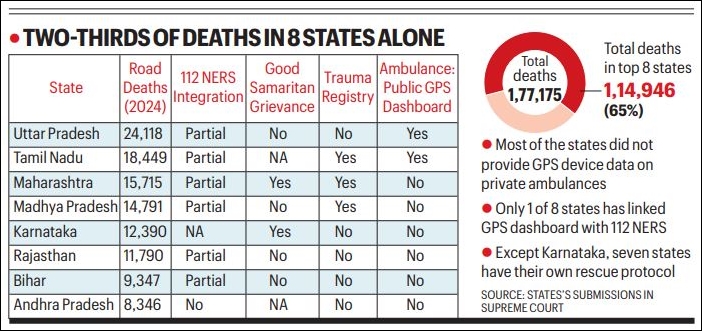
• Another important aspect which holds back people from offering help on the road is the fear of being harassed by the police or hospital with a lot of questioning. But of the eight states which accounted for two-thirds of 1.77 lakh fatalities in 2024, only two — Maharashtra and Karnataka — have a grievance redressal system for good samaritans. Four states do not have it, and two states did not provide the required information in the submission to the Supreme Court.
• More than 10 years ago, on March 30, 2016, the Supreme Court passed a significant order recognising the rights of
Good Samaritans or bystanders or Rah-Veer. Later, the Ministry of Road Transport and Highways (MoRTHs) notified the Good Samaritan Rules in 2020 under Section 134A of the Motor Vehicles (Amendment) Act, 2019 to provide protection to people helping out accident victims. Under the scheme, anyone who helps an accident victim receive medical attention within the Golden Hour is eligible for a Rs 25,000 reward.
• However, even 10 years after the court order, the states are dragging their feet on building key trauma-response infrastructure to save lives lost on the country’s road network. This matters because at least 30% of all trauma-related deaths in the country are attributable to delays in emergency care, according to a 2021 NITI Aayog-AIIMS Emergency and Injury Care Report.
• The documents further show that states with high fatality also lag behind in building trauma registry, and many are still working on the basis of manual databases. A trauma registry is a clinical database that tracks a patient’s journey from the scene of an injury through ambulance, hospital treatment and discharge. It is a key requirement to audit medical care, monitor outcomes, and policy decisions. But five out of these eight states do not have a trauma registry. Three states Tamil Nadu, Maharashtra and Madhya Pradesh said they have a trauma registry system. Tamil Nadu’s trauma care registry records pre-hospital ambulance details, transit case details in hospital reception and resuscitation details outcome of patient on a real time basis.
Do You Know:
• The roads in Uttar Pradesh are most unsafe and tops in road deaths. It recorded 24,118 or 13.61% of the total fatalities in 2024. On average in every second accident, there was a death.
The state said it has integrated most of the emergency number with 112 NERS, with only 102 emergency medical services remaining to be integrated. This was done between 2018 to 2025. It also does not have a separate grievance redressal system for Good Samaritans.
• Tamil Nadu is the number one state in total road accidents and second in fatalities. It has only partially integrated the various emergency numbers. In its September 25, 2025, letter, the state highlighted its comprehensive protocol for rescue of injured victims, which prescribes scene safety measures such as use of reflective jackets, warning triangle cones, blinkers, turning on ambulance hazard lights, at scene triage protocols tagged as critical/ based on canadian tirage acuity scale (CTAS), pre-arrival notification systems for medical facilities, pre-arrival intimation is given by the EMT to the receiving hospital through mobile application.
• Maharashtra said its emergency medical services (MEMS 108) or ambulances only are fitted with a GPS system. Madhya Pradesh said its grievance redressal system for good Samaritans is under process. The state recently developed a comprehensive trauma care policy, which specifies roles and responsibilities of different stakeholders (police, health, road patrol, road owning agency) for victim’s rescue.
Other Important Articles Covering the same topic:
📍Supreme Court sought trauma care system to curb road deaths: Why are states dragging their feet?
Previous year UPSC main Question Covering similar theme:
📍National Urban Transport Policy (NUTP) emphasises on ‘moving people’ instead of ‘moving vehicles’. Discuss critically the success of the various strategies of the Government in this regard. (2014)
Explained
If passport is not proof of citizenship, what is
Syllabus:
Preliminary Examination: Indian Polity and Governance-Constitution, Political System, Panchayati Raj, Public Policy, Rights Issues, etc.
Main Examination: General Studies II: Indian Constitution—historical underpinnings, evolution, features, amendments, significant provisions and basic structure.
What’s the ongoing story: The Ministry of External Affairs (MEA) on Wednesday clarified that an Indian passport is primarily a travel document and should not be construed as a standalone proof of citizenship.
Key Points to Ponder:
• What is passport?
• What exactly MEA said about Passport?
• Why did the MEA say a passport is not a citizenship document?
• Which documents are proof of citizenship in India?
• Why is passport is not a proof of citizenship?
• How does the Maneka Gandhi v. Union of India (1978) indirectly impacted passport issuance and citizenship proof?
• ‘Citizenship is a legal status, not a document’-discuss
• Why a passport is important but not conclusive for citizenship?
• What have the courts said?
• Who are ‘Citizens’?
• Who is a citizen in India’s constitutional scheme? What are various principles/kinds of citizenship?
• Citizens and Aliens-compare and contrast in terms of civil and political rights
• What are those rights and privileges that the Constitution of India confers on the citizens of India and denies the same to aliens?
• The Citizenship Act of 1955 prescribes five ways of acquiring citizenship-Know them in detail
• The Citizenship Act, 1955, prescribes three ways of losing citizenship-What are they?
Key Takeaways:
• The statement, made on Passport Seva Divas, triggered widespread confusion. For most Indians, the passport is the most authoritative document issued by the state — carrying the Republic’s name, accepted across the world, and issued only after verification by government authorities.
• The MEA’s clarification, however, reflects a longstanding legal position: a passport is issued because the government is satisfied that a person is an Indian citizen, but the passport itself does not create citizenship, nor is it conclusive proof of citizenship if that status is challenged in law.
• The answer lies in the architecture of Indian law. Articles 5 to 11 of the Constitution and the Citizenship Act, 1955 define who is an Indian citizen. Significantly, neither identifies any single document as proof of citizenship.
• Instead, citizenship is treated as a legal status arising from facts such as birth, parentage, domicile or naturalisation. Documents serve as evidence of those facts. For a person born in India, citizenship depends on when they were born and, in certain cases, the citizenship status of their parents. For someone naturalised, it depends on compliance with statutory conditions.
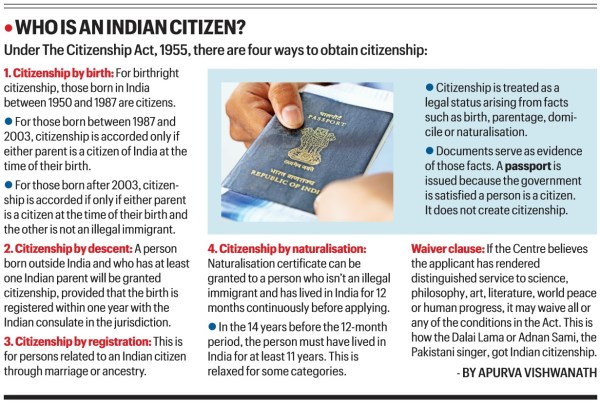 Who is an Indian citizen?
• This distinction is reflected in a little-noticed answer given by the Ministry of Home Affairs in Parliament in February 2020. Asked whether Aadhaar, passport, voter ID, PAN card or birth certificate constitute valid proof of citizenship, the government said: “Acquisition of Indian Citizenship is governed by The Citizenship Act, 1955 and rules made thereunder. Citizenship of India can be acquired by birth or descent or registration or naturalisation or incorporation of territory. The eligibility criteria for acquisition and determination of citizenship is as per the provisions of the Citizenship Act, 1955.”
Do You Know:
• Given that a passport is issued only to Indian citizens and is accepted abroad, in practice, it is among the strongest pieces of evidence that a person is an Indian citizen.
However, legally, its status as a citizenship document is complicated by the Passports Act itself. Section 20 of the Act empowers the Central government to issue a passport or travel document even to a person who is not an Indian citizen if it considers such issuance necessary in the public interest.
• Historically, Tibetan refugees and Sri Lankan Tamils in India have been issued special travel documents by Indian authorities when visiting foreign countries, sources said. In 2023, the madras High Court asked the government to grant a passport to a Sri Lankan Tamil Refugee under Section 20 of the Passport Act. The principle is common across democracies. In the UK and US, too, passports are issued because the state has already determined that a person is a citizen; they do not themselves create citizenship. The difference is that both countries have more robust civil registration systems and, for naturalised citizens, formal citizenship certificates that serve as primary legal proof.
• The current debate exposes a peculiarity of the Indian system. Unlike many countries, India does not issue a universal citizenship certificate to all citizens.
Certificates of citizenship do exist, but only for a limited category of people — those who acquire citizenship through registration or naturalisation under Sections 5 and 6 of the Citizenship Act. Such individuals receive formal certificates recording their acquisition of citizenship.
But the overwhelming majority of Indians are citizens by birth. They receive no equivalent citizenship certificate.
Other Important Articles Covering the same topic:
📍Passport a travel document, not proof of citizenship: MEA
Previous year UPSC Prelims Question Covering similar theme:
3) With reference to India, consider the following statements: (UPSC CSE, 2021)
1. There is only one citizenship and one domicile.
2. A citizen by birth only can become the Head of State.
3. A foreigner once granted the citizenship cannot be deprived of it under any circumstances.
Which of the statements given above is/are correct?
(a) 1 only
(b) 2 only
(c) 1 and 3
(d) 2 and 3
Previous year UPSC Main Question Covering similar theme:
📍”Right of movement and residence throughout the territory of India are freely available to the Indian citizens, but these rights are not absolute.” Comment. (UPSC, 2022)
‘100%’ tag on label, disclaimers on the back: Why CCPA fined 2 companies
Syllabus:
Preliminary Examination: Indian Polity and Governance-Constitution, Political System, Panchayati Raj, Public Policy, Rights Issues, etc.
Mains Examination: General Studies II: Important aspects of governance, transparency and accountability, e-governance applications, models, successes, limitations, and potential; citizens charters, transparency & accountability and institutional and other measures.
What’s the ongoing story: From juices to breads, the “100%” label is a near-ubiquitous marketing tool meant to assure consumers of a product’s unadulterated quality.
Key Points to Ponder:
• What is the role of the Central Consumer Protection Authority (CCPA) in safeguarding consumer interests?
• What is Central Consumer Protection Authority?
• What do you understand by “misleading advertisement”?
• How Central Consumer Protection Authority deals with false or misleading advertisements?
• What are the other powers vested with CCPA?
• What are the essential consumer rights?
Key Takeaways:
• However, in two separate orders passed this month, the Central Consumer Protection Authority (CCPA) imposed a penalty of Rs 1 lakh each on two major food and beverage companies — Mrs. Bectors Food Specialities Ltd and Storia Foods and Beverages Pvt Ltd — for running misleading advertisements and engaging in unfair trade practices by prominently using “100%” claims on their packaging and promotional materials. It also ordered them to immediately discontinue these advertisements.
• Central to both cases is the Consumer Protection Act, 2019. The CCPA invoked Section 2(28) of the Act, which defines a “misleading advertisement” as one that falsely describes a product, gives a false guarantee or deliberately conceals important information. It also relied on Section 2(47), which defines an “unfair trade practice” as making false representations about the standard, quality or composition of goods.
• The regulatory backdrop for these orders was set by the Food Safety and Standards Authority of India (FSSAI). In an advisory issued in May last year, the food regulator noted a growing trend of brands using the “100%” term. The FSSAI underlined that the term is not defined in its advertising regulations and that its use “is likely to convey a false sense of absolute purity or superiority, potentially leading consumers to believe that competing products in the market do not comply with prescribed standards.” This false sense of purity was the focal point in the case against Mrs. Bectors Food Specialities Ltd, the makers of English Oven bread. The CCPA took suo-motu cognisance of advertisements for the company’s “100% Atta Bread” and “100% Whole Wheat Bread”.
• During the proceedings, the company admitted that the actual wheat flour (atta) content in the bread was only 87%. However, it defended the “100%” label by arguing that it was meant to convey that wheat flour was the “sole grain source” used, without any refined flour (maida). The company also relied on FSSAI labelling regulations, which state that for a bread to be classified as “Whole Wheat Bread”, it must contain a minimum of 75% whole wheat flour. Since their product contained 87%, they argued the label was justified.
• The CCPA rejected this, noting that while FSSAI regulations prescribe a minimum 75% threshold to classify a product as atta bread, this cannot be “elevated into a justification for making an unqualified and absolute claim such as ‘100% Atta Bread’.”
• It observed that an average consumer would reasonably construe the label to mean the product is entirely composed of atta. “The use of the qualifier ‘100%’ is absolute, unequivocal, and admits of no dilution or interpretative flexibility,” the CCPA said in its order, adding that a product falling short of this literal meaning renders the claim factually incorrect.
Do You Know:
• The Section 2(28) of the Consumer Protection Act, 2019 defines “misleading advertisement” in relation to any product or service which— (i) falsely describes such product or service; or (ii) gives a false guarantee to, or is likely to mislead the consumers as to the nature, substance, quantity or quality of such product or service; or (iii) conveys an implied representation which, if made by the manufacturer or seller or service provider thereof, would constitute an unfair trade practice; or (iv) deliberately conceals important information.
• The Central Consumer Protection Authority is being constituted under Section 10(1) of The Consumer Protection Act, 2019. The Act replaced The Consumer Protection Act, 1986, and seeks to widen its scope in addressing consumer concerns. The new Act recognises offences such as providing false information regarding the quality or quantity of a good or service, and misleading advertisements. It also specifies action to be taken if goods and services are found “dangerous, hazardous or unsafe”.
Other Important Articles Covering the same topic:
📍Explained: Govt to establish Central Consumer Protection Authority; what is it?
Previous year UPSC Prelims Question Covering similar theme:
4) With reference to ‘consumers’ rights/privileges under the provisions of law in India, which of the following statements is/are correct ? (UPSC CSE 2012)
1. Consumers are empowered to take samples for food testing.
2. When a consumer files a complaint in any consumer forum, no fee is required to be paid.
3. In case of death of consumer, his/her legal heir can file a complaint in the consumer forum on his/ her behalf.
Select the correct answer using the codes given below:
(a) 1 only
(b) 2 and 3 only
(c) 1 and 3 only
(d) 1, 2 and 3
Economy
Relief to digital fraud victims: How losses up to Rs 50K can be recovered
Syllabus:
Preliminary Examination: Current events of national and international importance
Main Examination: General Studies III: Challenges to internal security through communication networks, role of media and social networking sites in internal security challenges, basics of cyber security; money-laundering and its prevention.
What’s the ongoing story: Victims of digital transaction fraud can breathe easy. Under the Reserve Bank of India’s revised compensation mechanism, victims of digital payment fraud involving amounts up to Rs 50,000 can recover a major portion of the money lost to fraud.
Key Points to Ponder:
• What new framework notified by the central bank says regarding digital transaction fraud?
• What do you understand by the term ‘digital payment frauds’?
• What are the reasons for the increase in cyber fraud?
• What are the various consumer protection reforms introduced by the RBI?
• What efforts have been taken by the government leading to increased digital transactions?
• Know the significance of India’s digital economy.
• What is Indian Cybercrime Coordination Centre (I4C)?
• What Supreme Court said on digital payment frauds?
• What are the issues and challenges in curtailing digital payment frauds?
• What are the steps taken by GOI to combat digital payment frauds?
Key Takeaways:
• Notified by the central bank on Wednesday, and effective January 1, 2027, the new system is another measure to limit customer liability and safeguard customers in such situations.
• The new framework, under which the RBI has offered to compensate a substantial portion, comes at a time when bank frauds, especially digital transaction frauds, have become a growing concern for the RBI. In FY26, while the reported fraud cases more than halved to 10,114, the amount involved rose 46% to Rs 48,021 crore.
• The central bank has attempted to make the new compensation guidelines strongly pro-consumer. The RBI will contribute the major part of the compensation under the new framework.
• Under the new mechanism, victims are eligible for compensation of up to 85% of their losses, up to Rs 25,000, thereby reducing the hit they take from such frauds. A bona fide victim who lodged a complaint involving gross loss of an amount up to Rs 50,000 on account of a fraudulent electronic banking transaction (EBT) will be compensated 85% of the net loss amount or Rs 25,000, whichever is less, once during the lifetime, the RBI’s new framework reads.
• For a complaint involving a loss of less than Rs 29,412 via fraudulent EBT, the customer will receive 85% of the amount as compensation. Victims are eligible for such compensation only if they lodge a complaint regarding the fraud within five calendar days. The loss must also be established in accordance with the internal processes set out in the victim’s bank’s policy.
• The central bank states that the victim’s bank must compensate the victim entirely for any fraud arising from the bank’s negligence. Negligence in this case includes failing to ensure proper safety and security mechanisms for EBTs, failing to send mandatory alerts for EBTs above Rs 500, failing to provide 24×7 channels for customer complaints, system malfunctions, security breaches, and failing to act diligently on customer complaints.
• The framework specifies that banks must resolve customer complaints regarding fraudulent EBTs within 45 calendar days for domestic fraudulent EBTs, and within 60 days for cross-border fraudulent EBTs.
Do You Know:
• Indian Cyber Crime Coordination Centre (I4C) has been instituted as an attached office to the Ministry of Home Affairs, so as to coordinate a comprehensive, national response to all cybercrime complaints. With respect to matters of digital arrest complaints, it has blocked over 1,700 Skype IDs, 59,000 WhatsApp accounts, 6.69 lakh SIM cards, and 1,32,000 IMEIs in 2024 alone.
• The Central Government and telecom service providers also devised systems to identify and block incoming international spoofed calls displaying Indian mobile numbers. The Citizen Financial Cyber Fraud Reporting and Management System has saved over ₹3,431 crore from fraudulent attempts.
Other Important Articles Covering the same topic:
📍How India strengthens its digital-fraud resilience
Previous year UPSC Prelims Question Covering similar theme:
5) In India, it is legally mandatory for which of the following to report on cyber security incidents? (UPSC CSE 2017)
1. Service providers
2. Data centres
3. Body corporate
Select the correct answer using the code given below:
(a) 1 only
(b) 1 and 2 only
(c) 3 only
(d) 1, 2 and 3
6) In India, under cyber insurance for individuals, which of the following benefits are generally covered, in addition to payment for the loss of funds and other benefits? (UPSC CSE, 2020)
1. Cost of restoration of the computer system in case of malware disrupting access to one’s computer
2. Cost of a new computer if some miscreant wilfully damages it, if proved so
3. Cost of hiring a specialised consultant to minimise the loss in case of cyber extortion
4. Cost of defence in the Court of Law if any third party files a suit
Select the correct answer using the code given below:
(a) 1, 2 and 4 only
(b) 1, 3 and 4 only
(c) 2 and 3 only
(d) 1, 2, 3 and 4
|
PRELIMS ANSWER KEY |
|
1.(d) 2.(c) 3.(a) 4.(c) 5.(d) 6.(b) |
For any queries and feedback, contact priya.shukla@indianexpress.com
Subscribe to our UPSC newsletter. Stay updated with the latest UPSC articles by joining our Telegram channel – IndianExpress UPSC Hub, and follow us on Instagram and X.