Prateek Tanmay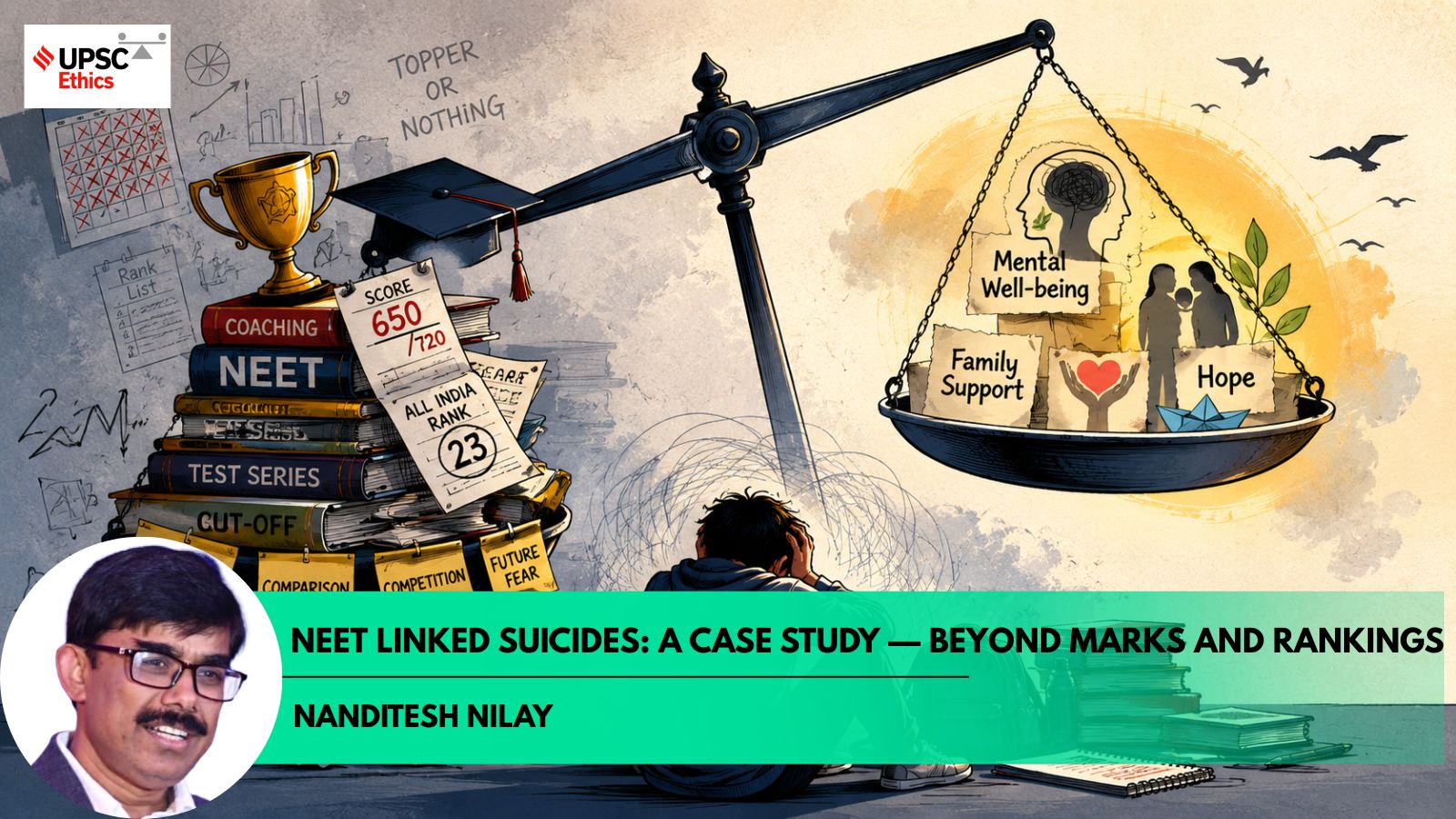
(UPSC Ethics Simplified is a special series under UPSC Essentials by The Indian Express that examines current affairs through the lens of ethics and governance. Today’s article explores the ethical questions raised by NEET-linked suicides and rising mental distress among young people. Through GS Paper IV concepts such as human dignity, empathy, emotional intelligence, resilience, and ethics of care, it examines how families, institutions, and society can collectively nurture hope and support life.)
A 17-year-old aspirant leaves his home to prepare for a highly competitive entrance examination. His family has invested its savings in his coaching, relatives frequently ask about his progress, and social media constantly reminds him of others’ achievements. After failing to secure the expected rank, he gradually withdraws from conversations, avoids friends, and begins to view himself as a burden rather than a person. One evening, while sitting alone with his thoughts, he confronts a question that many young people silently face: Is my worth determined by my success, or does my life have value beyond my achievements?

The answer to this question is not merely psychological. It is profoundly ethical.
If ethics is about choosing what is good, then the growing incidence of suicide among young people poses a serious moral challenge before society. Every human endeavour, whether education, employment, success, relationships, or public service, is ultimately aimed at sustaining life and giving it meaning. While death may be an inevitable reality, the desire to live is what nurtures hope, resilience, and human progress. It is therefore deeply distressing when young minds, unable to cope with visible and invisible pressures, begin to see death as an escape from suffering.
Why human life has intrinsic worth
The German philosopher Immanuel Kant presented a compelling argument against suicide in The Metaphysics of Morals. Explaining his principle of the Categorical Imperative, Kant argued that a person contemplating suicide should ask whether such an action can be reconciled with the very idea of humanity. By choosing suicide, an individual treats oneself merely as a means to end suffering. Since every human being possesses inherent dignity and must never be treated merely as a means to an end, Kant regarded suicide as ethically impermissible.
His argument reminds us that human life possesses intrinsic worth that transcends immediate circumstances, failures, or pain. The ethical principle here is simple yet powerful: a person’s value cannot be reduced to utility, performance, examination scores, or professional achievements. Human dignity exists independent of success or failure.
Success, failure and moral responsibility
In an age of intense competition, an important ethical question confronts families and society: Are we preparing children only for success, or also for failure?
Story continues below this ad
Admission to premier institutions such as IITs, NITs, and medical colleges has increasingly become a measure not only of a student’s achievement but also of parental expectations and social prestige. Children today grow up amid constant comparisons, motivational messaging, and the pressure to perform. Coaching institutes celebrate success stories through advertisements and billboards, but society rarely discusses the emotional cost of failure.
When expectations become disproportionate, setbacks can appear larger than life itself. The challenge, therefore, is not merely academic performance but the ability to develop emotional resilience and perspective. A society that glorifies achievement must also learn to normalise setbacks.
The role of emotional intelligence
Despair, however, is not limited to those who fail. Even some of the world’s most accomplished individuals have spoken openly about their struggles. Olympic swimmer Michael Phelps revealed that he battled depression and suicidal thoughts after the 2012 Olympics. His experience highlights an important lesson: external success alone cannot guarantee inner well-being. Human beings require not only achievement but also emotional support, purpose, and meaningful relationships.
This is where emotional intelligence assumes ethical significance. The ability to recognise, understand, and regulate emotions helps individuals navigate adversity without allowing temporary failures to define their identity. In public life as well, emotional intelligence remains a crucial attribute because it strengthens empathy, resilience, and balanced decision-making.
Story continues below this ad
Family: The first school of values
While individual resilience is important, the first line of support for any child must be the family. Children should not be viewed merely as competitors in a race for success but as individuals with emotions, vulnerabilities, and aspirations. Their worth cannot be measured solely through ranks, marks, or achievements.
Ethical parenting requires empathy, patience, and attentive listening. When children succeed, society readily applauds them; when they fail, it is the responsibility of parents to provide reassurance and stability. Many struggles remain unspoken, and often parents must understand what children are unable to express. Like gardeners nurturing a sapling, they must balance discipline with compassion, guidance with acceptance.
The ethics of care teaches us that individuals flourish when they feel valued, understood, and supported. Families are often the first institutions where these values are learnt and practised.
Loneliness in an age of connectivity
The changing nature of society has made this responsibility even more important. With the gradual decline of joint family structures, many young people increasingly seek companionship and validation in digital spaces. Yet being digitally connected does not necessarily mean being emotionally connected.
Story continues below this ad
In such circumstances, the role of parents needs to be reimagined. Equally, children must recognise that parents are not merely providers of resources but partners in their emotional journey. Healthy relationships require mutual understanding, trust, and communication.
From awareness to a culture of care
The limitations of conventional approaches to suicide prevention have also been highlighted by scholars. In his paper Rethinking Suicide: Why Prevention Fails, Craig J. Bryan argues that despite growing awareness campaigns and mental health advocacy, suicide rates have not declined proportionately. His analysis suggests that awareness alone is insufficient.
What is equally important is strengthening relationships, meaningful conversations, social connectedness, and support systems that make life worth living. This reflects the ethics of care, which emphasises that human flourishing depends not merely on individual strength but also on supportive relationships and communities.
Choosing hope, collectively
At its core, a life-affirming approach rests on communication, emotional intelligence, and human connectedness. Indian philosophical traditions have long emphasised self-discipline, self-awareness, and the integration of individual consciousness with a larger purpose. Yoga, in its broader sense, signifies this union between the self and a deeper meaning in life.
Story continues below this ad
Young people must recognise that consistency, perseverance, and character are often more important than immediate outcomes. Equally, families, educational institutions, and society must create environments where failure is not viewed as final and vulnerability is not seen as weakness. Students should periodically reflect on fundamental questions: What gives meaning to my life? Who cares for me? Whom do I care for? What responsibilities connect me to the world around me? Such reflection can strengthen a sense of belonging and purpose.
Hope, therefore, is not merely an individual virtue. It is a social and ethical responsibility that families, institutions, and communities must collectively nurture. A society committed to human dignity must ensure that individuals are not judged solely by examination scores, professional achievements, or temporary setbacks.
As Ernest Hemingway famously observed, “A man can be destroyed but not defeated.” The ethical challenge before us is to ensure that every individual, especially every young person, finds enough support, dignity, and meaning to choose life, even in moments of defeat.
POST READ QUESTION:
Living life with hope is not merely a personal choice; it is a collective duty. Discuss.
(The writer is the author of ‘Being Good’, ‘Aaiye, Insaan Banaen’, ‘Kyon’ and ‘Ethikos: Stories Searching Happiness’. He teaches courses on and offers training in ethics, values and behaviour. He has been the expert/consultant to UPSC, SAARC countries, Civil services Academy, National Centre for Good Governance, Central Bureau of Investigation (CBI), Competition Commission of India (CCI), National Judicial Academy, etc. He has PhD in two disciplines and has been a Doctoral Fellow in Gandhian Studies from ICSSR. His second PhD is from IIT Delhi on Ethical Decision Making among Indian Bureaucrats. He writes for the UPSC Ethics Simplified (concepts and caselets) fortnightly.)
Story continues below this ad
Subscribe to our UPSC newsletter and stay updated with the news cues from the past week.
Stay updated with the latest UPSC articles by joining our Telegram channel – Indian Express UPSC Hub, and follow us on UPSC section of The Indian Express on Instagram and X.
For your queries and suggestions write at manas.srivastava@indianexpress.com
PREVIOUS ARTICLES ON UPSC ETHICS SIMPLIFIED:
How can India’s civil services and governance rebuild Gen Z’s trust?
Story continues below this ad
CBSE row as a case study on accountability when technology fails
NEET Paper Leak: What is ethical governance in public examinations?
Dear UPSC aspirants, how do you know what’s ethical in everyday life
Are humans failing ethically in the AI age?
How fake success claims by aspirants reveal a deeper moral crisis