Prateek Tanmay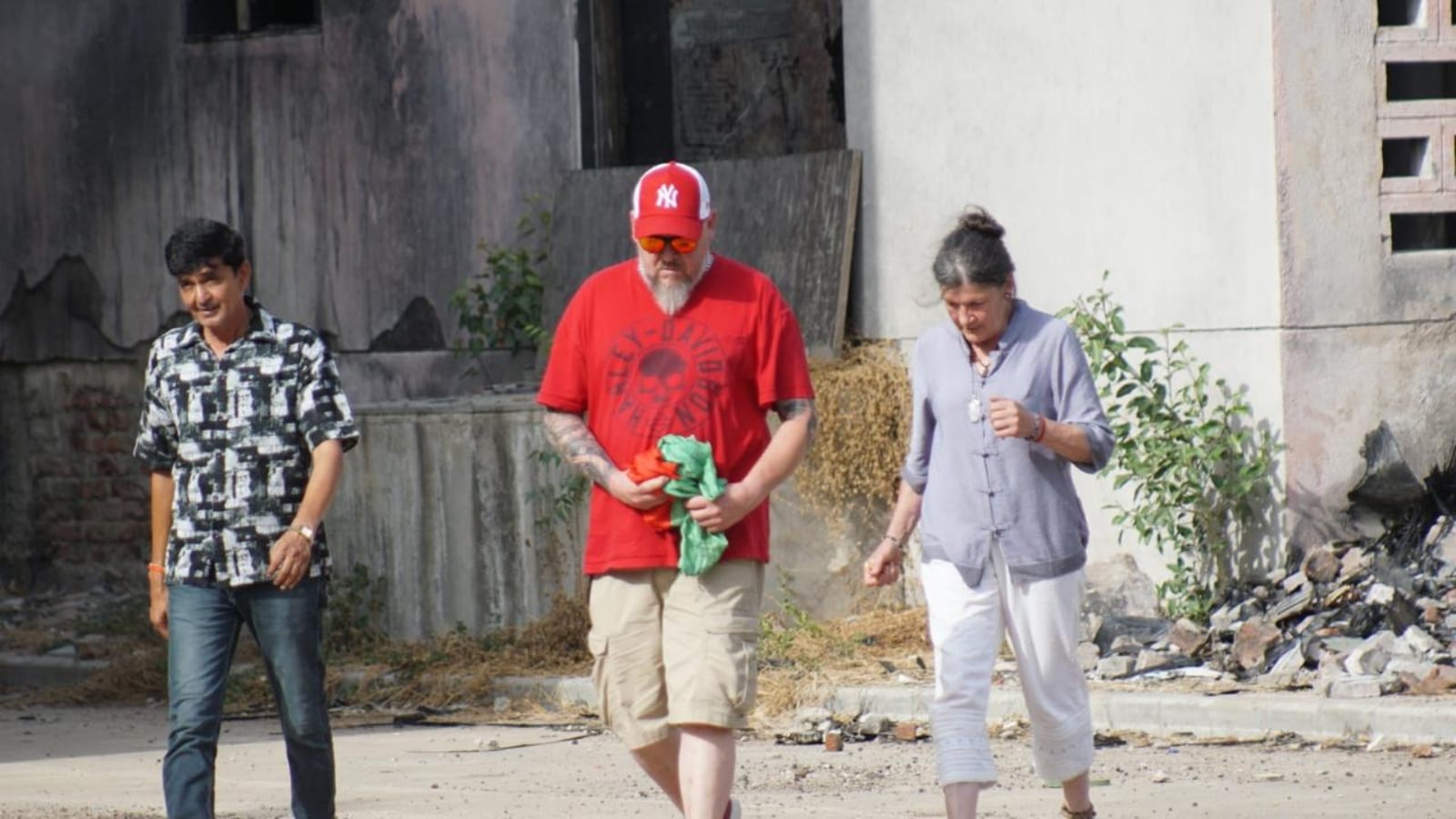
As she walks up with a bag full of ashes to the debris piled at the foot of a damaged hostel mess building in Ahmedabad, Amanda Donaghey has just one regret: that she still hasn’t found the remains of her son Fiongal, one of the 52 British citizens who died in the Air India plane crash of June 12 last year.
“All we got to bury was a DNA sample of my son Finn that appeared to be about a centimetre square… I can’t tell you how much that hurts,” the 67-year-old says.
Thirty-nine-year-old Fiongal and his 45-year-old husband Jamie Greenlaw-Meek were among the 260 people who died when the AI 171 Boeing Dreamliner crashed into the hostel and mess buildings of BJ Medical College minutes after take-off from the Sardar Vallabhbhai Patel International Airport in Ahmedabad. The crash killed 241 of the 242 people on board and 19 on the ground, leaving only one survivor: a British national, Vishwas Kumar Ramesh.
During the DNA identification process last year, her son’s remains were mixed up with those of an elderly woman. A year later, Donaghey, who is based in France, has returned to India seeking peace — and answers. On June 11, she performed a ‘hawan’ at Narayan Ghat on the Sabarmati River, offering letters from family and friends before dispersing their ashes on the heap of debris from the crash the next day.
“This sample was a piece of him large enough; there was obviously enough of him to take a sample from,” she tells The Indian Express in an exclusive interview. “So, where was the rest of him? What did they test? We never got that.”
Gujarat Health Minister Praful Pansheriya says he was not aware of the case. On the reasons for confusion in handing over the bodies, Pansheriya says, “There is a possibility in cases of a disaster of such an extreme nature where the temperature went as high as several thousand degrees.”
Fiongal and Jamie, founders of Wellness Foundry in Ramsgate on the south coast of the UK, were on a 10-day visit to India to celebrate their third wedding anniversary. They had visited India several times before. “They would visit India as part of a cleansing and clarifying process, visiting ashrams, an orphanage, and heritage sites,” Donaghey says. “They say it was part of their process of being spiritual guides.”
Story continues below this ad
On June 22 — 10 days after the crash — Donaghey returned home believing she was carrying her son’s remains. The remains had been handed over after DNA identification.
But a DNA test back home showed that the remains were not Fiongal’s but those of a 70-year-old Indian woman later identified as Vasuben Narendrasinh Raj, one of the 241 crash victims. What followed were further tests, with the Westminster Public Mortuary sending the results to Indian authorities, who acknowledged the mix-up. Soon after, Indian authorities sent back the sample used for Fiongal’s DNA identification.
“Other than my blood samples given as DNA, DNA from Finn’s (Fiongal’s) earphones at home was also taken,” she says. “I believe that he was cremated with other body parts. My coming back was because it’s very hard to bury a sample piece when you know it was taken from your loved one. I haven’t come to terms… I’m not searching for his remains. I know they’re gone. I’m looking for a solution to the identification.”
For Donaghey, the year after the accident was “all about trying to find him, and coming to terms”, not only with his death but also that of his father, who had been unwell and died soon after. “Those guys went out, clean of spirit. Happy as hell, in love to Earth’s end. Finn’s father died within the year. He didn’t have to see that.”
Story continues below this ad
But isolating as grief is, what hurts more is the lack of closure. “Sometimes I feel like I’m shouting in the wind. I don’t think people understand how much it hurts to get the wrong person. I would have rather they didn’t find him at all.”
The ‘votive letters’ she brought, she says, were from friends and family — people who loved the couple. On Friday, as they burned in the holy pyre, she said a prayer, sharing her grief with Sita Patni, who lost her 13-year-old son Aakash after flames from the crash engulfed him as he slept outside their tea stall.
“For mothers who have suffered the same grief, language cannot be a barrier,” she says.
At the crash site, Donaghey spread the ashes where the aircraft’s tail was lodged.
Story continues below this ad
“They were very well liked. They were very well known. And they were booming, so these messages went with offerings such as sage and sandalwood, and things that people wanted to give. And then we took the ashes…. I have learned to compromise… We wanted to put them in the river, but the water in the river was too low. So, we returned to the site, because the site hadn’t yet been cleared,” she says.
“I just feel close to them there.”