Prateek Tanmay
Delhi isn’t just India’s political capital, it’s also a biodiversity hotspot. While the city often makes headlines for politics and pollution, the newly released Delhi Bird Atlas highlights a different side of Delhi its extraordinary bird diversity. Here’s your UPSC Current Affairs Knowledge Nugget for today on the Delhi Bird Atlas.
The Delhi Bird Atlas, released on June 5, which claims to have mapped the distribution and abundance of bird species across the city for the first time, has placed the Capital “second only to Nairobi among the world’s national capitals in bird diversity”. In this context, let’s know about the key findings of Delhi Bird Atlas and first-ever grassland bird census.

Key Takeaways:
1. The atlas was developed by the Delhi Forest Department, Bird Count India, World Wide Fund for Nature (WWF)-India and other partner organisations, with the participation of birdwatchers, students, researchers, forest staff and citizen volunteers.
2. According to the atlas, “The Delhi Bird List now stands at 471 species”, excluding another 22 species that have not been re-recorded since 1975.
3. The atlas cites the rare mix of the city’s geography, including the northern edge of the Aravallis, proximity to the western Himalayas, the Yamuna and Sahibi floodplains, and its location near the Central Asian Flyway (CAF) — a key bird migration route stretching from the Arctic down to the Indian Ocean — as the primary reason behind the bird diversity.
4. The atlas covers 11 per cent of Delhi’s area in its sampling design. The survey started in January 2025, takes place twice a year, in winter and summer, and will run for at least two years.
5. In the first year, 221 species were recorded across the city, including 200 in winter and 152 in summer. Of these, 126 were resident species, 81 were winter migrants and 14 were summer migrants. Nearly half the recorded bird assemblage comprised invertebrate feeders, that is, 108 species or 48.87 per cent. Plant and seed feeders accounted for 37 species, omnivores for 34, vertebrate and carrion feeders for 33, and fruit and nectar feeders for nine.
Story continues below this ad
6. The atlas also records 18 endemic bird species, that is, species found exclusively in one specific geographic region. It also lists several vulnerable bird species, including the Endangered Egyptian Vulture and Black-bellied Tern, the Vulnerable River Tern and Common Pochard, and Near Threatened species such as the Black-tailed Godwit, Ferruginous Duck, Painted Stork, Black-headed Ibis and Oriental Darter.
Delhi Bird Atlas: Key Findings
#2
Among world’s national capitals in bird diversity
471
Total bird species on the Delhi Bird List
GLOBAL CONTEXT
Second only to Nairobi
The Delhi Bird Atlas, released on June 5, places the capital second only to Nairobi among national capitals for bird diversity. Developed by the Delhi Forest Department, Bird Count India, WWF-India and partner organisations, it drew contributions from birdwatchers, students, researchers, forest staff and citizen volunteers.
221
Species in first survey year
THE DELHI BIRD LIST
471 species — and counting
The survey started in January 2025, runs twice a year (winter and summer), and recorded 200 species in winter and 152 in summer. Of 221 first-year species, 14 were summer migrants. Another 22 species not re-recorded since 1975 are excluded. The atlas covers 11% of Delhi’s area and will run for at least two years.
WHY DELHI
An ecological crossroads
Delhi’s bird count is rooted in a rare convergence of geography — the Aravallis, major river floodplains, Himalayan proximity, and its position at the heart of a major global migration route.
◆
Aravalli Ridge
The northern edge of the Aravallis brings a distinct dryland landscape into the capital, supporting species adapted to scrub and rocky terrain.
~
Yamuna & Sahibi Floodplains
Wetlands along the Yamuna and Sahibi rivers provide critical refuge for waterbirds and migrants. The Yamuna floodplains are a key ecosystem for conservation.
★
Western Himalayas Proximity
Delhi’s closeness to the western Himalayas facilitates seasonal movement of mountain and foothill species into the city.
→
Central Asian Flyway (CAF)
Delhi lies almost at the heart of the CAF — a migration route stretching from the Arctic to the Indian Ocean — making it a seasonal haven for species from Central Asia and beyond.
CONSERVATION ALERT
Vulnerable species documented in Delhi
The atlas lists several species under varying levels of threat, underscoring Delhi’s importance as a refuge — and the urgency of protecting its green and blue spaces.
●
Egyptian Vulture & Black-bellied Tern
ENDANGERED Two Endangered species recorded, highlighting the capital’s critical habitat value.
●
River Tern & Common Pochard
VULNERABLE Both species depend heavily on riverine and wetland habitats.
●
Black-tailed Godwit, Ferruginous Duck, Painted Stork, Black-headed Ibis, Oriental Darter
NEAR THREATENED Five Near Threatened species recorded across Delhi’s wetlands and floodplains.
18
Endemic species recorded in Delhi
471
Total species on Delhi Bird List
ENDEMISM IN THE CAPITAL
Species found nowhere else
The atlas records 18 endemic species — birds found exclusively in one specific geographic region. Their presence in Delhi reflects its position at the ecological intersection of the Aravalli landscape, Himalayan foothills, and Indo-Gangetic plains. The atlas describes Delhi as “a meeting point of history, geography, and biodiversity”, noting this diversity persists despite pressures from one of the world’s most populous urban regions.
7. Experts associated with the atlas attribute Delhi’s bird diversity to the city’s position at an ecological intersection: the Ridge brings the Aravalli landscape into the Capital, while the Yamuna floodplains and associated wetlands provide refuge for waterbirds and migrants.
8. The city’s proximity to the western Himalayas, meanwhile, facilitates seasonal movement. The atlas notes that Delhi “lies almost at the heart of the Central Asian Flyway”, making it “a seasonal haven for species arriving from as far as Central Asia and the Arctic”.
9. Meanwhile, the atlas also describes Delhi as “a meeting point of history, geography, and biodiversity”, noting that such diversity persists despite the pressures of one of the world’s most populous urban regions. It also underlines the importance of protecting “the green and blue spaces that sustain it”. The Yamuna floodplains, in particular, are identified as a key ecosystem for conservation and habitat restoration.
Story continues below this ad
BEYOND THE NUGGET: First-ever grassland bird census
1. In May last year, a survey to record the grassland bird population in Kaziranga National Park was undertaken by a team of forest officials, scientists, and conservationists. It was the “first-ever grassland bird census” conducted in Assam’s Kaziranga National Park.
2. The grassland bird census recorded a total of 43 grassland bird species, including 1 Critically Endangered, 2 Endangered, and 6 Vulnerable species, according to the IUCN Red List.
Why is the Kaziranga National Park famous?Covering 42,996 ha, Kaziranga National Park is located in the State of Assam. It is the single largest undisturbed and representative area in the Brahmaputra Valley floodplain. It is a UNESCO World Heritage Site recognised in 1985. It is renowned for its significant population of one-horned rhinoceroses. Kaziranga National Park is India’s second-largest butterfly habitat with 446 species. |
3. A new methodology was deployed in the survey. According to Kaziranga National Park Director Dr. Sonali Ghosh, the use of passive acoustic recording monitoring was the highlight of the survey.
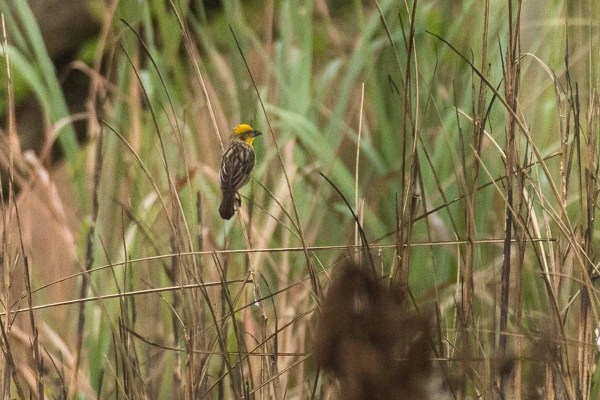 The national park authorities have been particularly excited by the discovery of a breeding colony of the endangered Finn’s Weaver, which is endemic to the Brahmaputra flood plain. (Source: Wikimedia)
5. The survey prioritised 10 species that are either globally threatened or endemic to the Brahmaputra floodplains:
| Species |
Scientific Name Story continues below this ad |
IUCN Red List status |
| Bengal Florican | Houbaropsis bengalensis | Critically Endangered |
| Swamp Francolin | Ortygornis gularis | Near Threatened |
| Indian Grassbird | Graminicola bengalensis | Near Threatened |
| Finn’s Weaver | Ploceus megarhynchus | Endangered |
| Swamp Grass Babbler | Laticilla cinerascens | Endangered |
| Jerdon’s Babbler | Chrysomma altirostre | Vulnerable |
| Slender-billed Babbler | Argya longirostris | Vulnerable |
| Black-breasted Parrotbill | Paradoxornis flavirostris | Vulnerable |
| Marsh Babbler | Pellorneum palustre | Vulnerable |
| Bristled Grassbird | Schoenicola striatus | Vulnerable |
5. The national park authorities have been particularly excited by the discovery of a breeding colony of the endangered Finn’s Weaver, which is endemic to the Brahmaputra flood plain.
Post Read Questions
(1) With reference to India’s biodiversity, Ceylon frogmouth, Coppersmith barbet, Gray-chinned miniyet and White-throated redstart are (UPSC CSE, 2020)
(a) Birds
(b) Primates
(c) Reptiles
(d) Amphibians
(2) If you walk through countryside, you are likely to see some birds stalking alongside the cattle to seize the insects disturbed by their movement through grasses. Which of the following is/are such bird/birds? (UPSC CSE, 2014)
1. Painted Stork
2. Common Myna
3. Black-necked Crane
Select the correct answer using the code given below.
(a) 1 and 2
(b) 2 only
(c) 2 and 3
(d) 3 only
| Answer Key |
|---|
|
(Sources: Delhi Bird Atlas released on June 5, First-ever grassland bird census : A must-know for UPSC exam,
Story continues below this ad
🚨 Click Here to read the UPSC Essentials magazine for May 2026. Share your views and suggestions in the comment box or at manas.srivastava@indianexpress.com🚨
Subscribe to our UPSC newsletter. Stay updated with the latest UPSC articles by joining our Telegram channel – Indian Express UPSC Hub, and follow us on Instagram and X.