Prateek Tanmay
Headlines tell you what happened, but UPSC asks why. The UPSC Civil Services Examination, whether at the Prelims or Mains stage, increasingly rewards conceptual clarity and the ability to apply core ideas. That is especially true in the most dynamic areas of the syllabus: Science, Economy and Environment.
The UPSC Weekly Concepts Snapshot brings you, every Wednesday, simplifies three important current themes from these subjects through an exam-oriented lens, focusing on concepts and clarity.
Read the article, understand the concept, and then crack the quiz.
Q1 of 5 • SCIENCE
What property of ethanol makes it suitable for blending with petrol as a biofuel?
Ethanol is a biofuel because it comes from biomass — plants, agricultural waste, or industrial biowaste. At 99%-plus purity, it can be blended with petrol for use as vehicle fuel, making it renewable unlike fossil-derived fuels.
Q2 of 5 • SCIENCE
How does a flex-fuel vehicle adapt to different ethanol-petrol blends without driver input?
FFVs use sensors to detect the fuel blend in real time, then adjust engine parameters like fuel injection and ignition timing automatically. No manual intervention by the driver is required at any point.
Q3 of 5 • ECONOMY
Why are Government Securities described as “gilt-edged instruments”?
The term “gilt-edged” historically referred to high-quality bonds with minimal risk. G-Secs earn this label because the government, backed by its sovereign authority, is considered incapable of defaulting on domestic currency debt.
Q4 of 5 • ECONOMY
What is the key structural difference between the General Route and FAR for foreign investment in G-Secs?
Under the General Route, FIIs face caps on investment in individual securities, minimum holding periods, and overall limits. FAR removes all these restrictions for select G-Secs, making it a fully open-access channel.
Q5 of 5 • ENVIRONMENT
Which property of seismic S waves distinguishes them from P waves in terms of propagation?
S waves move rock particles sideways (shear motion), which means they cannot propagate through fluids. This is why S waves do not pass through the Earth’s liquid outer core — a key tool for mapping Earth’s interior structure.
How closely are YOU following? Share your score!
Read more
WORLD
Philippines earthquake: buildings, rubble, death toll updates
WORLD
Earthquake hits offshore Cuba, tremors felt in Florida
Indian Express InfoGenIE
SCIENCE
E85 fuel and flex-fuel vehicles (FFVs)
Core Concept:
— To understand E85, it is important to first know what Ethanol is. Ethyl alcohol, or Ethanol, is a liquid with several uses. At 95% purity, it is called rectified spirit and is used as the intoxicating ingredient in alcoholic beverages.
— At 99%-plus purity, ethanol is used for blending with petrol. It is a common type of biofuel, a renewable fuel derived from biomass, from plants or agricultural, animal, domestic, and industrial biowaste.
Story continues below this ad
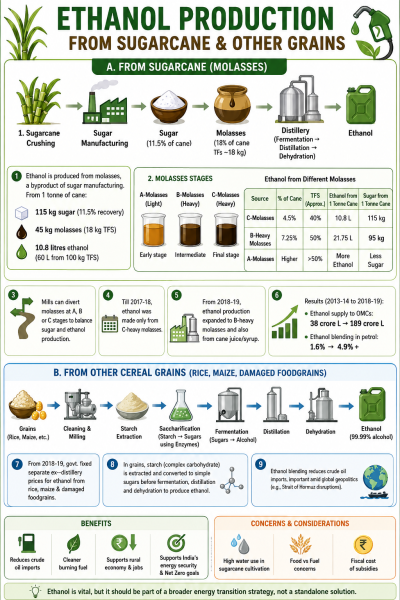 (Infographic AI-generated)
— E85 is a high-ethanol blended fuel comprising 80-85% ethanol and 14-19% petrol, specifically designed for use in flex-fuel vehicles.
— Regular petrol vehicles cannot use E85 as it is engineered exclusively for specialized flex-fuel vehicles. To push consumer adoption, the government has launched E85 at nearly Rs 20 per litre cheaper than normal petrol.
What are Flex-fuel vehicles?
— Flex-fuel vehicles are equipped with modified internal combustion engines that can run on petrol, ethanol, or any combination of the two without requiring manual adjustments by the driver.
India’s first mass-market flex-fuel passenger carMaruti Suzuki India has launched the WagonR Flex Fuel billed as the country’s first mass-market flex-fuel passenger car, marking a significant step in India’s push towards alternative fuels. The car is capable of running on pure ethanol (E100), although it has been homologated to run on E85 fuel—85% ethanol and 15% petrol. |
— Sensors in the vehicle detect the fuel blend and automatically alter engine settings such as fuel injection and ignition timing to ensure optimal performance.
Story continues below this ad
— NITI Aayog officially classifies ethanol-based Flex-Fuel Vehicles (FFVs), including vehicles running on high ethanol blends such as E85, as Zero-Emission Vehicles.
📍UPSC Twist Points: Butanol and ABE biofuels
— Butanol and acetone-butanol-ethanol (ABE) mixtures as fuel are superior to ethanol. These products are synthesised naturally by solventogenic Clostridia – bacteria capable of fermenting a broad spectrum of cellulosic and hemicellulosic substrates. Among them, Clostridium beijerinckii BA101 has been identified as a particular butanol tolerant, high-yield strain.
— However, ABE downstream processing for product recovery is more complex than a single product like ethanol, as the former involves separating multiple solvents (acetone-butanol-ethanol) while the latter needs water-ethanol separation. Researchers are also working on finding ways to make the ABE product recovery more viable.
ECONOMY
Government Securities (G-Secs)
Core Concept:
— G-secs are tradable instruments issued by the Central Government or the State Governments. It is used by the government to borrow money from the public.
Story continues below this ad
— The two key categories of G-Secs are treasury bills and dated securities. Treasury bills are short-term instruments which mature in 91 days, 182 days, or 364 days, and dated securities or government bonds are long-term instruments, which mature anywhere between 5 years and 40 years.
— In 2010, the RBI introduced a new short-term instrument, known as Cash Management Bills (CMBs) with the aim to manage the temporary cash flow mismatches. CMBs, having the same generic character of T-Bills, are issued for maturities less than 91 days.
— Treasury bills, or T bills are zero coupon securities and pay no interest. They are issued at a discount and redeemed at the face value at maturity. Let’s understand this through an example:
A 91 day Treasury bill of ₹100 (face value) may be issued at say ₹ 98.20, that is, at a discount of say, ₹1.80 and would be redeemed at the face value of ₹100. The return to the investors is the difference between the maturity value or the face value (that is ₹100) and the issue price (that is ₹ 98.20).
Story continues below this ad
— According to the RBI, “In India, the Central Government issues both, treasury bills and bonds or dated securities while the State Governments issue only bonds or dated securities, which are called the State Development Loans (SDLs). G-Secs carry practically no risk of default and, hence, are called risk-free gilt-edged instruments.”
Government Securities (G-Secs) Explained
Definition
Tradable debt instruments issued by the government
Government Securities (G-Secs) are tradable instruments issued by the Central or State Governments to borrow money from the public. They carry practically no risk of default, earning them the label of risk-free gilt-edged instruments.
◆
Tradable instruments
G-Secs can be bought and sold in the market, unlike fixed deposits, giving them liquidity.
★
Gilt-edged instruments
Backed by the sovereign guarantee of the government — virtually zero default risk.
⚖
RBI as sole authority
The RBI issues G-Secs through auctions conducted on E-Kuber, its Core Banking Solution platform.
Short-term
Treasury Bills (T-Bills)
Mature in 91, 182, or 364 days. Zero coupon — issued at discount, redeemed at face value.
Long-term
Dated Securities / Bonds
Mature between 5 and 40 years. State versions are called State Development Loans (SDLs).
91d
Shortest T-Bill maturity
364d
Longest T-Bill maturity
Mechanics
Zero coupon: profit from the discount
T-Bills pay no interest. Instead, they are issued below face value and redeemed at full face value on maturity. The difference between the two is the investor’s return.
→
Issue price: ₹98.20
A 91-day T-Bill with face value ₹100 is issued at a discount of ₹1.80.
✓
Redemption: ₹100
At maturity, the investor receives the full face value of ₹100, regardless of issue price.
★
Return: ₹1.80
Investor’s profit is face value minus issue price — no periodic coupon payment involved.
RBI Innovation — 2010
Cash Management Bills: plugging short-term cash gaps
The RBI introduced Cash Management Bills (CMBs) in 2010 to manage temporary cash flow mismatches in government accounts. They share the same character as T-Bills but are issued for maturities of less than 91 days.
2010
Year introduced by RBI
<91d
Maturity — shorter than any T-Bill
Issuance Split
Not all governments issue the same instruments
The Central Government issues both T-Bills and dated bonds. State Governments can only issue bonds — called State Development Loans (SDLs) — and have no power to issue T-Bills.
Central Government
T-Bills + Dated Bonds
Issues both short-term (T-Bills) and long-term instruments (Government Bonds).
State Governments
SDLs only
Can only issue State Development Loans — long-term bonds. No T-Bills permitted.
General Route
Standard channel
Allows foreign investors to buy permitted G-Secs with caps on investment size, holding period, and security-level limits.
FAR — Fully Accessible Route
Open-access channel
Foreign investors can invest in select G-Secs without the restrictions that apply under the General Route.
◆
Who can invest?
Commercial banks, UCBs, insurance companies on E-Kuber; foreign investors via General Route or FAR.
— The RBI is the sole authority for the G-Secs which issues it through auctions. The auctions are conducted on an electronic platform called the E-Kuber, the Core Banking Solution (CBS) platform of RBI.
— Commercial banks, Urban Co-operative Banks (UCBs), Insurance companies, and others who are members of E-Kuber can place their bids in the auction through this electronic platform.
— Foreign investors can invest in Indian G-Secs through routes such as the General Route and the Fully Accessible Route (FAR).
Story continues below this ad
(i) General Route is the standard channel for foreign investors. It allows them to buy and sell permitted Indian G-secs, but comes with certain restrictions, such as caps on how much can be invested in a particular security, how long it must be held, and an overall investment limit.
(ii) FAR is an open-access channel where foreign investors can invest in select G-Secs without restrictions that apply under the General Route.
📍UPSC Twist Points: Bond yield
— The effective interest on the government bonds is called yield. G-sec yields change over time; often several times during a single day. This happens because of the manner in which G-secs are structured.
— Every G-sec has a face value, a coupon payment and price. The price of the bond may or may not be equal to the face value of the bond.
Story continues below this ad
— Here’s an example: Suppose the government floats a 10-year G-sec with a face value of Rs 100 and a coupon payment of Rs 5.
If one were to buy this single G-sec from the government, it would mean that one will give Rs 100 to the government today and the government will promise to 1) return the sum of Rs 100 at the end of tenure (10 years), and 2) pay Rs 5 each year until the end of this tenure. At this point, the face value of this G-sec is equal to its price, and its yield (or the effective interest rate) is 5%.
ENVIRONMENT
Earthquakes
Core Concept:
— An earthquake is an intense shaking of the ground caused by movement under the earth’s surface. It happens when two blocks of the earth suddenly slip past one another, according to USGS. This releases stored-up ‘elastic strain’ energy in the form of seismic waves, which spreads through the earth and cause the shaking of the ground.
Story continues below this ad
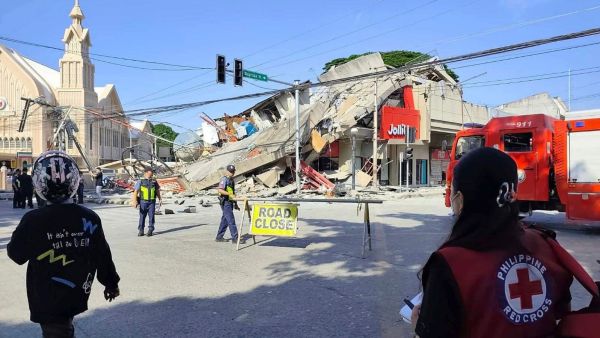 In this photo provided by the Philippine Red Cross, rescuers inspect the damage after an earthquake in General Santos, Philippines. (Photo: AP)
— The earth’s outermost surface, crust, is fragmented into tectonic plates. The edges of the plates are called plate boundaries, which are made up of faults. The tectonic plates constantly move at a slow pace, sliding past one another and bumping into each other. As the edges of the plates are quite rough, they get stuck with one another while the rest of the plate keeps moving.
— Earthquake occurs when the plate has moved far enough and the edges unstick on one of the faults. The location below the earth’s surface where the earthquake starts is called the hypocenter, and the location directly above it on the surface of the earth is called the epicentre.
📍UPSC Twist Points: Earthquake Wave Types
— When an earthquake occurs, it generates seismic waves that cause the shaking we experience. There are two major types of seismic waves: body waves and surface waves. Body waves comprise P and S waves, and they are called body waves because they can travel through the Earth’s interior, rather than being confined near the surface.
— Primary or ‘P’ wave is a type of sound wave that travels through rock. In a P wave, the rock particles are alternately compressed and expanded, a process known as compressions and dilatations. This is why P waves are also referred to as compressional waves. They are capable of traveling through solids, liquids, and gases. Notably, P waves can move through the liquid outer core of the Earth.
How Earthquakes Work: From Fault Slip to Seismic Waves
THE SEQUENCE
How a fault slip becomes an earthquake
Tectonic plates constantly move at a slow pace. Their rough edges get stuck against each other at plate boundaries while the rest of the plate keeps moving. This builds up elastic strain energy. When the plate has moved far enough, the edges suddenly unstick — releasing that stored energy as seismic waves that shake the ground.
◆
Plates lock at rough edges
Tectonic plate edges (faults) are rough and get stuck even as the rest of the plate continues moving, building pressure.
●
Elastic strain accumulates
Stored-up elastic strain energy builds in the rocks along the fault over time — the longer the lock, the more energy stored.
★
Sudden slip releases energy
When the fault edges finally unstick, the stored energy releases explosively as seismic waves — causing the ground to shake.
KEY LOCATIONS
Two points every earthquake report mentions
Every earthquake has two key reference points: one below the ground and one on the surface. News reports typically cite the epicentre, but the hypocenter is where the rupture actually begins.
HYPOCENTER
Below the surface
The point inside the Earth where the earthquake originates — where the fault first ruptures and seismic waves begin.
EPICENTRE
On the surface
The point on Earth’s surface directly above the hypocenter. This is what news reports reference as the quake’s location.
WAVE TYPES
Two major families of seismic waves
When an earthquake occurs, it generates seismic waves that cause the shaking we feel. These fall into two major families — defined by where they travel.
BODY WAVES
Travel through Earth’s interior
Not confined to the surface. Include P waves and S waves. Can probe the deep interior of the planet.
SURFACE WAVES
Confined near Earth’s surface
Travel along the surface rather than through the interior. Include Love waves and Rayleigh waves. Typically cause more damage.
BODY WAVES
P waves and S waves — the key differences
Both are body waves that travel through Earth’s interior, but their particle motion and travel medium differ critically — a distinction that helped scientists map the Earth’s liquid outer core.
P
Primary (P) wave — compressional
Rock particles alternately compress and expand (compressions and dilatations). Travels through solids, liquids, and gases — including Earth’s liquid outer core.
S
Secondary (S) wave — shear
Rock particles slide past one another, creating shear. Cannot travel through liquids or gases — blocked by the ocean and Earth’s liquid outer core.
SURFACE WAVES
Love waves and Rayleigh waves compared
Both are surface waves confined near Earth’s surface, but their particle motion patterns are distinct.
LOVE WAVES
Shear motion, trapped at surface
A type of shear wave that is trapped near the Earth’s surface. Particle motion is horizontal and perpendicular to the direction of travel.
RAYLEIGH WAVES
Rolling motion like ocean waves
Particle motion resembles that of water particles in ocean waves — an elliptical rolling motion. Travel along the surface.
— In Secondary or ‘S’ wave, the rock particles slide past one another, which creates shear – hence, S waves are also known as shear waves. S waves cannot travel through liquids or gases, which means they do not propagate through the ocean or the outer core.
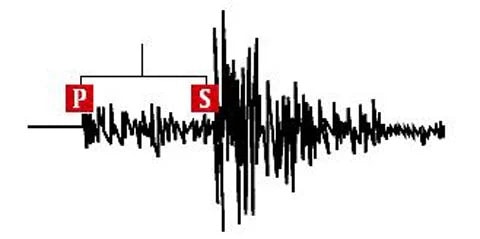
— Surface waves are named for their tendency to be confined near the Earth’s surface, as opposed to traveling through the Earth’s interior like P and S waves. There are two main types of surface waves: Love waves, which are shear waves that are trapped near the surface, and Rayleigh waves, which exhibit particle motions similar to those of water particles in ocean waves.
Prelims Practice MCQ
Let’s see how much can you recall
Consider the following statements:
1. E85 is a high-ethanol blended fuel designed for use in flex-fuel vehicles.
2. Treasury Bills pay periodic coupon interest to investors during their tenure.
3. S-waves cannot travel through liquids.
Which of the statements given above is/are correct?
(a) 1 only
(b) 1 and 3 only
(c) 1 and 2 only
(d) 1, 2 and 3
ALSO CHECK
UPSC Prelims Weekly Snapshot: GPS interference, RBI’s Monetary Policy, Heatwaves
UPSC Prelims Weekly Snapshot: Dimethyl Ether, CPI overhaul, Tar Balls
UPSC Prelims Weekly Snapshot : Induction cooktop, Forex reserve, and Earth’s energy imbalance
UPSC Prelims Weekly Snapshot: Talking cars, GDP rebasing and Nor’westers — quick look
🚨 Click Here to read the UPSC Essentials magazine for May 2026. Share your views and suggestions in the comment box or at manas.srivastava@indianexpress.com🚨
Subscribe to our UPSC newsletter. Stay updated with the latest UPSC articles by joining our Telegram channel – Indian Express UPSC Hub, and follow us on Instagram and X.