Prateek Tanmay
In 2024, two private equity (PE) and venture capital veterans — Piyush Gupta and Norbert Fernandes — set out to build a new investment firm, Kenro Capital, at a time when artificial intelligence (AI) had become the industry’s most overused buzzword.
They started with a quieter, almost philosophical question that has been echoing through boardrooms and venture circles as AI accelerates its reach: In a rapidly changing AI-driven world, what are the things that will not change?
The premise was not that AI would reshape everything — but that it would come close. The real challenge was identifying the rare corners of life that would remain stubbornly human.
“One answer that stood out was high-touch businesses like schools. People will always send their children to schools,” Fernandes says.
With this conviction, Kenro Capital invested roughly Rs 340 crore in K12 Techno Services Private Limited at the end of 2024, best known for its flagship chain, Orchids: The International School.
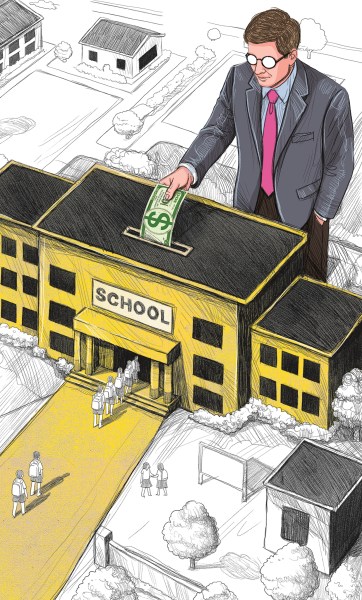
And Kenro Capital is not alone in making that bet. Across India, private equity firms are increasingly circling the K-12 (Kindergarten to Class 12) education space. Nowhere is this more visible than in Gurgaon, where at least nine K-12 schools are already backed by private equity capital.
Why schools are turning to private equity
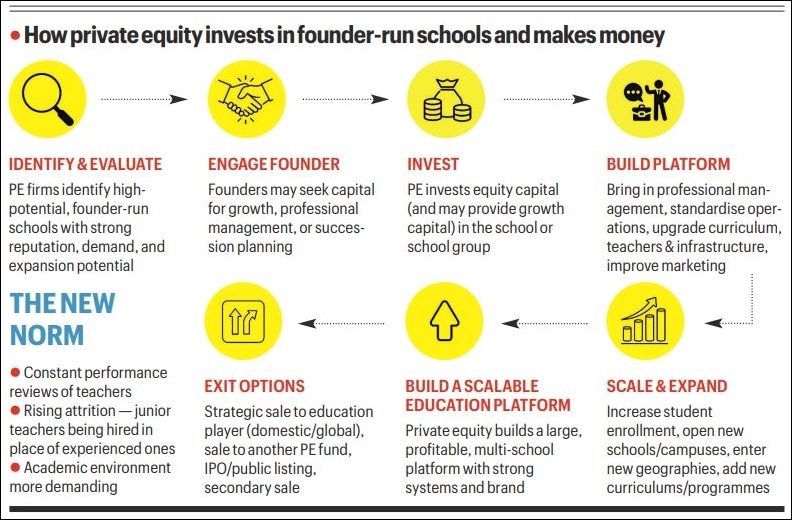
Even as most schools in India operate as nonprofit trusts or societies, private equity firms generate returns by investing in the commercial entities around them rather than the trusts themselves. According to industry insiders, PE funds that pool money from wealthy individuals and institutions, acquire companies that own school real estate, manage operations, license brands, provide technology platforms, or run services such as transport and curriculum support. “The school trust pays lease rentals, management fees and service charges to these for-profit entities, allowing investors to earn recurring revenue indirectly from school cash flows,” an industry insider said.
Story continues below this ad
The PE firms, the industry insider points out, also benefit from the scalability of branded school chains and higher valuations driven by consolidation in the education sector. “This improves profitability. Some exit at higher valuations through sales or public listings,” the industry insider says.
Increasingly, India’s private school sector is emerging as a target.
Industry insiders say PE’s growing presence in K-12 education reflects a structural shift years in the making. For decades, many private schools in India operated like family-run businesses, where key decisions — from hiring teachers to expanding infrastructure — were made within the founder’s close circle.
Now, many of these schools are at an inflection point. The next generation of founders is often unwilling to take over day-to-day operations, preferring instead to bring in professional management.
Story continues below this ad
“Their next generation is no longer interested in running it on a daily basis and is instead open to handing over the management to professionally run players,” Fernandes says.
This opens the door for private equity firms, which see not just a school, but a scalable institution with predictable demand and long-term cash flows.
At the same time, demand-side pressures are also reshaping the sector.
For India’s growing middle class, education is no longer just about securing admission to a nearby good school. “They want high-quality infrastructure, holistic exposure, and best-in-class outcomes,” says Amitabh Jhingan, partner at EY Parthenon and EY’s Global Education Sector Leader.
This shift in expectations is transforming private K-12 schools.
Story continues below this ad
“The new normal is a more global, aspirational and future-ready school format across both national (CBSE and ICSE) and international curricula (IGCSE and IB),” Jhingan says. For parents, these international programmes also promise smoother pathways to foreign universities and stronger global credentials.
However, the transition comes at a cost.
“IB and Cambridge systems require schools to send teachers for expensive training programmes. They also have larger staff structures. Overall costs are high,” says Ameeta Wattal, Chairperson of DLF Foundational Schools.
On the supply side, expansion is capital-intensive. Setting up a school requires large land parcels, regulatory approvals, and significant upfront investment. Regulations often mandate long-term control over land — either ownership or leases of up to 30 years, according to an industry insider who did not wish to be named.
Many schools also operate under not-for-profit structures, limiting access to traditional financing. “Thus, it becomes difficult to expand on their own, necessitating institutional capital. This is where private equity comes in,” the insider says.
Interest in schools
Story continues below this ad
Private equity firms are not solely focused on high-risk and high-return sectors, a senior PE investor emphasises. “A lot of their capital ends up in lower-risk, stable, cash-generating sectors like healthcare or essential consumer goods,” he says.
He explains the rationale lies in how PE funds are structured and how they generate returns. “Typically, they buy companies using a significant amount of borrowed money. To safely service that debt, they need businesses that generate steady and predictable cash flows.”
“Also, PE firms usually need to exit investments within 10 years through a sale. Buyers prefer companies with low operational risk, so low-risk industries make exits more certain,” he says.
Fernandes says PE firms view education as relatively lower risk because demand is stable. “Parents won’t stop sending their children to school. One of the most important budget allocations at a household level tends to be their education. Other factors are that these are cash-flow positive businesses in which fees are collected in advance of the school year.”
Story continues below this ad
Investors are also drawn to fragmented, unorganised markets that can be consolidated, similar to platforms like Uber and Oyo, according to an industry executive.
“K-12 schooling in India, until now, is a largely unorganised market. Once you consolidate the market and have a large number of schools on your platform, efficiencies created by the economies of scale will help you increase your margins while providing value,” he says.
Driven by these shifts, major private equity firms are investing in K-12 schools. Blackstone reportedly considered a majority stake in Jaipur-based Globetrotters Educational Innoventions, which runs Jayshree Periwal International School (JPIS), last November. KKR, the second-largest global PE firm, holds a majority stake in Lighthouse Learning and increased its investment in November. In India, ChrysCapital, Peak XV, and Kedaara Capital hold stakes in K-12 Techno Services.
Changes that PE brings
When PE firms invest in schools, the focus shifts toward expansion and higher student enrollment, according to industry insiders. For instance, in 2023, Lighthouse Learning partnered with a top IB school in Gurgaon, Heritage Xperiential Schools, to open 10 new schools over five years. Manit Jain, co-founder of the Heritage group, had said that Lighthouse would provide infrastructure and operational support to enable faster expansion.
Story continues below this ad
Growth in occupancy, insiders say, becomes a key metric. Schools carry heavy fixed costs — teacher salaries, classrooms, and infrastructure — regardless of student strength. “As a result, even with half the number of students, the school continues to incur nearly the same overall costs,” Fernandes says. The goal, therefore, is to reach 90–95% occupancy within one to two years, spreading fixed costs over a larger base.
Fernandes also highlights that PEs prefer to invest in a network of schools instead of a single standalone school because of economic advantage. He cites examples like senior-school coaching classes as an example.
He says students in higher classes often need extra subject-specific coaching for competitive exams — say for physics or chemistry. For one independent school, hiring a dedicated specialist teacher for each subject may be too expensive. “But if the school is part of a larger network, like K12 Techno Services’ schools, that same specialist teacher can be shared across multiple campuses. Instead of one school bearing the full cost, the teacher can rotate between schools and teach students at each one,” he adds.
Within individual schools, the changes are most visible in everyday classroom practices, where insiders say standardisation has emerged as the most visible shift.
Story continues below this ad
Take for instance, Dwarka’s Shantigyan School. A teacher said that after the founder’s death, the institution was divided between his three children. While two continue to run separate schools, one brought in what the teacher described as the professional “cavalry” — K12 Techno Services. The company arrived with its management team, as well as physical, academic and technological infrastructure, and its brand name ‘Orchids: The International School’.
“When the new management came in, they brought everything new with them, even the furniture. The new furniture, which we were told is the same in every K12 school, was brought in from Bengaluru,” the teacher says.
Teachers receive lesson plans from the K12 team in Bangalore that include videos, presentations and instructional material for every period. “This is great mostly since we can teach according to a plan, but many times it also leads to micromanaging, as there are directions for every five minutes which are not feasible to implement and become tedious,” the teacher adds.
The model has also drawn support. Speaking about the difficulty of building schools such as DPS and Columbus, which take years to develop, former Reserve Bank of India governor Raghuram Rajan had pointed to the Orchids system two years ago on a podcast as a case study.
“What he (founder of K12 Techno) does is that he has 37,000-plus lesson plans put together for each lesson that a teacher will give. Every lesson plan is written down for every subject, and then teachers are recruited to deliver this. You get pretty close to top-level public school education,” Rajan said.
Insiders also point to improvements in infrastructure and extracurricular activities. The Orchids network, for instance, the students point out has invested in facilities for music, dance, textiles, and pottery. At Heritage Xperiential International School (HIXS), a teacher says Lighthouse Learning is investing a lot in exploring the use of AI in teaching. “They want teachers to learn how to use AI in classrooms,” she says.
The concerns
For many teachers in Gurgaon’s elite private schools, the arrival of PE investors has brought with it a quiet but noticeable shift in everyday life — one marked by surveillance, scoring systems, and constant performance reviews.
“Every morning, five teachers have to install microphones before classes begin. These devices record us throughout the day, and later we are given scores based on how we taught and managed students. Principals and coordinators also observe classes and assign ratings, which are used in appraisals,” the teacher says.
Concerns are emerging among teachers and students over what they describe as a gradual erosion of the school’s original culture — one shaped by long-term teacher loyalty. They say the shift is contributing to higher teacher attrition.
As per one teacher, the institution was never defined by the highest pay scales, but by continuity and personal connection. “People stayed — for the brand name, yes, but also because the founders created a personal connection. There was warmth, a sense of belonging,” she said, adding that this environment was now fading.
At two Gurgaon-based PE-backed schools, teachers point to a growing preference for hiring junior faculty over more experienced educators.
Students say the attrition has had a direct impact on them. A senior student at one of the schools said at least nine senior faculty members left in 2025 alone.
“Letters of recommendation for foreign university applications are extremely important for those of us seeking undergraduate admission to top global universities,” the student says. But newer teachers often do not know students well enough to write references. “If the senior teachers had stayed, we would not be facing this issue,” the student adds.
Even prospective parents are concerned. At a parent tour organised by the school two weeks earlier, one parent asked: “We hear that a large number of teachers are now being hired from outside.” The response from the school representative was carefully worded — “We are providing all teachers with the right facilities and a good work environment. But some teachers leave for professional growth. At the same time, we also encourage fresh blood.”
Another visible shift has been the growing emphasis on academic rigour. Parents, however, remain divided over whether the change represents progress or a departure from what once distinguished these schools. “There is a shift away from the experiential learning model that prioritises holistic learning,” one parent says.
Others view the transition more favourably. Anisha Agarwal, a finance professional at Acuity Partners whose children attend a PE-backed school in Gurgaon, said the academic environment had become noticeably more demanding. “My eldest child hardly studied at all,” she says. “But now, my younger child has far more assignments. Academics have become more rigorous. This a positive change.”
Sridhar Rajagopalan, an education entrepreneur, said that while PE firms often focus on funding new facilities, technology upgrades and professional management, the real measure of success lies in learning outcomes.
“The only metric to judge all these investments is whether the school is improving the learning outcomes of students, both academic and non-academic,” he said, adding that the sector will ultimately be judged by “what kind of impact these investments have on learning outcomes.”
****
K12 Techno Services
Origin: A K-12 school management and education services company founded in 2010
Brands it owns: Orchids: The International School with around 100,000 students in its roughly 110 schools nationwide, and Eduvate that provides content and platform services to schools.
Investors: Kedaara Capital, Peak XV (formerly Sequoia Capital India), Vitruvian Partners and Kenro Capital.
Monthly fees: Rs 8,000 to Rs 16,000
Schools run in Gurgaon: 4
Lighthouse Learning Group
Origin: Formerly known as EuroKids International, it is one of India’s largest Early Childhood & K-12 Education groups.
Brands it owns: EuroKids Preschool, Kangaroo Kids Preschool, EuroSchool, Billabong High International, Centre Point Group of Schools, Heritage International Xperiential School, Heritage Xperiential Learning School, Phoenix Greens School of Learning and Finland International School Maldives. It has around 1,850 preschools and 60 K-12 schools.
Investors: Majority stake owned by KKR, one of the largest PE firms in the world.
Monthly fees: Heritage International Xperiential School charges Rs 13,000-Rs 30,000, excluding admission, transport fees, & one-time security deposit.
Schools run in Gurgaon: 5